CHEM 334 (F26, BFT, F261002) Lec. 18: Ch. 18: Electrophilic Aromatic Substitution
 Watch on YouTube →
Overview
The lecture develops a systematic method for predicting electrophilic aromatic substitution (EAS) products: identify each substituent’s directing pattern, rule out occupied ring positions, and use relative directing strength when groups compete. Examples progress from iodine-, carbonyl-, and methyl-substituted benzenes to rings bearing two or three substituents, ending with a nitration using nitric acid and sulfuric acid.
Key takeaways
- Halogens such as iodine are ortho/para directors despite being deactivating; fuming sulfuric acid adds SO₃H at an available ortho or para position.
- Methyl groups direct EAS ortho/para, while carbonyl-containing and nitro substituents direct meta; occupied ring positions cannot accept another substituent.
- For multiple substituents, determine each group’s favored positions independently, then identify overlap among the available positions.
- When directing effects conflict, the relative-strength ranking on the directing-group chart determines which substituent exerts the stronger influence; OH outranks methyl in the lecture’s nitration example.
- A ring’s symmetry can make two indicated positions equivalent, reducing multiple apparent outcomes to a single distinct product.
- Directing position is determined from the starting ring before selecting the EAS reaction; nitration then uses HNO₃ and H₂SO₄ to install NO₂.
Chapters
0:00
Classroom Setup Before the EAS Practice Problems
- At 0:03, students are invited to attempt a problem, with reassurance that their answers will not be judged.
- After a pause, the first worked chemistry problem begins at 3:43 with iodine on a benzene ring.
3:43
Ortho/Para and Meta Directing in Single-Substituent Rings
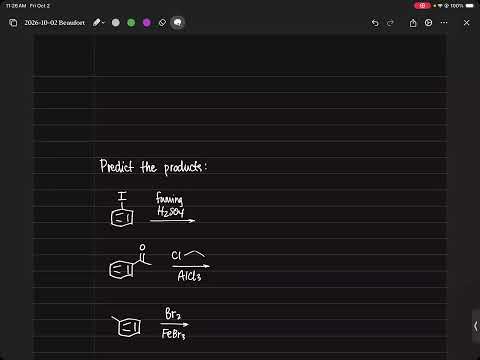
- Iodine is a halogen and directs sulfonation to ortho and para positions; fuming sulfuric acid installs an SO₃H group at either available position.
- A carbonyl-containing substituent attached to the ring is identified as a meta director; the added substituent must also preserve the stated two-carbon count.
- A methyl group directs bromination ortho and para, so both distinct products are drawn; equivalent ortho positions count as one product.
12:09
Combining Methyl and Nitro Directing Effects
- For bromination of a para-substituted methyl–nitro benzene, evaluate the groups already on the ring; the incoming bromine does not determine selectivity.
- The methyl group directs ortho/para, while NO₂ directs meta; both favor the same available ring position.
- A line of symmetry makes the two apparently indicated carbons equivalent, yielding one distinct brominated product.
18:40
Resolving Competition Between Hydroxyl and Methyl Groups
- In nitration of a ring bearing OH and methyl groups, both substituents are ortho/para directors, but their available positions differ.
- The chart ranks OH above methyl in directing strength, so the stronger OH group determines the favored nitration position.
- When directing groups compete, compare their relative strengths on the chart rather than treating all ortho/para directors as equal.
23:06
Choosing a Favored Position with Three Ring Substituents
- For a ring bearing OH, methyl, and NO₂, map each group’s directing preferences and disregard positions already occupied.
- OH favors one available position, while methyl favors two; NO₂ is a strong meta director and also favors the OH-directed position.
- The overlap of the stronger directing effects makes the position favored by both OH and NO₂ the best prediction.
28:27
Applying the Three-Group Analysis to Nitration
- Nitration uses HNO₃ and H₂SO₄; the new NO₂ group is placed at the position selected before choosing the EAS reaction.
- The example produces a highly nitrated, potentially explosive compound, illustrating that directing analysis predicts position even when the product is hazardous.
- The lecture concludes that repeated use of the directing-group chart makes product predictions faster and more reliable.
Summary, takeaways, and chapters were generated by AI from the video's transcript and may contain errors. The video belongs to its creator, Dr. Eubanks’ Chemistry.