CHEM 119 Fall 2026 - Exam 3 Review #1 (Chapters 8-12)
Overview
Alicia Altemose reviews CHEM 119 Exam 3 material from Chapters 8 through 12 using mock-exam and practice-quiz questions. The review connects electron configurations, periodic trends, lattice and bond energies, intermolecular forces, resonance, formal charges, and VSEPR shapes to practical comparison and prediction strategies.
Key takeaways
- Paramagnetism depends on unpaired electrons, not whether the total electron count is odd; Cr2+ is paramagnetic with a 3d4 configuration, while Zn2+ is diamagnetic with a filled 3d10 subshell.
- Atomic and ionic size comparisons require identifying what changes: more shells increase size, added electrons increase repulsion, and more protons in an isoelectronic series pull the same electrons into a smaller radius.
- A large jump between successive ionization energies marks the point where removal begins from a core shell; lithium has a larger IE1-to-IE2 gap than sodium because Li+ has less shielding.
- Lattice energy increases with larger ionic charge magnitudes and shorter ion-to-ion distance; a +2/-2 charge pair has a charge-product magnitude of 4, compared with 1 for +1/-1.
- For intermolecular forces, check for ions first, then N-H, O-H, or F-H bonds, then molecular polarity; nonpolar molecules have dispersion only, and all molecules experience dispersion.
- VSEPR bond angles shrink as lone pairs replace bonded atoms: AX4 is ideally 109.5 degrees, AX3E is less than 109.5 degrees, and AX2E2 is smaller still.
Chapters
- Alicia Altemose begins with the oldest exam material, Chapter 8, and uses the mock exam as the main review guide.
- Students can ask questions aloud or use the chat, with additional examples available if needed.
- Paramagnetic species have unpaired electrons; an even electron count does not guarantee that all electrons are paired.
- Na+ has 10 electrons and the neon configuration, while Ca2+ has 18 electrons and the argon configuration; both have filled shells.
- Zn2+ loses its 4s electrons before 3d electrons, leaving a filled 3d10 subshell and no unpaired electrons.
- Cr2+ has a 3d4 configuration after losing two electrons and therefore has four unpaired electrons; chromium's neutral configuration is the exception [Ar] 4s1 3d5.
- Effective nuclear charge describes how strongly valence electrons feel attraction to the positively charged nucleus.
- Across a period, proton count increases without adding a shell, so stronger attraction generally makes atoms smaller and raises ionization energy.
- Down a group, added shells increase distance and shielding, generally increasing atomic size and lowering ionization energy.
- The Coulombic relationship between charge and distance helps explain why closer valence electrons are harder to remove.
- Sulfur is more favorable for gaining an electron than potassium because sulfur is farther right in the periodic table.
- Sulfur has a higher electron affinity than selenium because selenium's added shell increases distance and shielding.
- Potassium has a higher electron affinity than rubidium; rubidium's outer electrons are farther from the nucleus.
- Electron affinity generally increases up and to the right, similar to electronegativity, with noble gases as an important exception.
- Molybdenum, atomic number 42, loses its two 5s electrons when forming Mo2+.
- Transition-metal cations lose their highest-energy s electrons before their d electrons.
- Molybdenum is also an electron-configuration exception, but identifying the exception is unnecessary for this +2 ion question.
- Between sulfur and chlorine, chlorine is smaller because it has more protons while retaining the same number of core electrons.
- Sulfide, S2-, is larger than neutral sulfur because adding electrons increases electron-electron repulsion without adding protons.
- For isoelectronic ions such as S2-, Cl-, and K+, the species with more protons is smaller because its nucleus pulls on the same electron count more strongly.
- Compare proton and electron counts when moving from an atom to its ion rather than applying atomic trends without considering charge.
- A large gap between IE1 and IE2 indicates an element with one valence electron: removing the first forms a noble-gas-like ion, while removing the next reaches a core electron.
- Lithium and sodium fit the one-valence-electron pattern, while beryllium and magnesium would show a major jump between IE2 and IE3.
- Lithium has a larger IE1-to-IE2 gap than sodium because Li+ has a helium-like configuration with less shielding than neon-like Na+.
- The gap between the first two ionization energies generally decreases down Group 1, as illustrated by lithium, sodium, and potassium.
- Lattice energy reflects the energy needed to separate an ionic solid and increases with stronger electrostatic attraction.
- Compare the product of ionic charge magnitudes and the distance between ions; larger charges and shorter distances mean greater lattice energy.
- The charge products in the examples are 1 for +1/-1, 2 for +1/-2 or +2/-1, and 4 for +2/-2.
- When comparing ions with similar sizes, the +2/-2 combination has the strongest attraction and the highest lattice energy.
- Stronger bonds require more energy to break, so greater bond strength corresponds to higher bond energy.
- Longer bonds are generally weaker; the weakest single bond in the comparison is the longest one.
- Atomic size helps predict bond length: carbon is larger than hydrogen, and sulfur is larger than fluorine.
- Using the largest atoms in the choices identifies the C-S bond as the longest and weakest of the listed single bonds.
- Bond polarity depends on electronegativity difference; HF is more polar than CF among the compared bonds.
- HF combines a strong bond dipole with small atoms, contributing to strong intermolecular attraction between HF molecules.
- Bond polarity is distinct from bond length and strength, so evaluate electronegativity separately from atomic size.
- Mg2+ interacting with water has ion-dipole attraction as its strongest intermolecular force; dispersion is also present.
- Ion-dipole forces require an ion, so neutral NH3 and H2O cannot have ion-dipole attraction.
- NH3 and H2O can hydrogen-bond because they contain N-H and O-H bonds.
- HBr and HCl are polar molecules with dipole-dipole forces; nonpolar molecules such as Cl2, CO2, and CCl4 have dispersion as their only intermolecular force.
- All molecules have dispersion forces, which generally grow stronger with molar mass and the number of electrons; stronger intermolecular forces raise boiling points.
- Resonance structures differ in electron placement, such as moving a lone pair to form a double bond while shifting existing pi electrons to a lone pair.
- For the illustrated oxyanion, the single and double bonds switch positions while the negative formal charge moves between oxygen atoms.
- The two equivalent C-O bonds have an average bond order of 1.5, making them equal in length and energy.
- A carbon-carbon triple bond is shorter and stronger than a carbon-carbon single bond.
- Calculate formal charge from valence electrons, nonbonding electrons, and bonding electrons; for oxygen, three lone pairs and one bond give -1, while two lone pairs and two bonds give 0.
- In the compared nitrogen-oxygen structures, the first has formal charges of -1, +2, and -1, while the second has -1, +1, and 0.
- The second structure is preferred because it minimizes formal-charge magnitude and has fewer nonzero charges.
- Electronegativity is a useful guide for choosing a central atom, but formal-charge considerations can take priority, as in Cl2O.
- AX2 has a linear molecular shape with a 180-degree bond angle.
- AX3 is trigonal planar with ideal 120-degree angles; AX2E is bent with an angle below 120 degrees.
- Lone pairs repel more strongly than bonding pairs, reducing bond angles from their ideal electron-domain geometry.
- AX4 has tetrahedral geometry with an ideal bond angle of 109.5 degrees.
- AX3E has a trigonal-pyramidal shape and bond angles below 109.5 degrees.
- AX2E2 is bent, as in water, with a smaller bond angle than AX3E because it has two lone pairs.
- Alicia Altemose uses approximate examples of 107 degrees for one lone pair and 105 degrees for two lone pairs to illustrate the angle reductions.
- Five electron domains give AX5 a trigonal-bipyramidal shape and AX4E a seesaw shape.
- AX3E2 is T-shaped, while AX2E3 is linear because only two bonded atoms remain.
- The seesaw shape can be visualized by removing one terminal atom from a trigonal bipyramid; the T shape has two lone-pair positions.
- Six-domain examples include octahedral AX6, square-pyramidal AX5E, and square-planar AX4E2 geometries.
- A lone pair converts the octahedral arrangement to square pyramidal, while two lone pairs opposite each other produce square planar geometry.
- Alicia Altemose closes by inviting students to bring further questions to the next review session, scheduled for Thursday at 1:00 p.m.
Transcript excerpt
0:03 You can put the questions in the chat if you want to, or you can say them out loud. Um All right. Well, we'll just take a look at the uh review a little from each chapter. Start with the oldest material like chapter
0:50 eight. >> Yes, sure. >> Okay. So, let's see. Um let's I guess do it in terms of we'll look at everything in terms of the the mock exam for now. Um and then we can look if you want to see other examples of those types of problems, we can do that. Um but I'll start with the the mock exam and we'll look at chapter eight first. Okay. So, let me close my door so that it's not so loud. Okay.
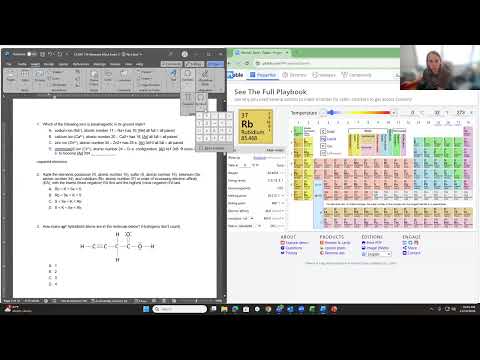
1:46 So, this first question is from chapter eight. So is the second question. Um so our first question here, which of following ions is paramagnetic in its ground state? So who can tell me what paramagnetic means in terms of electrons? So does paramagnetic mean it has unpaired electrons or it doesn't? It does. Yes. So paramagnetic means it has unpaired electrons. And that doesn't just mean that it's an
2:37 odd number of electrons. You can have unpaired electrons with an even number of electrons. So we're going to take a look. So sodium ion regular sodium is atomic number 11. So neutral sodium, atomic number 11. What does that tell us about its electrons? How many electrons does it have? Neutral sodium 11. Good. Um so when it's a sodium ion, a plus one ion, how many electrons does it have? 10. Good.
3:23 So Na plus has 10. And if it has 10, how would you write its electron configuration? We can Let's see if I can put a periodic table here same time.
This is the start of the transcript. Save this video free for the whole transcript, searchable and time-coded.
In this course
Related notes
Summary, takeaways, and chapters were generated by AI from the video's transcript and may contain errors. The video belongs to its creator, Alicia Altemose.