CHEM 119 Fall 2026 - Chapter 8 (10232026)
 Watch on YouTube →
Overview
Alicia Altemose completes Chapter 8 of CHEM 119 by connecting electron configurations to magnetism, transition-metal ions, and periodic properties. Students practice identifying paired and unpaired electrons, explain the chromium and copper exceptions, calculate isoelectronic species, and use effective nuclear charge and shielding to predict atomic and ionic size, ionization energy, and electron affinity.
Key takeaways
- Magnetic behavior depends on orbital occupancy, not simply on whether an atom has an even number of electrons: paired electrons make a species diamagnetic, while any unpaired electrons make it paramagnetic.
- Chromium and copper deviate from the usual filling order because their ground-state configurations gain stability from half-filled 3d⁵ and filled 3d¹⁰ subshells.
- Transition-metal cations lose 4s electrons before 3d electrons; this makes Zn²⁺ [Ar] 3d¹⁰ even though neutral nickel, with the same total electron count, is [Ar] 4s² 3d⁸.
- Isoelectronic comparisons require counting electrons after applying ionic charge: Ar, Cl⁻, and K⁻ each have 18 electrons, but O²⁻ has 10.
- Core-electron shielding changes little across a period, so increasing proton number raises effective nuclear charge and pulls valence electrons inward, decreasing atomic size.
- Losing electrons produces smaller cations, while gaining electrons produces larger anions, because both electron count and electron-electron repulsion affect the electron cloud.
Chapters
- Alicia Altemose plans to finish Chapter 8 and preview Chapter 9, with Lewis structures needed for the following week's lab.
- Students are asked to watch less than an hour of posted videos before Monday, when class will focus on practice.
- Exam 2 is graded, with answer keys expected by Wednesday of the following week.
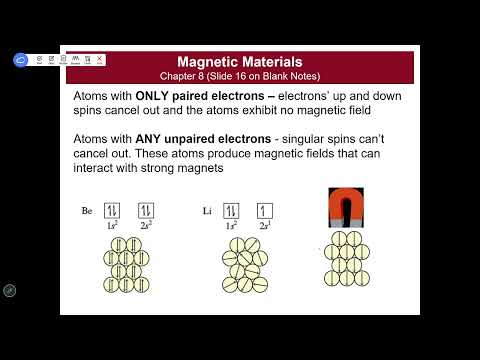
- Diamagnetic atoms have only paired electrons; their electron spins cancel and produce no net magnetic field.
- Paramagnetic atoms have at least one unpaired electron, whose spin contributes to magnetic behavior.
- Beryllium, with 1s² 2s², is diamagnetic; lithium, with one unpaired 2s electron, is paramagnetic.
- Use orbital box diagrams and Hund's rule: place one electron in each equal-energy orbital before pairing.
- Calcium's 4s² electrons are paired, while iron's 3d⁶ arrangement has four unpaired electrons and is paramagnetic.
- Magnesium is diamagnetic; sodium, nitrogen, and lithium are paramagnetic because each has unpaired valence electrons.
- A d subshell has five orbitals because its possible magnetic quantum numbers are −2, −1, 0, 1, and 2; a p subshell has three.
- Chromium and copper are the first-row d-block electron-configuration exceptions students are expected to know.
- Chromium promotes a 4s electron to produce a half-filled 3d subshell, which is more stable than 4s² 3d⁴.
- Copper promotes a 4s electron to complete the 3d subshell, giving 4s¹ 3d¹⁰ rather than 4s² 3d⁹.
- Half-filled and fully filled subshells are more stable than intermediate arrangements; the configurations discussed are ground states.
- Isoelectronic species have the same number of electrons, even when they are different elements or ions.
- Sodium loses one electron to become Na⁺ with 10 electrons, matching neon; fluorine gains one to become F⁻ with 10.
- For the comparison involving Ar, Cl⁻, K⁻, and O²⁻, Ar, Cl⁻, and K⁻ each have 18 electrons, while O²⁻ has 10.
- Determine an ion's electron count by adjusting its atomic number for charge: positive ions lose electrons and negative ions gain them.
- When forming transition-metal cations, remove valence s electrons before removing d electrons.
- Neutral zinc is [Ar] 4s² 3d¹⁰; Zn²⁺ loses both 4s electrons and becomes [Ar] 3d¹⁰.
- Zn²⁺ and neutral nickel both have 28 electrons but different configurations: Zn²⁺ is [Ar] 3d¹⁰, while nickel is [Ar] 4s² 3d⁸.
- Zn²⁺ is diamagnetic because its 3d subshell is full, whereas nickel has two unpaired 3d electrons and is paramagnetic.
- Neutral cobalt has atomic number 27 and the configuration [Ar] 4s² 3d⁷.
- Forming Co²⁺ removes the two 4s electrons first, leaving [Ar] 3d⁷.
- The electron-removal order for transition-metal ions is supported by spectroscopic and magnetic evidence, even though its theoretical explanation is complex.
- Effective nuclear charge, Zₑff, describes the net nuclear attraction experienced by an electron after accounting for electron repulsion and shielding.
- Core electrons shield outer electrons effectively, while neighboring valence electrons provide comparatively weak shielding.
- A larger effective nuclear charge holds valence electrons more tightly, drawing them closer to the nucleus.
- The periodic trends discussed depend chiefly on effective nuclear charge experienced by valence electrons, not inner electrons.
- Across a period, the number of core electrons stays the same while proton number rises, increasing effective nuclear charge and decreasing atomic size.
- Down a group, valence electrons occupy a higher principal energy level and experience more shielding, so atomic size increases.
- Ionization energy is the energy required to remove an electron; electron affinity concerns the energy released when an atom gains one.
- Altemose describes size as opposite to ionization energy and electron affinity as increasing with stronger attraction; the stated size trends are most reliable for main-group elements.
- Cations are smaller than their neutral atoms because losing electrons leaves more protons than electrons to attract the remaining electron cloud.
- Anions are larger than their neutral atoms because added electrons increase electron-electron repulsion.
- Cations are generally smaller than anions, though comparisons involving species separated by about two periods can be exceptions.
- The next class will continue periodic-trend practice and work on Chapter 9 material in preparation for Lewis structures.
Transcript excerpt
0:00 is usually due. So, if you're already did both of those, great. You don't have any homework to worry about this weekend. If you didn't, you still got time. Uh I'm going to have my drop-in hours after class today. I'm going to end a little bit early. Probably going to end it like 12:20 today um cuz I'm going to go to lunch with some seniors who are graduating and I want to celebrate with them. Um and uh yeah, so the other big news I guess is that we're going to finish chapter eight today and we're going to start chapter nine {slash} 10. We're hopefully going to just breeze through chapter nine um and start chapter 10 because I'm going to ask you guys to view some videos over the weekend. I don't want to rush through the material
0:47 on Monday cuz I know that's we don't like that. Um so, I don't want to rush through the material on Monday. So, it's maybe maybe an hour. I don't think it's even an hour um worth of videos. You can, you know, zoom through it. You don't have to watch real carefully. Um we are still going to go over the material. We're going to practice with it on Monday. Um but I'd like you to have a preview at least of chapter nine so that we can practice it and start talking about Lewis structures, which you'll need for the lab next week. And then exam two is graded. The answer keys will be posted by Wednesday next week. Um and if you had any questions about it, uh let me know at the end of class. You can come up and we can talk about it then.
1:35 Okay. So, the rest of chapter eight. Uh we
This is the start of the transcript. Save this video free for the whole transcript, searchable and time-coded.
Related notes
Summary, takeaways, and chapters were generated by AI from the video's transcript and may contain errors. The video belongs to its creator, Alicia Altemose.