CHEM 119 Fall 2026 - Exam 1 Review #2 (Chapters 1 - 3 all, Chapter 4 Part 1)
 Watch on YouTube →
Overview
Alicia Altemose reviews CHEM 119 Exam 1 material through Chapter 4 Part 1, emphasizing stoichiometry, limiting reactants, percent yield, solution concentration, density, and isotope abundance. Worked examples show how to translate problem wording into dimensional-analysis steps, including a 73% yield phosphorus problem, concentrated nitric acid at about 15 M, and finding oxygen atoms in a cobalt(III) oxide cube; Altemose also clarifies exam scope, format, and study support.
Key takeaways
- Percent yield is actual yield divided by theoretical yield times 100; when actual product and yield are given, divide actual by the yield as a decimal to find the theoretical amount.
- For limiting-reactant problems, convert each reactant to the same possible product using balanced-equation coefficients; the smaller product amount identifies the limiting reactant.
- A mass-percent and density problem can produce molarity by chaining solute mass per solution mass, solution density, volume conversion, and molar mass.
- In density-to-atom-count problems, match volume units to the density before multiplying, then convert sample mass to moles and use formula subscripts before Avogadro’s number.
- An isotope’s greater abundance pulls the weighted-average atomic mass closer to its isotope mass; exact abundance can be solved by assigning fractions x and 1 − x.
- The CHEM 119 Exam 1 is an 18-question multiple-choice exam, covers material through dilution, and is graded on answers without partial credit for written work.
Chapters
- Exam coverage includes Chapters 1 through 3 and Chapter 4 Part 1, ending with dilution problems.
- Limiting reactants are included, while redox and memorizing strong and weak acids and bases are not yet in scope.
- The Chemistry Learning Lab is open 3 to 6 p.m. in ILSQ W204, with an SI session at 7:30 p.m.
- Nadia holds Wednesday office hours at 8 a.m. in the Eller oceanography and meteorology building.
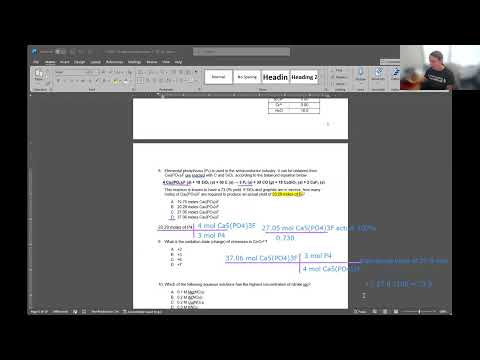
- The mock exam asks how many moles of a calcium-containing reactant are needed to produce 20.29 mol P4 at 73% yield.
- Using the balanced-equation ratio of 4 mol reactant to 3 mol P4 gives 27.05 mol reactant at an assumed 100% yield.
- Because 73% yield produces less product than the theoretical amount, divide 27.05 mol by 0.73 to get about 37.06 mol starting reactant.
- Check the result by converting 37.06 mol through the balanced equation to theoretical P4, then multiplying by 0.73.
- Write percent yield = actual yield ÷ theoretical yield × 100 before substituting values.
- For the phosphorus example, the given 20.29 mol is actual product and 73% is the yield, so the theoretical yield can be solved first.
- Once theoretical product is known, use balanced-equation mole ratios to connect product and reactant amounts.
- Altemose presents the direct conversion and formula-first approaches as interchangeable ways to begin.
- When reactant amounts and actual yield are given, calculate theoretical yield from stoichiometry, then solve for percent yield.
- When reactant amounts and percent yield are given, find theoretical yield first and use the percentage to calculate actual yield.
- When reactant amounts are the unknown, use the actual product and percent yield to determine the theoretical product before applying mole ratios.
- The third type is especially challenging because the requested reactant quantity is not given directly.
- For a 73.2% by-mass HNO3 solution, assume 100 g of solution contains 73.2 g HNO3.
- The density, 1.29 g solution per mL solution, applies to the entire mixture, not just the acid or water.
- Convert the 73.2 g HNO3 per 100 g solution ratio using density and 1 L = 1000 mL to obtain about 944 g HNO3 per liter.
- Divide by HNO3 molar mass, about 63.02 g/mol, to get a concentration of about 15.0 M.
- Calcium is a metal that forms Ca2+, while nitrogen is a nonmetal that forms N3−, so calcium nitride is ionic.
- Crisscrossing the ion charges gives the neutral formula Ca3N2.
- Nitrogen gas is diatomic, N2, and calcium is written as Ca(s) when elemental.
- The balanced formation equation is 3Ca(s) + N2(g) → Ca3N2(s).
- Convert 88.5 g Ca and 49.4 g N2 to moles using 40.08 g/mol and 28.02 g/mol, respectively.
- Use the balanced equation to compare possible Ca3N2 production: divide calcium moles by 3 and multiply nitrogen moles by the 1:1 product ratio.
- The calcium amount permits about 0.736 mol Ca3N2, while nitrogen permits about 1.76 mol, so calcium is limiting.
- The limiting reactant determines the maximum theoretical product; excess nitrogen does not increase the yield.
- Ca3N2 has a molar mass of about 148.26 g/mol, giving roughly 109 g theoretical product from the limiting calcium.
- For a 91.9% yield, set actual ÷ 109 g = 0.919 to find approximately 100 g Ca3N2 actually formed.
- Reactant quantities determine theoretical yield, while percent yield converts theoretical product into actual product.
- Keep significant figures in mind when the result rounds to a value such as 100 g.
- A combustion reaction uses oxygen gas as a reactant; hydrogen fuel forms water vapor as its only product.
- The unbalanced equation is H2 + O2 → H2O, and balancing gives 2H2 + O2 → 2H2O.
- Unlike hydrocarbon combustion, this reaction makes no CO2 because the fuel contains no carbon.
- Altemose distinguishes the hydrogen-only example from the usual course pattern for fuels containing carbon and hydrogen, which produce CO2 and H2O.
- Treat the stated 619 kg of water as actual product and use actual ÷ theoretical = 0.937 to solve for theoretical water.
- The theoretical water amount is about 6.61 × 10^5 g; convert it to moles using 18.02 g/mol.
- The balanced equation gives a 2:2, or 1:1, mole ratio between H2 and H2O.
- Convert hydrogen moles to grams using about 2.02 g/mol, producing an answer near 7.41 × 10^4 g H2.
- Percent yield is actual product divided by theoretical product, multiplied by 100.
- Mole ratios connect theoretical quantities in the balanced equation; keep actual yield separate until applying the percent.
- The hydrogen calculation uses three significant figures, and the homework system may be more exacting about molar masses than exam multiple choice.
- The review moves next to a decomposition problem requiring a balanced equation and theoretical yield.
- The decomposition problem starts with 53.50 g Si2S4 and asks for silicon yield at 40.9%.
- Use a molar mass of about 184.4 g/mol for Si2S4, then apply the balanced-equation ratio of 4 mol Si to 2 mol Si2S4.
- Convert product moles to grams with silicon’s molar mass, 28.084 g/mol, to obtain about 16.3 g theoretical silicon.
- Multiply theoretical yield by 0.409 to get about 6.66 g actual silicon; yields are generally below 100% in the course problems.
- The practice quiz earns a small amount of credit but is intended primarily as exam preparation.
- Students may find it harder than the mock exam because it is not multiple choice and includes multi-part questions.
- Altemose describes the real exam difficulty as likely between the practice quiz and mock exam.
- Submitting practice answers reveals feedback and worked steps, so attempting the quiz is useful even when uncertain.
- The problem gives Co2O3 density as 6.11 g/cm3 and a cube edge length of 3.92 mm.
- Convert 3.92 mm to 0.392 cm before cubing, matching the cubic-centimeter unit in the density.
- For a cube, volume = edge length cubed, giving about 0.0602 cm3.
- Multiply density by volume to obtain the mass of the entire Co2O3 cube before calculating oxygen atoms.
- Calculate Co2O3 molar mass from 2 cobalt atoms and 3 oxygen atoms, approximately 165.86 g/mol.
- Convert the cube’s sample mass to moles of Co2O3, then use the formula subscript to apply 3 mol O atoms per 1 mol Co2O3.
- Multiply oxygen moles by Avogadro’s number, 6.022 × 10^23 atoms/mol, to obtain approximately 2.0 × 10^21 oxygen atoms.
- The Roman numeral in cobalt(III) identifies cobalt’s charge, not the number of cobalt atoms in the formula.
- Boron’s average atomic weight of 10.81 lies between the mass numbers of its two major isotopes, boron-10 and boron-11.
- Because 10.81 is closer to 11 than to 10, boron-11 has the greater natural abundance.
- The weighted average is pulled toward the isotope with the larger fractional abundance.
- This comparison works when only the more abundant isotope is requested, without calculating an exact percentage.
- Represent boron-10 abundance as x and boron-11 abundance as 1 − x so the fractions total 100%.
- Set the average atomic mass equal to the sum of each isotope’s mass multiplied by its fraction, then solve algebraically.
- In Altemose’s illustrative values, solving for x gives about 19.8% boron-10, leaving about 80.2% boron-11.
- Check the result against the 10.81 average, which should be closer to boron-11 because it is more abundant.
- Students can email Alicia Altemose with study questions, and Nadia’s office hours begin at 8 a.m. the next day.
- The exam is graded on selected answers rather than written work, so students should bubble choices carefully and check the answer sheet.
- The multiple-choice format provides no partial credit, and distractors may reflect common calculation errors.
- Alicia notes that faster grading is one benefit of the answer-only format.
- The exam contains 18 multiple-choice questions, mostly single-answer items rather than the practice quiz’s multi-part layout.
- Question wording and difficulty should resemble the mock exam more than the practice quiz’s response format.
- Students will not need to enter numeric responses or complete dropdown, fill-in-the-blank, or true-or-false items.
- Significant figures matter mainly for the question that explicitly tests them.
Transcript excerpt
0:00 be here. All right. Where where would we like to start? I we can look at the uh we can look at the mock exam. We can look at the practice quiz. We can look at questions from the homework questions from the textbook. Kind of up to you guys. Whatever you want to do. >> Oh. Um, miss out. I mean, >> I was wondering if there was any redux on the test. >> No, we didn't get there yet. >> Okay. No redu. And then is there any limiting reagents? >> Definitely limiting reagents. >> Mhm. >> And then is like do we have to remember the strong bases and acids and weak acids and bases?
0:47 >> Not yet. So if you Yeah. So, if you have friends in um some of the other classes, I know Dr. Zu and maybe Dr. Gets um are going to have some of that on their exam, but our exam is going to stop with uh like dilutions. So, what we >> the practice problem we started with yesterday is the last kind of thing we're going to see. >> Mhm. Okay. And then Yeah. So, there's no like like oil rig, right? >> No. No, we didn't get there yet. >> Okay. Okay. And then um so your office hours tomorrow is at 8:00 a.m. in the M building. >> So that is with Nadia, our um she's our IIA. She's a grad student. She Yeah, she has office hours at 8 a.m. on
1:35 Wednesdays. >> Okay. And the on building, like if I just searched that up in the Google Maps, like that's what it's called. >> I really don't know. Hopefully >> cuz I've never been there. But like if I just like put that in the search like I
This is the start of the transcript. Save this video free for the whole transcript, searchable and time-coded.
Related notes
Summary, takeaways, and chapters were generated by AI from the video's transcript and may contain errors. The video belongs to its creator, Alicia Altemose.