CHEM 119 Fall 2026 - Exam 3 Review #2 (Chapters 8-12)
Overview
Alicia Altemose reviews CHEM 119 Exam 3 topics from Chapters 8 through 12, working through practice-quiz and mock-exam questions on periodic trends, Lewis structures, molecular geometry, magnetism, lattice energy, and intermolecular forces. The session emphasizes reasoning from effective nuclear charge and formal charge, applying step-by-step procedures, and identifying which details, including transition-metal ion configurations and magnetic behavior, are likely to be tested.
Key takeaways
- Across a period, increasing proton count raises effective nuclear charge while shielding remains similar, pulling electrons closer; down a group, added shells and shielding generally increase atomic radius.
- Second ionization energy must be compared after one electron has been removed: K⁺ has a noble-gas configuration, making its next electron especially difficult to remove.
- Use a fixed Lewis-structure workflow: count valence electrons including ionic charge, draw the skeleton, complete terminal-atom octets, place leftover electrons centrally, and consider multiple bonds only when needed or when comparing formal charges.
- Molecular shape depends on both bonds and lone pairs: SF₄ is seesaw with one lone pair, IF₃ is T-shaped with two lone pairs, and SO₃²⁻ is trigonal pyramidal with one lone pair on sulfur.
- For ionic lattice energy, larger charge products and shorter ion separations increase attraction; this explains why MgS outranks lower-charge salts and why KBr outranks RbBr.
- When compounds share the same strongest intermolecular force, larger molecules generally have stronger dispersion interactions and higher boiling points, as butanol does compared with ethanol.
Chapters
- Alicia Altemose invites students to select topics and begins with Chapter 8 questions from the practice quiz.
- She notes that many Chapter 8 questions were also covered in a mock-exam review, and identifies hybridization, Lewis structures, and polarity as other practice topics.
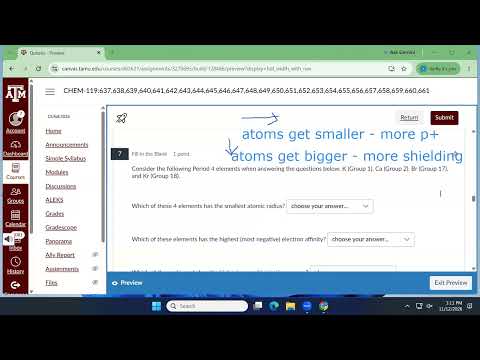
- For potassium, calcium, bromine, and krypton, bromine has the smallest atomic radius because atomic size decreases from left to right across a period.
- Across Period 4, core-electron shielding stays similar while proton count rises, increasing effective nuclear charge and pulling valence electrons closer.
- Moving down a group adds electron shells and shielding, which generally makes atoms larger.
- Electron affinity generally increases across a period, but noble gases are an exception because their filled shells make gaining an electron unfavorable.
- Among potassium, calcium, bromine, and krypton, bromine has the greatest tendency to gain an electron; krypton's small radius does not make it the answer.
- For second ionization energy, first remove an electron and then compare the resulting ions: K⁺ has a noble-gas configuration, so removing its next electron requires the most energy.
- For the same pair of atoms, a single bond is longer and weaker than a double bond; a triple bond is shorter and stronger than a double bond.
- More shared electrons pull the nuclei closer together, which explains why higher bond order generally corresponds to shorter, stronger bonds.
- A carbon with three electron domains has an approximately trigonal-planar arrangement; a double bond changes nearby angles, making the angle opposite it less than 120° and angles that include it greater than 120°.
- A two-dimensional sketch can make a bond angle look like 90° or 180°, but the correct estimate comes from counting electron domains around the central atom.
- For a carbon with three domains, use an ideal angle near 120° and account for double-bond repulsion when deciding which angles are larger or smaller.
- The H–C–H angle opposite a carbon-carbon double bond is less than 120°, while angles that include the double bond are greater than 120°.
- A seesaw molecule has four bonds and one lone pair, giving five electron domains and a trigonal-bipyramidal electron-domain arrangement.
- Two lone pairs and four bonds produce square-planar geometry, not seesaw; square pyramidal has five bonds and one lone pair in an octahedral domain arrangement.
- The Lewis structures identify SF₄ as seesaw, BrF₅ as square pyramidal, IF₃ as T-shaped, and CF₄ as tetrahedral.
- Calculate formal charge as valence electrons minus one electron for each bond line and minus the number of nonbonding electrons.
- For phosphate structures, a phosphorus with five bonds has formal charge zero, while adding more double bonds can make phosphorus negatively charged.
- Prefer structures with fewer nonzero formal charges; when negative charge is present, placing it on more electronegative oxygen is generally more favorable than placing it on phosphorus.
- In the example with a central oxygen, four bonds give oxygen a formal charge of +2; the alternative central nitrogen with four bonds has a +1 charge.
- The structure with central nitrogen is the better of the two choices because its combined formal charges are lower, although it is not necessarily the best possible Lewis structure.
- A neutral oxygen with two bonds and two lone pairs has formal charge zero, calculated as 6 − 2 − 4.
- Water can hydrogen-bond with a molecule containing nitrogen, oxygen, or fluorine because water supplies an O–H bond and the other molecule supplies an appropriate interaction site.
- The N₂O structure with an electronegative oxygen end is polar, allowing its oxygen to interact with the partially positive hydrogen of water.
- Pure N₂O does not hydrogen-bond with itself because its molecules contain no hydrogen bonded to N, O, or F.
- Germanium, atomic number 32, has the configuration [Ar] 4s² 3d¹⁰ 4p².
- Hund's rule places the two 4p electrons in separate orbitals, leaving two unpaired electrons and making germanium paramagnetic.
- Diamagnetic means all electrons are paired; paramagnetic means at least one electron is unpaired, even when the total electron count is even.
- Lattice-energy comparisons depend on ionic charge magnitudes and the distance between ions, consistent with the electrostatic relationship charge product over separation.
- For NaCl, MgCl₂, Na₂S, and MgS, the Mg²⁺ and S²⁻ charge magnitudes give MgS the largest charge product and the greatest lattice energy in the comparison.
- When charges are the same, smaller ions sit closer together and produce greater lattice energy; KBr therefore has greater lattice energy than the larger-ion comparison RbBr.
- Ethanol and butanol both contain an O–H bond, so hydrogen bonding is the strongest intermolecular force in both substances.
- When the strongest intermolecular forces are the same, compare molecular size: butanol's longer carbon chain gives it greater dispersion interactions.
- Stronger intermolecular attractions raise boiling point, so ethanol has the lower boiling point.
- A substance with a normal boiling point of 231.15 K has weaker intermolecular forces than the comparison compound at 249.15 K.
- The oxygen-containing comparison molecule, CH₃OCH₃, is polar and has dipole-dipole forces but cannot hydrogen-bond to itself because it has no O–H, N–H, or F–H bond.
- A hydrocarbon with only carbon and hydrogen is nonpolar and relies on dispersion forces, which are weaker than the dipole-dipole forces in CH₃OCH₃.
- When forming transition-metal cations, remove 4s electrons before 3d electrons, even though 4s fills first in the neutral atom.
- Neutral chromium is an exception with [Ar] 4s¹ 3d⁵; Cr²⁺ loses its 4s electron and one 3d electron, leaving [Ar] 3d⁴ with four unpaired electrons.
- Zn²⁺ is diamagnetic because it retains a filled 3d¹⁰ subshell, while Cu⁺ is diamagnetic after losing copper's 4s electron and retaining 3d¹⁰.
- Count 26 valence electrons for sulfite: six from sulfur, eighteen from three oxygens, and two added for the 2− charge.
- The octet-rule structure uses sulfur as the central atom, three S–O single bonds, three lone pairs on each oxygen, and one lone pair on sulfur.
- Sulfur has four electron domains, one of them a lone pair, so the molecular shape is trigonal pyramidal with bond angles below 109.5°; sulfur's formal charge in this structure is +1.
- Use polarity as a quick guide to miscibility: two nonpolar hydrocarbons are expected to mix, while nonpolar propane and polar water are expected not to mix.
- Water and polar HCl are expected to mix because both substances are polar.
- Altemose identifies transition-metal ion configurations, diamagnetic versus paramagnetic behavior, effective nuclear charge, atomic and ionic sizes, ionization energies, and possibly electron affinity as Chapter 8 exam topics.
- For sulfur and chlorine atoms, sulfur is larger because atomic radius decreases from left to right as proton count increases while shielding remains similar.
- S²⁻ is larger than neutral sulfur because the ion has the same number of protons but more electrons; more electron-electron repulsion expands the electron cloud.
- For bonds with the same bond order, a shorter bond between smaller atoms is predicted to be stronger, while the longest bond is predicted to require the least energy to break.
Transcript excerpt
0:01 Yes. Okay. All right. So, this is this is for you guys. So, what do you want to what do you want to look at? Any problems you want to start with in particular? Yeah, chapter eight problems. So, we can do that. Um, so let's see. Let's take a look at the ones on. Let's see if I had any on this practice quiz. I did go over most if not all of the chapter 8 um questions on the mock exam on Thursday. So, if you check that
0:51 recording, you can see those. Um but let's see what I had in here. That one was about hybridization, sigma and pi bonding. Two is about Lewis structures. Three is about polarity. See? Okay. So, here's one. Um, so number seven on the practice quiz, consider the following period four elements when answering the questions below. So we've got potassium which is in group one, calcium in group two, bromine in
1:42 group 17, and krypton in group 18. So I don't have to scroll up to the periodic table. Is that still okay for you guys? Okay. Um, so which of these four elements has the smallest atomic radius? So they're all, it says they're all in period 4. So if they're all in the same period, what do we look at for the radius? So based on the trend left to right,
2:29 yes, you are correct. What is left to right? Is that going to make it bigger or smaller? >> Smaller. Why? >> Good. Good. So it's more important to know why than just memorize the trend. So as we go to the right across a period, we have the same amount of shielding. Um, so that was perfect. We have the same amount of shielding because we have the same number of core
This is the start of the transcript. Save this video free for the whole transcript, searchable and time-coded.
In this course
Related notes
Summary, takeaways, and chapters were generated by AI from the video's transcript and may contain errors. The video belongs to its creator, Alicia Altemose.