CHEM 119 Fall 2026 - Chapters 12.1 and 6.1 (11162026)
Overview
Alicia Altemose connects Chapter 12 intermolecular forces and phase behavior to Chapter 6 thermochemistry, reviewing how stronger intermolecular forces raise boiling points and lower vapor pressure before introducing heat, work, and energy conservation. Students practice assigning signs to heat and work, applying ΔE = Q + W, and learn the specific-heat relationship Q = mcΔT, which will be used to calculate temperature changes.
Key takeaways
- Stronger intermolecular forces make it harder for molecules to escape a liquid, producing higher boiling points and lower vapor pressures.
- When molar masses are similar and hydrogen bonding is absent, greater molecular polarity and a larger dipole moment can predict a higher boiling point; acetaldehyde is the example with the highest boiling point.
- On a phase diagram, boiling and melting temperatures vary with pressure, and the triple point is the condition where solid, liquid, and gas coexist.
- The first law is applied as ΔE = Q + W: heat absorbed by a system and work done on it are positive, while energy transferred out is negative.
- Specific heat capacity depends on both the substance and the amount of material; Q = mcΔT relates heat transfer to mass and temperature change.
Chapters
- Chapter 12.1 homework and the practice quiz remain open on ALEKS and Canvas until midnight, mainly for participation points rather than Exam 3 preparation.
- Lab assessments take place this week; students should check their assigned time and bring a calculator that is not a phone.
- The participation survey closes at 5 p.m.; reaching 80% participation earns extra credit for everyone, while Exam 3 feedback is expected by Wednesday.
- The Q-drop deadline is 5 p.m.; grade calculations are available in the Student Resources module, and Alicia Altemose offers drop-in help.
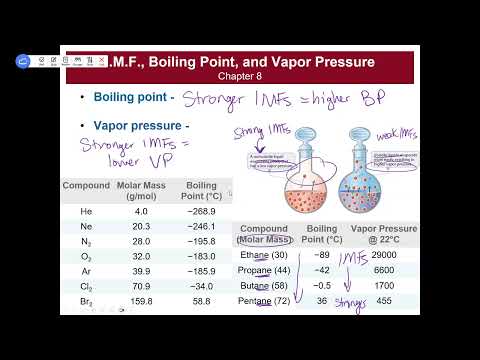
- Stronger intermolecular forces produce a higher boiling point but a lower vapor pressure.
- Nonvolatile liquids have strong intermolecular forces, so few molecules escape into the gas phase and vapor pressure stays low.
- Volatile liquids have weaker intermolecular forces and higher vapor pressure; many organic chemistry solvents require use of a fume hood.
- For nonpolar hydrocarbons such as propane and butane, longer carbon chains and greater molar mass strengthen dispersion forces, raising boiling points and lowering vapor pressure.
- When compounds have similar molar masses, compare intermolecular force strength to predict boiling point; a molar-mass difference of roughly 30 g/mol or more may also matter.
- The class comparison compounds have similar molar masses and no hydrogen bonding, so their dipole moments indicate the relative strength of dipole-dipole attractions.
- Acetaldehyde has the highest dipole moment in the comparison and therefore the highest boiling point.
- An oxygen near one end of a molecule can create a stronger overall dipole than an oxygen positioned closer to the molecule's middle.
- A class poll invited students to suggest a name for a young female animal named Rehea's calf, born October 22.
- On a standard phase diagram, solid occupies the lower-temperature, higher-pressure region, gas the higher-temperature region, and liquid lies between them.
- Melting and freezing connect solid and liquid; vaporization and condensation connect liquid and gas; sublimation and deposition connect solid and gas.
- The triple point marks conditions where solid, liquid, and gas coexist, while the critical point leads to a supercritical fluid with properties of both liquids and gases.
- Boiling and melting points depend on pressure; increasing pressure raises boiling temperature, and water's unusual solid-liquid boundary helps explain why ice floats.
- Chapter 6 introduces thermochemistry, the study of heat energy involved in chemical reactions and physical processes.
- Melting ice requires absorbed heat, which can be written on the reactant side of a process.
- Forming liquid water from hydrogen and oxygen releases heat, which can be written on the product side; reversing the process to split water requires energy.
- Heat on the reactant side indicates absorption, while heat on the product side indicates release.
- Thermodynamics tracks heat Q, energy change ΔE, and work W; the system is the chosen sample or reaction, and the surroundings are everything outside it.
- Heat is energy transfer, not temperature: a system can absorb or release heat without necessarily changing temperature.
- The course uses joules and calories; 1 small calorie equals 4.184 J, and 1 food Calorie equals 1,000 small calories.
- The first law states that energy is conserved: the universe's total energy change is zero, and a system's energy change is ΔE = Q + W.
- Only energy changes, calculated as final minus initial, are measured rather than the absolute energy of a system.
- Heat absorbed by the system is endothermic and has positive Q; heat released by the system is exothermic and has negative Q.
- Work done on the system by the surroundings is positive W, while work done by the system on its surroundings is negative W.
- Drawing arrows into or out of a system boundary helps track signs: inward energy transfer is positive and outward transfer is negative.
- These sign conventions determine whether a process increases or decreases the system's internal energy.
- Pressure-volume work is tied to a system's volume change: compression decreases volume and corresponds to positive work done on the system.
- When volume does not change, ΔV is zero and PV work is zero, so ΔE = Q under constant-volume conditions.
- At constant pressure, PV work is generally nonzero, so internal energy change must include both heat and work.
- The lecture focuses on PV work, while noting that physics courses consider other kinds of work.
- For a gas compressed by 150 J of work while losing 241 J of heat, W is +150 J and Q is −241 J.
- Using ΔE = Q + W gives the gas an internal energy change of −91 J, meaning it loses energy overall.
- When a system releases 5 J of heat and does 5 J of work on its surroundings, both terms are negative and ΔE = −10 J.
- The key step in these problems is assigning signs from the direction of heat and work before adding the values.
- For similar heat input, a small metal needle warms more than a glass of water because the needle has less mass and metal has lower specific heat capacity.
- Specific heat capacity is the energy needed to raise 1 g of a substance by 1°C; water's value is 1 calorie per gram per degree Celsius.
- The heat equation is Q = mcΔT, where Q is heat, m is mass in grams, c is specific heat capacity, and ΔT is temperature change.
- A glass of water also transfers heat to its container, so the glass may need to be considered in a calorimetry calculation.
Transcript excerpt
0:28 Howdy. Good morning. How are we doing today? Did you have a good weekend? Good. All right. Good weekend. I know it's Monday, so we'll hopefully it gets better because it's Monday and Mondays are great. Yeah. So, reminder for everyone, um, or maybe a heads up for everyone, I reopened the chapters 12.1 homework on Alex and the practice quiz. Um, it won't help you with exam three anymore, but uh, if you want those points, um, Alex homework points or Canvas, those are participation points in case you're worried about your clickers, those are open um, until midnight tonight.
1:17 I have drop in hours after class or on Tuesdays, so tomorrow at 10:30 um on Zoom. SI sessions Tuesday through Thursday. Chemistry learning lab open today through Thursday. And then reminder, your lab assessments are this week. I don't know much about it, but make sure you know when you're supposed to go. And make sure you bring a calculator that is not your phone because I don't think they provide calculators. Make sure you bring one. Um, then another reminder, we had I sent a link or I sent the announcement about it last night. So, check the announcement if you didn't see it yet. If you need this link for the participation survey, so if we get to 80% participation on this survey, it's going to close at 5:00 p. p.m. tonight.
2:05 So, make sure you do it if you haven't. If we get to 80% participation, everybody gets some extra credit. I'm not sure if it was updated today or not, but it looked like 50% when I checked it this morning. Um, exam 3 is graded and the feedback will be posted by Wednesday. And then hopefully this doesn't affect a lot of people, but just make sure it's
This is the start of the transcript. Save this video free for the whole transcript, searchable and time-coded.
In this course
Related notes
Summary, takeaways, and chapters were generated by AI from the video's transcript and may contain errors. The video belongs to its creator, Alicia Altemose.