CHEM 119 Fall 2026 - Chapter 12.1 (11112026)
Overview
Alicia Altemose explains how to identify intermolecular forces and use them to predict boiling points, emphasizing that hydrogen bonding requires an O–H, N–H, or F–H bond between molecules in a pure substance. She develops the comparison from hydrogen bonding and dipole interactions through dispersion, polarizability, and molecular shape, while noting that stronger intermolecular forces generally raise boiling points and lower vapor pressure.
Key takeaways
- Hydrogen bonding in a pure substance requires a donor bond to O, N, or F, specifically O–H, N–H, or F–H; merely containing hydrogen and one of those atoms is not enough.
- A molecule that cannot hydrogen-bond with itself may still hydrogen-bond with water if it has an O, N, or F acceptor, as dimethyl ether can in a water mixture.
- Dispersion forces occur in every substance, and their strength increases with electron-cloud polarizability; large iodine molecules can therefore have stronger dispersion than water has hydrogen bonding.
- For similar-mass substances, stronger intermolecular forces generally mean a higher boiling point and lower vapor pressure; comparisons across very different molecular sizes require accounting for polarizability.
- Among same-formula hydrocarbons, straight chains generally boil at higher temperatures than branched isomers because their shapes allow more effective molecular contact.
Chapters
- Chapter 12 homework is due tonight, before Exam 3 on Friday; no Chapter 6 homework is assigned Monday because the class has not reached it.
- The Canvas practice quiz earns up to 3 participation points and remains open through Monday night, although Thursday night is listed as its due date.
- Alicia Altemose scheduled a review session for Thursday at 1 p.m. in ILSQ W204, with Zoom access and a recording; SI sessions are at 7:30 p.m.
- Exam 3 covers Chapter 8 magnetism and transition-metal ions through the current intermolecular-forces material; the mock exam, answer key, and seating chart are posted.
- For hydrogen bonding in a pure substance, look for an O–H, N–H, or F–H bond that can donate hydrogen to a matching O, N, or F acceptor on another molecule.
- 1-Butanol has an O–H bond and can form an O–H···O interaction with another 1-butanol molecule; diethyl ether has an oxygen but no O–H bond.
- Diethyl ether can form dipole–dipole interactions, but its best possible hydrogen-bond arrangement with itself does not meet the required donor pattern.
- The boiling points illustrate the difference: 1-butanol boils at 117 °C, while diethyl ether boils at 34.5 °C; stronger intermolecular forces correspond to higher boiling points.
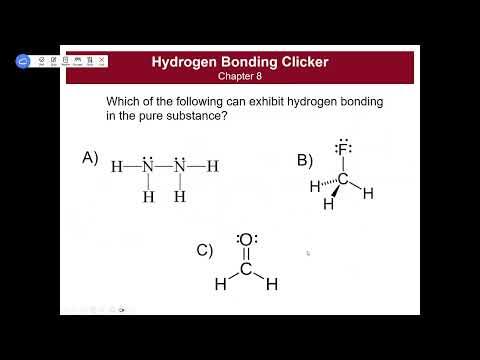
- Of N₂H₄, CH₃F, and CH₂O, only N₂H₄ can hydrogen-bond with itself because it contains an N–H bond.
- CH₃F and CH₂O contain fluorine or oxygen, respectively, but neither has an F–H, O–H, or N–H donor bond for hydrogen bonding in the pure substance.
- Water can donate an O–H hydrogen bond to a molecule that supplies an O, N, or F acceptor, so an ester such as ethyl propanoate can hydrogen-bond with water.
- Drawing the molecules and checking whether the proposed interaction uses existing bonds helps distinguish hydrogen bonding from an invalid arrangement.
- Ethanol, CH₃CH₂OH, and dimethyl ether, CH₃OCH₃, are structural isomers with the same molecular formula, C₂H₆O.
- Ethanol has an O–H bond and hydrogen-bonds with other ethanol molecules; dimethyl ether has no O–H bond and relies on dipole–dipole forces in its pure substance.
- The stronger hydrogen bonding in ethanol helps explain its higher boiling point compared with dimethyl ether.
- In a mixture with water, dimethyl ether can accept hydrogen bonds from water even though it cannot hydrogen-bond with itself in a pure sample.
- A dipole indicates a polar molecule, while an induced dipole indicates a normally nonpolar molecule whose electron cloud has been distorted.
- When polar water approaches nonpolar O₂, its partial charges repel or attract electrons in O₂, temporarily creating a dipole; ions can induce dipoles in nonpolar molecules as well.
- Two nonpolar molecules can also create temporary, mutually induced dipoles as their constantly moving electrons shift, producing an attraction.
- These interactions are called dispersion forces, London dispersion forces, or van der Waals forces; dispersion occurs in all substances.
- Water exhibits dispersion, dipole–dipole interactions, and hydrogen bonding, with hydrogen bonding as its strongest intermolecular force.
- The number of electrons affects polarizability: a larger electron cloud is easier to distort and can produce stronger dispersion forces.
- I₂ has only dispersion forces, but its many electrons make those forces strong enough for iodine to be solid at room temperature and stronger overall than water’s in this comparison.
- Use boiling points to compare substances of similar size, and account for molecular mass and state when sizes differ; water’s 100 °C boiling point exceeds bromine’s 59 °C.
- Hydrocarbons contain only carbon and hydrogen, are treated as nonpolar, and have dispersion as their only intermolecular force.
- As a hydrocarbon’s molar mass and electron count increase, polarizability, dispersion strength, and boiling point generally increase.
- For molecules with the same formula and similar mass, a straight-chain structure such as n-hexane generally has a higher boiling point than a branched isomer.
- Branching reduces how effectively molecules can pack together; the branched six-carbon example therefore boils below n-hexane.
- SeF₄ has dispersion forces because all substances do, and dipole–dipole forces because its polar bonds and asymmetric structure create a net dipole.
- SeF₄ does not hydrogen-bond with itself because it lacks an O–H, N–H, or F–H bond.
- HCl also does not hydrogen-bond with itself: the presence of hydrogen alone is insufficient because chlorine is not one of the required atoms.
- For a single molecule type of similar size, the lecture’s general ranking is hydrogen bonding stronger than dipole–dipole, which is stronger than dispersion.
- The interaction depends on the pair: ions with polar molecules can form ion–dipole forces, ions with nonpolar molecules can induce dipoles, and polar–nonpolar pairs can form dipole-induced-dipole interactions.
- Polar molecules with O–H, N–H, or F–H bonds can hydrogen-bond; polar molecules without those bonds have dipole–dipole forces, while nonpolar-only pairs have dispersion.
- A general strength ranking is useful for similar-sized substances, but a large molecule such as I₂ can have stronger dispersion than a smaller molecule’s hydrogen bonding.
- Stronger intermolecular forces raise boiling point and lower vapor pressure; vapor pressure and phase diagrams are mentioned as homework material, not Exam 3 topics.
Transcript excerpt
0:32 Howdy. All right. Good morning. How are we doing today? Good? Okay. Good. So, just a reminder for everyone. Let's just double check. It looks like this is working, but just Beautiful song. Okay. Great. And hide that. So, uh I pushed that chapter 12 homework back so that we could finish it today. Um the chapter 12 homework is due tonight. I know it's not our normal Monday deadline, but it's due tonight so that you would definitely do it before the test on Friday. And then uh on Monday, tentatively, maybe some chapter six homework. If we
1:22 don't get to it, then nothing nothing will be due. Um there is a practice quiz on Canvas. That is for participation points like the other ones. So, you get all the participation points, all three points. If you get 100, you get some percentage of three points. If you get not 100 Um that practice quiz says it's due Thursday night, but it'll be open through Monday night. Um you just want to do it before the test uh for practice ideally. Um So, I do have drop in hours after class today and then forgot to fix that, but uh tomorrow, Thursday, I have a review session at 1:00 p.m. in ILSQ, same place as my regular drop-in hours. So ILSQ W204 have a review session at 1 p.m.
2:13 tomorrow. I'll post an announcement about it um to remind you tomorrow or tonight. And that uh will also be on Zoom. So if you can't come for the whole time, but you can pop in on Zoom for some of the time, great. Um or if you just want to watch the recording, that's okay too. Um there's an SI session tonight and another one tomorrow, 7:30 um p.m. for
This is the start of the transcript. Save this video free for the whole transcript, searchable and time-coded.
In this course
Related notes
Summary, takeaways, and chapters were generated by AI from the video's transcript and may contain errors. The video belongs to its creator, Alicia Altemose.