CHEM 119 Fall 2026 - Chapter 6 (11182026)
Overview
Alicia Altemose explains how specific heat, temperature change, and heat transfer fit together, then applies those ideas to equilibrium and calorimetry. The worked examples use Q = mcΔT for copper, glass, nickel, platinum, and propylene glycol, emphasizing signed temperature changes, unit handling, and algebra; the lecture concludes by distinguishing constant-pressure coffee-cup calorimetry from constant-volume bomb calorimetry.
Key takeaways
- Specific heat capacity is calculated as C = Q/(mΔT); with heat and mass held constant, a larger temperature change indicates a smaller specific heat.
- Use ΔT = Tf − Ti rather than always subtracting the smaller temperature from the larger one, because cooling produces negative Q and warming produces positive Q.
- In an insulated heat-transfer problem, Qlost + Qgained = 0, and both objects reach the same final temperature, which is generally not the midpoint of their initial temperatures.
- For constant-pressure processes, heat corresponds to ΔH; for constant-volume bomb calorimetry, zero volume work makes heat correspond to ΔE.
- Coffee-cup calorimetry may require adding both solution heat, mcΔT, and calorimeter heat, CcalΔT; the calorimeter term can be omitted only when its heat absorption is negligible.
Chapters
- Chapter 6 parts 1 and 2 homework is due Monday night; part 3 is tentative, depending on class progress.
- Lab assessments take place during the week's regular lab times; students need to bring a calculator that is not a phone.
- Exam 3 is graded, with answer keys due to be posted that day and an extra-credit reflection due in a couple of weeks.
- Alicia Altemose lists drop-in help after class, a Thursday 1 p.m. practice session, and Eric's Zoom SI sessions.
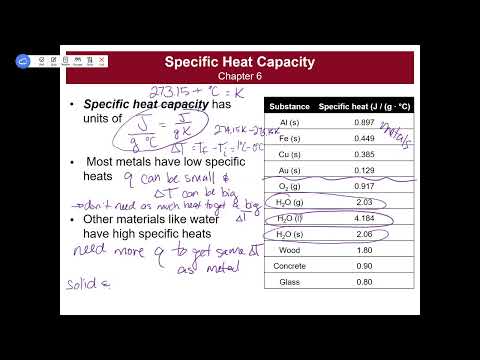
- Specific heat capacity is the energy needed to raise 1 g of a material by 1 degree, commonly expressed in J/(g·°C).
- A temperature difference has the same numerical value in Celsius and Kelvin, so ΔT can use either scale.
- For temperature differences, Fahrenheit is not interchangeable with Celsius or Kelvin.
- Molar heat capacity is expressed per mole, unlike specific heat capacity, which is expressed per gram.
- Metals such as aluminum, iron, copper, and gold have relatively low specific heat capacities, so modest heat input can produce a sizable temperature change.
- Liquid water has a high specific heat capacity, requiring more heat than a metal to produce the same temperature change.
- Water vapor, ice, and liquid water have different specific heat capacities, so the substance's phase matters when selecting a value.
- Liquid water's specific heat is 1 cal/(g·°C), equivalent to 4.184 J/(g·°C), a value provided on the formula sheet.
- Rearrange the relationship as C = Q/(mΔT), with ΔT calculated as final temperature minus initial temperature.
- For 5 g of copper receiving 150 J and warming from 20.0°C to 97.9°C, the calculated specific heat is about 0.385 J/(g·°C).
- Glass with the same heat input and mass warms less, giving a larger specific heat of about 0.840 J/(g·°C).
- Specific heat and temperature change are inversely related when heat and mass are held constant; subtract temperatures with appropriate decimal-place precision.
- A nickel practice problem asks students to isolate C from Q = mcΔT and substitute the measured heat, mass, and temperature change.
- The rearranged expression is C = Q/[m(Tf − Ti)], which follows directly from dividing both sides by mass and ΔT.
- The example uses 94.4 J, a 14.4 g sample, and temperatures of 23.4°C and 37.2°C.
- Altemose recommends calculating the temperature subtraction first and writing intermediate results down to avoid calculator-parentheses errors.
- A direct heat calculation uses Q = mcΔT without rearranging when Q is the unknown.
- To solve for final temperature, rearrange to Tf = Ti + Q/(mc).
- Label the supplied quantities as Q, mass, specific heat, and initial temperature before substituting them.
- The temperature-change expression must remain Tf − Ti so the sign reflects whether the material warmed or cooled.
- When objects at different temperatures touch, heat transfers from the hotter object to the cooler one until both reach the same final temperature.
- In the wood-at-25°C and aluminum-at-75°C example, equilibrium is below the 50°C midpoint because the materials have different heat capacities.
- For an insulated system, heat lost by the hotter object plus heat gained by the cooler object equals zero.
- The object with the larger temperature change has the lower specific heat when the heat exchange and masses are comparable.
- For a hot iron bar placed in water, iron is the system and water is the surroundings.
- The iron cools and has negative Q, while the water warms and has positive Q; their heat quantities have equal magnitudes in an insulated setup.
- At constant pressure, heat Q corresponds to enthalpy change ΔH.
- The example assumes no heat escapes into the beaker or surrounding air, so total heat transfer is zero.
- A 12.73 g platinum block starts at 10.37°C and is placed in 24.56 g of propylene glycol starting at 60.81°C.
- The glycol cools while the platinum warms, so their heat terms have opposite signs and share the same final temperature.
- Substitute each material's mass and specific heat into Q = mc(Tf − Ti), then distribute and combine the terms containing Tf.
- The algebra gives a final equilibrium temperature of approximately 59.5°C.
- A copper sample has a specific heat of about 0.385 J/(g·°C), a mass of 18.7 g, and supplied initial and final temperatures.
- Calculate copper's heat change with Q = mc(Tf − Ti); because the copper cools, Q for copper is negative.
- In the insulated model, the heat gained by the water is equal in magnitude and opposite in sign to the heat lost by the copper.
- The exercise highlights that solving for heat is simpler than solving for an unknown equilibrium temperature.
- Calorimetry measures heat exchange, and the calorimeter is the container or device used for the measurement.
- Constant-pressure coffee-cup calorimetry relates heat to ΔH; constant-volume bomb calorimetry relates heat to ΔE because volume work is zero.
- For coffee-cup calorimetry, ΔH per mole is obtained by dividing heat Q by the amount of substance in moles.
- The surroundings term can include water or solution heat, mcΔT, plus calorimeter heat, CcalΔT, when the calorimeter's heat absorption is not negligible.
Transcript excerpt
0:11 Howdy. Oh, let me try again. Howdy. Good morning. How are we doing today? Okay, it's Wednesday, halfway through the week. Uh, so just a reminder for everybody. So, we have homework due Monday night as usual and that that is going to be uh chapter 6 parts one and two definitely part three tentatively. We'll see how far we get this week. Um, [clears throat] I have dropin hours after class today and then there's a extra practice session slashdropin hours whatever you want to call it tomorrow at 1
0:59 in and same place ILSQ W20 204 the um Eric has SI sessions Tuesday, Wednesday, Thursday, so tonight and tomorrow 7:30 and uh he is out of commission so he's doing Zoom until further notice. Um, so you can join the SI sessions from anywhere. Uh, hop on between classes or something if you if you need to. Uh, the learning lab's open today and tomorrow as well. Um, lab assessments are this week. Some of you had it yesterday, some of you have it today, some of you have it tomorrow. Um, make sure you know when to go. I think it's just the regular start of lab time. And bring a calculator. They will not have calculators for you. So, bring a calculator. that is not your phone.
1:47 Um, exam 3 is graded. The answer keys will be posted by the end of the day. And there'll be another extra credit reflection just like all of the other exams. Um, that'll be due in a couple weeks. And here's a little puppy picture. I don't know if I showed you this one. I've lost track, but there's little puppy picture for you. Any questions on anything coming up? So now it's just going to be the lab
This is the start of the transcript. Save this video free for the whole transcript, searchable and time-coded.
In this course
Related notes
Summary, takeaways, and chapters were generated by AI from the video's transcript and may contain errors. The video belongs to its creator, Alicia Altemose.