CHEM 119 Fall 2026 - Chapter 6 (11202026)
Overview
Alicia Altemose explains constant-pressure coffee-cup calorimetry and constant-volume bomb calorimetry, showing how temperature changes, calorimeter heat capacity, and reaction stoichiometry determine heat and molar energy changes. She then introduces enthalpy as a state function and connects the sign of ΔH to endothermic and exothermic processes, including heat flow, phase changes, and bond breaking or formation.
Key takeaways
- In coffee-cup calorimetry, calculate the surroundings' heat from the solution and, when provided, the calorimeter: q_surroundings = mcΔT + C_calΔT; the reaction heat is the same magnitude with the opposite sign.
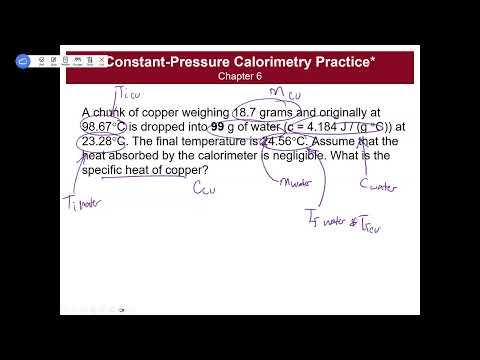
- The copper example yields a specific heat near 0.383 J/(g·°C) from 18.7 g of copper, a 98.67°C initial temperature, and a shared final temperature of 24.56°C.
- Bomb calorimetry uses q_bomb = C_calΔT; combustion heat is negative, and dividing by the combusted moles gives molar energy in kJ/mol.
- A stated temperature increase, such as 16.9°C in the acetylene exercise, is already ΔT and should not be recalculated from initial and final temperatures.
- Positive ΔH denotes endothermic heat absorption, while negative ΔH denotes exothermic heat release; reversing a process, such as boiling versus condensation, reverses the sign.
- Bond breaking absorbs heat and bond formation releases heat, so a reaction's ΔH reflects the net heat effects of the bonds changed.
Chapters
- Chapter 6 homework is due Monday before the break, and a six-point Canvas participation assignment is available after the break.
- Exam 3 is graded with an average of about 71; answer keys are posted in the Canvas exams module.
- The extra-credit Exam 3 reflection and participation assignment are due Monday, November 30.
- A coffee-cup calorimeter operates at constant pressure and typically uses nested Styrofoam cups, water or solution, a temperature probe, and a stir bar.
- The system is the reaction or hot metal; the measured solution and calorimeter are the surroundings.
- Total surroundings heat is the sum of solution heat, mcΔT, and calorimeter heat, C_calΔT; the calorimeter constant already includes its mass.
- The system and surroundings exchange equal amounts of heat with opposite signs: q_system = −q_surroundings.
- The example uses 18.7 g of copper initially at 98.67°C and 99 g of water initially at 23.28°C, with a shared final temperature of 24.56°C.
- Because the calorimeter's heat absorption is negligible, its C_calΔT term is omitted; the water absorbs about 534 J.
- Copper releases that heat, and dividing its heat change by 18.7 g and its final-minus-initial temperature change gives a specific heat near 0.383 J/(g·°C).
- Specific heat must be positive; consistently using final minus initial preserves the correct signs as copper cools and water warms.
- Students vote on a calf's name from choices including Sunshine, Cowbella, Pumpkin, and Dot.
- Dot wins the close poll with 302 responses, and Alicia Altemose suggests calling the calf Lil Dot.
- A bomb calorimeter burns a sample inside a sealed steel chamber surrounded by water in an insulated container.
- The reaction is the system; the bomb and surrounding water are treated as the surroundings, whose heat is calculated as C_calΔT.
- Combustion releases heat, so q_reaction = −q_bomb; at constant volume, volume-change work is zero and ΔE equals q.
- For molar energy of combustion, convert heat to kJ and divide by the moles combusted.
- The example gives a bomb-calorimeter heat capacity of 5615 J/°C and a water-temperature rise from 24.4°C to 27.1°C.
- Multiplying 5615 J/°C by the 2.7°C rise gives about 15,161 J, or 15.161 kJ, absorbed by the bomb.
- The reaction heat is negative; dividing it by the sample's calculated 0.0886 mol gives a molar combustion energy of roughly −171 kJ/mol.
- A negative combustion value identifies an exothermic reaction and can eliminate positive answer choices before detailed calculation.
- The practice problem uses C_cal = 8170 J/°C, 3.56 g acetylene, a molar mass of 26.04 g/mol, and a stated temperature increase of 16.9°C.
- Because 16.9°C is already the temperature change, no final-minus-initial subtraction is needed.
- Calculate q_bomb from C_calΔT, reverse its sign for the reaction, convert grams of acetylene to moles, and report the result in kJ/mol.
- The class selects answer D after converting the calorimeter heat to approximately 139 kJ and applying the negative sign for combustion.
- A state function depends only on initial and final states; elevation between floors illustrates this, while travel time and number of steps depend on the route.
- Enthalpy H is a state function, so ΔH = H_final − H_initial, or H_products − H_reactants for a reaction.
- At constant pressure, heat flow is associated with ΔH; at constant volume, the corresponding energy change is ΔE.
- Endothermic processes absorb heat into the system and have positive ΔH; boiling liquid water into vapor is an example.
- Exothermic processes release heat from the system and have negative ΔH; condensation is the reverse of boiling and therefore reverses the sign.
- An exothermic process warms the surroundings, while an endothermic process cools them; inward and outward heat arrows indicate the direction.
- The examples include forming water from hydrogen and oxygen as exothermic, and decomposing mercury oxide as endothermic.
- An enthalpy diagram that rises from reactants to products has positive ΔH, while a downward change has negative ΔH.
- A negative ΔH means heat leaves the reacting system, making the reaction exothermic; heat can be written on the product side.
- A positive ΔH means the system absorbs heat, making the reaction endothermic.
- Breaking bonds requires heat and forming bonds releases heat; reaction enthalpy reflects the combined effects and the amount of material reacting.
Transcript excerpt
0:03 Howdy. Good morning. Happy Friday. How are we doing today? Doing okay. Fantastic. Wonderful. So, just uh some reminders as usual. So, uh pretty sure we won't get to uh the chapter 6 part three stuff today. So, I pushed that one back. No rush. Um, so we'll do the rest of chapter 6, parts one and two. We did all of part one. We'll do the rest of part two today. And then, uh, that's homework is due Monday nights before the break. So, the break does not start this weekend, though some of you might think so. Um, so that
0:52 homework's due on Monday in three days. And then after the break, there's a participation assignment on Canvas for participation points. So if you've been worried about your clickers or your participation points in general, make sure you do that one. It's super easy and it's six points, so it's a big one. Uh I drop in hours after class. Um and then I'll have them Thursdays. cuz I didn't, you know, Thursday's a while from now, but I'll have it not next Thursday cuz that's Thanksgiving, but I will have it after class today and on Monday as well. Uh Eric is still holding his SI sessions. I imagine I think he might have one on Tuesday, but I'm not sure. Um if not, they'll be the following
1:39 week. Um and those are on Zoom until further notice. The learning lab opens up again on Monday for next week. Monday and Tuesday next week. Exam three is graded. The average was about a 71. Howdy. All right. Exam 3 is graded. The average was about a 71 if you wanted to know where you stand compared to other people. Though it doesn't matter. It's not a competition.
This is the start of the transcript. Save this video free for the whole transcript, searchable and time-coded.
In this course
Related notes
Summary, takeaways, and chapters were generated by AI from the video's transcript and may contain errors. The video belongs to its creator, Alicia Altemose.