CE 312 Lecture 27: Beam/Frame Deflections V, Frame Example, Shear Deformations (2026.10.21)
 Watch on YouTube →
Overview
Gregory Michaelson develops virtual work for frame deflections by combining axial and flexural contributions, then applies the method to a two-member frame with a 10 ft member AB and a 20 ft member BC. The calculated vertical deflection at A is 3.36 in from bending alone and about 3.37 in when axial deformation is included; Michaelson then explains how shear deformation enters virtual work and when deep members make it significant.
Key takeaways
- Frame virtual work can combine bending and axial terms, but the frame example gives 3.36 in of bending deflection versus only 0.01 in of axial deflection at A.
- A member's contribution to virtual work can be omitted when its virtual internal action is zero, as with member AB's bending term and member BC's axial term in this example.
- For the 20 ft member BC, the virtual moment is x2 - 20 and the real moment is 70x2 - 1.5x2² - 600, yielding a 3.36 in downward flexural displacement after integration.
- Shear deformation is more consequential as a beam becomes deeper relative to its span; an L/D ratio near or below 10 is a useful trigger for checking it.
- The W14×26 beam example has about 1.9% shear-related error, while the much deeper W36×135 example reaches about 10%, illustrating the effect of geometry on deflection estimates.
- Hand calculations and MASTAN results may differ because structural software can include shear deformation by default, an effect that becomes larger for deep members.
Chapters
- Gregory Michaelson schedules a complete moment-diagram and displacement problem for Friday's exam review.
- Homework 5-7 was accidentally configured out of 10 instead of 15 points, so completed submissions receive five additional points.
- Homework 6-3 and 6-4 are due Friday; 6-3 only requires proof that Mathcad is installed.
- Beam deflection uses the sum of integrals of virtual moment times real moment divided by EI; truss deflection uses virtual force times real force divided by EA.
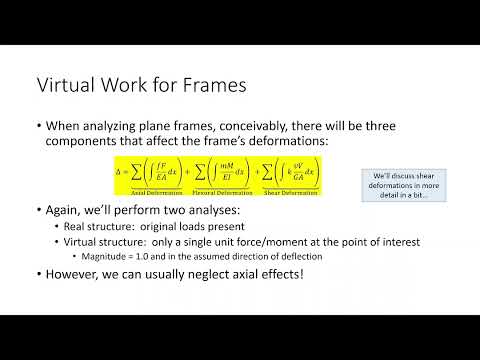
- A more general virtual-work calculation can include axial, flexural, torsional, thermal, and shear deformation contributions.
- For frames, Michaelson includes axial and flexural effects in the example, while setting shear deformation aside for later discussion.
- The frame has members AB and BC, with lengths of 10 ft and 20 ft, respectively; the target is the vertical displacement at A.
- A 1.0-unit downward virtual load at A produces support reactions at fixed point C of 1.0 vertical force and 20 moment, with zero horizontal reaction.
- For virtual member AB, the axial force is 1 over the full 0 to 10 ft span, while the moment is zero.
- The real frame carries 20 kip and 10 kip point loads plus a 3 kip/ft distributed load on the 20 ft member.
- The stated reactions at C are 20 kip horizontally, 70 kip vertically, and a 600 ft-kip moment.
- Real axial force in AB is 10 kip over 0 to 10 ft, but its real moment function is unnecessary because the virtual moment in AB is zero.
- Cutting virtual member BC and summing moments at the section gives M_BC = x2 - 20 over 0 to 20 ft; its axial force is zero.
- For the real member, the 3 kip/ft distributed load over length x2 contributes a resultant of 3x2 acting at x2/2.
- Summing moments gives real M_BC = 70x2 - 1.5x2² - 600 over 0 to 20 ft; the real axial force can be skipped because the virtual axial force is zero.
- The bending calculation integrates the product of the virtual and real BC moment functions over 0 to 20 ft; the AB contribution vanishes because its virtual moment is zero.
- Michaelson uses E = 30,000 ksi, I = 800 in⁴, and a 1728 unit-conversion factor for the ft-based integration.
- The resulting flexural displacement at A is 3.36 in downward.
- The axial virtual-work sum uses virtual force × real force × member length divided by EA; only member AB contributes.
- For AB, the values are virtual force 1, real force 10 kip, length 10 ft, E = 30,000 ksi, and A = 4 in²; multiplying by 12 converts the result to inches.
- Axial deformation is about 0.01 in downward, changing the total from 3.36 in to 3.37 in, so Michaelson recommends neglecting axial effects in many frame-deflection problems.
- Shear deformation can be added with an integral of virtual shear times real shear, using the shear modulus G, area A, and a shape factor.
- Real and virtual shear functions can be obtained by section analysis or by differentiating their corresponding moment functions.
- The shape factor is 1.2 for a rectangular section and 10/9 for a circular section, according to the conventions presented.
- Shear deformation becomes important for deep members; a practical warning threshold is an L/D ratio of roughly 10 or less.
- Examples include a short, deep hammerhead bridge pier and a transfer girder that carries loads from multiple building stories across an open lobby.
- For a 25 ft steel beam under 3 kip/ft, the W14×26 example has about 1.9% shear-related error, while the deeper W36×135 example reaches about 10%.
- MASTAN software may include shear deformation by default, so software results can differ from hand calculations depending on member geometry and whether that feature is enabled.
Transcript excerpt
0:04 Okay. Let me get the lights adjusted. Let's get started. I was a popular guy yesterday. That was a I know that was a pretty rough assignment, wasn't it? If it makes you feel better, I think that is the roughest assignment for the rest of the semester. The homework assignments from here on out are a lot more smooth. I was inspired by our last exam review to ask the following question. So, given you know, homework 6-2 and all that, I'm curious, would you like Here's what I was thinking. So, I'm going to between now and Friday get maybe like a practice problem ready for exam review on Friday, sort of like a start to finish problem. It seemed
0:52 like a lot of students like that instead of just like standing here and opening it up to questions. Now, of course, I'll answer any questions that you want during Friday, but do you all think that would be a valuable use of time to just do a problem, sort of a problem from start to finish? My thought is a problem where there's a little bit of a challenge on the moment diagram, but we also not only just draw the moment diagram, but also compute a displacement and we'll do it all in class on Friday. Does that sound good? Okay, we'll do that then. That'll That'll uh hopefully shake off some nerves for our celebration on Monday. Um okay, so with that, uh a couple housekeeping items, attendance grades are up to date. I still haven't gotten through uh the project submission. I was hoping to do it, but every time that I that I get to this point in the semester, I look at my
1:40 calendar and I've got all my advising appointments and it just eats up up my
This is the start of the transcript. Save this video free for the whole transcript, searchable and time-coded.
Related notes
Summary, takeaways, and chapters were generated by AI from the video's transcript and may contain errors. The video belongs to its creator, Gregory Michaelson.