CE 312 Lecture 17: Shear/Moment Diagrams II, Concentrated Loads (2026.09.25)
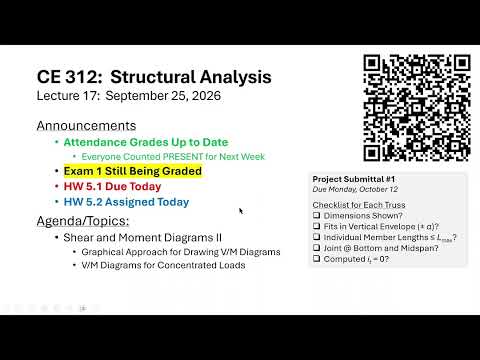 Watch on YouTube →
Overview
Gregory Michaelson explains how to build shear and moment diagrams for beams carrying concentrated loads, using the relationships between load, shear, and moment to derive each diagram graphically. A 30-foot beam example shows how signed load jumps create piecewise-constant shear, shear areas create piecewise-linear moment, and diagram closure checks equilibrium and recovers the internal forces at 12 feet from support A; the opening also covers exam grading, MASTAN2 setup, and truss-project requirements.
Key takeaways
- With concentrated loads and no load between them, shear is constant on each beam interval, jumps by the signed point-load magnitude, and produces linear moment segments.
- The moment-diagram slope equals shear, while the change in moment over an interval equals the signed area under the shear diagram.
- For the 30-foot example, the shear levels are +35.8, +15.8, -14.2, and -32.2 kips; the support reaction at the right end returns the shear diagram to zero.
- The signed shear areas, +214.8, +142.2, -99.4, and -257.6 kip-feet, sum to zero and bring the moment diagram back to zero, providing an equilibrium check on the reactions.
- At 12 feet from support A, the diagrams give V = +15.8 kips and M = 214.8 + 15.8(6) = +309.6 kip-feet, matching the section-cut result.
- The first truss-project submission requires three dimensioned designs that meet the geometric envelope and member-length limits, include a bottom midspan joint, and satisfy m + r = 2j for static determinacy.
Chapters
- Gregory Michaelson grades problem by problem and uses a correct-for-data approach, deducting for an error without penalizing later steps that correctly follow from it.
- Exam results will be emailed with problem-specific feedback; exams may be available for pickup if grading is completed before he leaves the country.
- Next week's prerecorded lectures are scheduled to premiere on YouTube Monday, Wednesday, and Friday at 10:00 a.m.; Blackboard attendance is already marked full for that week.
- The October 12 truss-project submission requires three dimensioned trusses, compliance with the vertical envelope and maximum member lengths, a bottom midspan joint, a determinacy check with m + r = 2j, and a write-up selecting among the designs.
- The construction sequence is load diagram to shear diagram to moment diagram.
- At a point, the shear-diagram slope equals the load, and the change in shear between two locations equals the signed load over that interval.
- At a point, the moment-diagram slope equals the shear, and the change in moment equals the signed area under the shear diagram.
- For the concentrated-load unit, Michaelson emphasizes using these graphical relationships rather than carrying out explicit differentiation or integration.
- Between point loads, the beam has zero load, so shear remains constant over each interval.
- A concentrated force creates a jump in the shear diagram equal to its signed magnitude.
- Because constant shear has a constant slope in the moment diagram, each moment segment is linear.
- The slope of each moment segment matches the shear value in that interval.
- Michaelson revisits a simply supported beam with spans of 6, 9, 7, and 8 feet, totaling 30 feet.
- Previously calculated internal values at 12 feet to the right of A are V = 15.8 kips and M = +309.6 kip-feet.
- He lays out vertical guide lines at key beam locations and labels the shear diagram in kips to keep the construction organized.
- Start at zero, jump up 35.8 kips at support A, and hold that value constant from A to C.
- The 20-kip load at C reduces shear to 15.8 kips; the 30-kip load at D reduces it to -14.2 kips.
- The 18-kip load at E reduces shear to -32.2 kips, and the right support reaction brings it back to zero.
- The diagram starts and ends at zero because the net vertical force on the beam must be zero for equilibrium.
- The four signed shear areas are +214.8, +142.2, -99.4, and -257.6 kip-feet, using interval widths of 6, 9, 7, and 8 feet.
- The areas sum to zero, consistent with the moment diagram returning to its starting value at the right end.
- Michaelson explains that a shear diagram can close even with incorrect reactions, but both shear and moment diagrams close only when the reactions satisfy equilibrium.
- The shear diagram therefore provides a vertical-force check, while the accumulated shear areas provide a moment-equilibrium check.
- Starting at zero, the first shear area raises moment to 214.8 kip-feet at C.
- The next positive area raises moment by 142.2 kip-feet to 357 kip-feet at D.
- The negative shear regions decrease moment by 99.4 and then 257.6 kip-feet, returning the diagram to zero.
- The moment slopes are +35.8, +15.8, -14.2, and -32.2 kips, matching the shear values in each interval.
- At 12 feet to the right of A, the shear is read directly from the diagram as +15.8 kips.
- The moment at that point starts from 214.8 kip-feet at C and increases across the next 6 feet by 15.8 kips times 6 feet.
- This gives M = 214.8 + 15.8(6) = 309.6 kip-feet, matching the earlier section-cut calculation.
- The diagram thus recovers internal forces without repeating a full equilibrium analysis at the section.
- Michaelson demonstrates another way to find the moment at the 12-foot section: add the shear-diagram areas to the left of the cut.
- The two rectangles are 35.8(6) and 15.8(6), totaling 309.6 kip-feet.
- He closes by noting plans to ask IT to address the dim classroom screen before the next in-person class.
Transcript excerpt
0:01 All right. $64,000 question I know is about the exam. I did uh everything I could last night to try and get the exam graded between uh then and you know start a class. It just didn't happen. I I was I stayed up for a while and I got about half of it graded and I I just didn't think I was going to get it done between uh now or then and now. So, I just sort of decided to punt and just sort of make sure I was ready for class. So, just so everybody is aware on a few things with the exam. So, u uh number one, uh I tend to grade on a problem by problem basis, not a student by student basis. So, um like I'll grade problem one for everybody, then problem two for everybody. Um so, I've gotten through uh like problem one and and problem two,
0:49 and largely everybody's doing pretty well on it. So, I'm I'm I'm so far I'm pretty happy with everybody's uh performance, but I haven't finished it yet. And so, I didn't want to rush through it. It just it does take me a little while to grade exams. Um I tend to use what's called a uh uh it's called a correct for data approach. And so, just to sort of make the point, um let's say you have a problem on an exam and it takes seven steps. And so, I'll start going through the calcs and let's say you have an error on step four. Well, if I have if I change the value on step four and I get everything that you're getting for steps five, six, and seven, then your error is only on step four, right? So, I will only deduct for the
This is the start of the transcript. Save this video free for the whole transcript, searchable and time-coded.
Related notes
Summary, takeaways, and chapters were generated by AI from the video's transcript and may contain errors. The video belongs to its creator, Gregory Michaelson.