CE 312 Lecture 14: Exam 1 Review (2026.09.18)
 Watch on YouTube →
Overview
Gregory Michaelson reviews CE 312 Exam 1, which has four problems: short conceptual questions and three longer problems covering stability and determinacy, support reactions, truss analysis, and virtual-work deflections. He explains the closed-book rules and student-made formula sheet, then works a three-member truss example that combines reactions, member forces, and a vertical deflection of 0.126 inches upward at joint B.
Key takeaways
- Exam 1 covers four skill areas: classifying stability and determinacy, calculating reactions, analyzing trusses, and finding deflections with real and virtual structures.
- The permitted formula sheet is one student-prepared 8.5-by-11-inch page printed or written on both sides; assembling methods and reminders is intended to function as studying.
- For the method of joints, choose a joint with at most two unknown member forces because planar joint equilibrium provides two equations; method of sections adds a moment equation.
- A truss deflection calculation requires two analyses, one under real loads and one under a unit load at the joint in the assumed displacement direction, followed by summing fFL/EA for members.
- In Michaelson’s worked example, only BC contributes to the virtual-work sum; using its 16-foot length and the stated material properties yields a 0.126-inch upward displacement at B.
Chapters
- Gregory Michaelson says Blackboard attendance and homework grades are current.
- He plans to distribute an “at home game” grade spreadsheet near semester’s end, after Exam 2 grades provide enough information to estimate the final-exam score needed.
- Exam 1 has four problems: one set of very short conceptual questions and three longer problems.
- Michaelson times each problem and uses a rule of three: a problem taking him 10 minutes should allow students about 30 minutes; points reflect the effort required.
- The exam is closed book and closed notes, but students may use a calculator and one self-prepared 8.5-by-11-inch sheet, front and back.
- The formula sheet should contain methods and reminders rather than fully worked examples; making it by hand helps students study, and Michaelson collects sheets bearing students’ names.
- Students must classify structures as unstable, statically determinate, or indeterminate, and give the degree of indeterminacy when applicable.
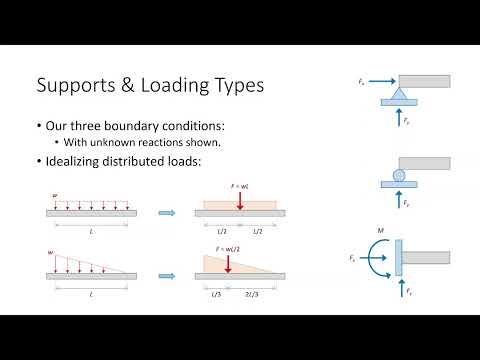
- Support-reaction problems may include concentrated forces and moments, distributed loads, pins, rollers, fixed supports, and internal hinges.
- Truss questions require either the method of joints or method of sections; students must also solve real and virtual trusses to calculate deflections.
- Michaelson reviews external and internal indeterminacy, load resultants at distributed-load centroids, inclined-force components, zero-force-member rules, and virtual work using Σ(fFL/EA).
- Michaelson analyzes a textbook truss with a 75-kip load, 12-foot and 16-foot dimensions, and E = 29,000 ksi and A = 5.25 square inches for every member.
- Using equilibrium, he obtains a 75-kip horizontal reaction at C, a 100-kip upward reaction at A, and a 100-kip downward reaction at C.
- Starting at joint C and then examining joint A, he identifies members carrying 75 kips and 100 kips in tension and the diagonal carrying 125 kips in compression.
- He notes that analyzing joint B instead confirms the diagonal’s 125-kip compressive force.
- To find vertical displacement at B, Michaelson removes the real loads and applies a unit virtual load downward at B.
- The virtual-load case gives zero force in members AB and AC, leaving member BC as the only nonzero contribution to Σ(fFL/EA).
- For BC, he uses a virtual force of 1, a real force of 100 kips, a 16-foot length converted to 192 inches, E = 29,000 ksi, and A = 5.25 square inches.
- The calculation gives a signed displacement of approximately −0.126 inches relative to the assumed downward direction, so joint B deflects 0.126 inches upward.
- Michaelson says the exam will begin promptly at 10:00, with a timer displayed on screen.
- A class uses the room at 11:00, so he plans to ask its instructor whether Exam 1 can run until 10:55.
Transcript excerpt
0:06 Okay, hold on. There's the slide. >> Okay, we are in exam one review mode. Let's get started. Um, so just a couple of housekeeping items. Uh everything on Blackboard is current which means your homework grade is current, your attendance grade is current. Um I also thought that I would paste a little table from the syllabus indicating the weight of the grade distribution. Um, one of the things that I tend to do, um, near the end of the semester, I had a a friend of mine in, uh, grad school, and he called this playing the at home game. What he would do is he would say, "Okay,
0:55 here's my attendance grade, here's my project grade, here's my homework grade, and then calculate what do I need to get on the final to get, you know, an A or a B or a C or whatnot." And so I create this spreadsheet for my class called the at home game. And I'll send that out near the end of the semester right before the final. So you can plug in your grades and go, I need to get a 74 on the final to make this cuz it always comes up. So um but it's a little early to do that now because there's not enough grade components. It really doesn't mean much until after we've uh returned exam two because then you know you can go seek it out. Um, what we're going to do today is go through uh sort of the structure and format of the exam and then I'll shut up and let everybody
1:42 ask whatever questions uh they have uh of me. Sound good? And did everybody get the code? Okay. All right. Okay. So, let's talk about the exam. Um so let's talk about the logistics and
This is the start of the transcript. Save this video free for the whole transcript, searchable and time-coded.
Related notes
Summary, takeaways, and chapters were generated by AI from the video's transcript and may contain errors. The video belongs to its creator, Gregory Michaelson.