CE 312 Lecture 16: Shear/Moment Diagrams I, Internal V/M (2026.09.23)
 Watch on YouTube →
Overview
Gregory Michaelson introduces internal shear and bending moment analysis as the basis for constructing diagrams used to design beams, then establishes the sign conventions and section-cut method needed to calculate internal forces. A worked beam section gives V = 15.8 kips and M = 309.6 kip-ft, while a differential-element derivation connects distributed load, shear, and moment to the graph shapes used in later lectures.
Key takeaways
- For a linear structure, multiplying every applied load by a factor multiplies every response by that factor; scaling only one load among several does not scale the full response uniformly.
- The chosen internal-force convention is downward positive shear and counterclockwise positive moment on a left-hand cut, with opposite directions on a right-hand cut.
- At the section 12 feet from A, the left segment's equilibrium gives V = 15.8 kips and M = 309.6 kip-ft.
- When a cut passes through a distributed load, calculate the resultant from only the retained portion; the illustrated partial load has a 13-kip resultant rather than 20 kips.
- For a beam element, dV = w dx and dM = V dx, linking load intensity to shear change and shear to moment change.
- Diagram shape can be inferred from these relationships: constant shear gives a linear moment segment, while linear shear gives a quadratic moment curve.
Chapters
- For a structure with a single 20-kip load, scaling the load scales every reaction and member force by the same factor.
- Michaelson notes that a virtual analysis can be obtained by dividing real-structure results by the applied load when only one load is present.
- Influence lines will apply the same linearity idea by moving a unit load across a structure and recording its response.
- Shear and moment diagrams plot the internal forces and moments that keep a beam in equilibrium.
- Design decisions such as beam depth, concrete rebar placement, and steel flange and web dimensions depend on maximum internal shear and moment.
- A concentrated force creates a jump in the shear diagram, while a concentrated moment creates a jump in the moment diagram.
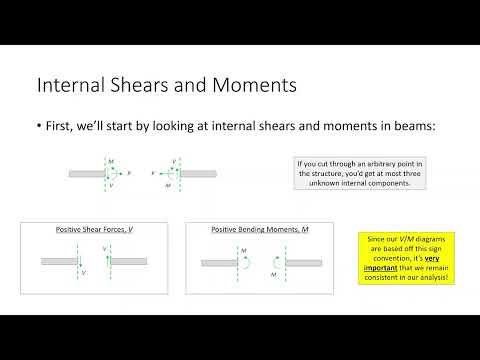
- On a left-hand section cut, positive shear points downward and positive moment is counterclockwise.
- On a right-hand section cut, positive shear points upward and positive moment is clockwise.
- The sign convention makes diagram values consistent: negative calculated shear or moment is plotted below the reference axis.
- The reused simply supported beam has a known 35.8-kip reaction at A; the cut is 12 feet from A, leaving a 6-foot segment to the 20-kip point load.
- Using the left segment and summing vertical forces gives an internal shear of V = 15.8 kips.
- Summing moments at the cut gives M = 35.8 × 12 − 20 × 6 = 309.6 kip-ft.
- A right-side cut produces the same positive shear when its own sign convention is applied.
- Replace a 2-kip-per-foot load over 10 feet with its 20-kip resultant at the 5-foot centroid only when analyzing the entire loaded length.
- If a section cut retains only part of that load, recompute the resultant from the retained load area.
- For the illustrated partial segment, the correct resultant is 13 kips, not the original 20 kips.
- Michaelson isolates an infinitesimal beam segment of width dx, treating a variable distributed load w as approximately constant across that tiny interval.
- Vertical-force equilibrium gives dV = w dx, or equivalently the rate of shear change is governed by the load intensity.
- Moment equilibrium, with the negligible higher-order dx-squared term discarded, gives dM = V dx.
- These relationships explain why load, shear, and moment diagrams have linked slopes and shapes.
- The integral of a constant shear is linear moment, so constant shear corresponds to a straight segment in the moment diagram.
- Positive shear produces a positive moment-diagram slope; negative shear produces a negative slope.
- Integrating linear shear produces a quadratic, curved moment segment, and a shear sign change marks a change in the moment curve's direction.
- The next class will develop shear and moment diagram patterns for concentrated loads.
- A prerecorded Monday lecture will cover distributed loads, followed by triangular load distributions.
- A linearly varying triangular load produces a curved shear diagram and a higher-order curved moment diagram.
Transcript excerpt
0:07 Okay. Let's get started. I understand I understand a number of you just got done with the an exam. I'm I'm hoping everything's okay, sensing a little bit of surface tension. I'm sure it was a very high pressure environment. Just uh make sure you take it easy and go with the flow. I'm such a dork, I know. Just wait. I mean like I we're not done with this. Just wait till you know we take a moment and pause and Yeah, I know. Y'all y- Y'all are just getting started with all these really bad cheesy puns. Okay. All right, everybody. Um so, just a
0:55 heads-up, no, I do not have your exam graded. I do have a goal of getting it to you by Friday, mainly for two reasons. As I mentioned that I'm going to be going out of the country next week. So, I would like to kind of have your exam graded by then, but also midterm grades are due on Monday and I'd I'd like to get the exams graded before I post those. So, um I did want to show you something though on the exam. I mentioned it to a couple people uh outside in the hall as we were waiting to for the room to be available. And it's not as if anybody did anything wrong, but there was a thing I did on the exam that I kind of wanted to just illustrate and there's a reason for it that'll become clear later. But I kind of wanted to show you something. So, um
1:42 just as a thought experiment. Okay, so let's say that you have a truss. So, I've got the same truss drawn two different ways. And let's say the truss only has this single 20 kip load on it.
This is the start of the transcript. Save this video free for the whole transcript, searchable and time-coded.
Related notes
Summary, takeaways, and chapters were generated by AI from the video's transcript and may contain errors. The video belongs to its creator, Gregory Michaelson.