CE 312 Lecture 03: Reactions I, Concentrated/Distributed Loads (2026.08.21)
Overview
Gregory Michaelson introduces support reactions as the starting point for analyzing beams, trusses, and frames, then solves two beam examples using force and moment equilibrium. He shows how to replace distributed loads with statically equivalent point loads using area and centroid: a 30-foot beam with concentrated loads gives reactions of 35.8 and 32.2 kips, while an overhanging beam with triangular and uniform loads gives reactions of 5.4 and 55.6 kips.
Key takeaways
- A pin-and-roller beam in planar equilibrium has three reaction unknowns, Ax, Ay, and By, solved using the three equations ΣFx = 0, ΣFy = 0, and ΣM = 0.
- Choosing a moment center at a support eliminates that support's reactions from the moment equation and can isolate the opposite support reaction.
- For the 30-foot concentrated-load example, moments about A total 966 kip-feet, giving By = 32.2 kips and Ay = 35.8 kips.
- A distributed load's statically equivalent resultant equals the area under its load diagram and acts at that diagram's centroid.
- A 2.4-kip-per-foot triangular load over 15 feet becomes an 18-kip resultant 5 feet from its high end; a 1.5-kip-per-foot uniform load over 22 feet becomes 33 kips at its midpoint.
- Equivalent point loads are appropriate for support reactions, but internal shear and moment diagrams must use the original distributed loading.
Chapters
- Homework 2.1 opens at 11:00 and is due Monday at 10:00 a.m.; its solution follows on Wednesday.
- Support reactions recur in analyses of trusses, beams, frames, internal forces, and deflections.
- The lecture builds from simple reaction calculations toward longer problems without changing the underlying method.
- Support reactions are external forces needed to maintain equilibrium, as illustrated by a 100-pound load on a table.
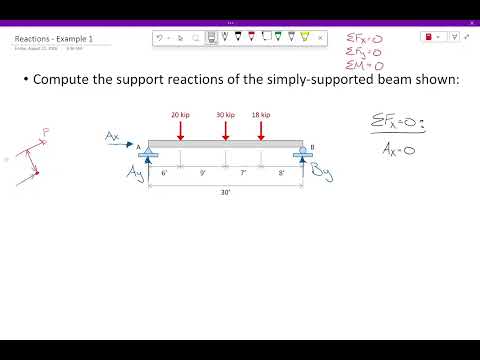
- A simply supported 30-foot beam carries concentrated loads of 20, 30, and 18 kips.
- Support A is a pin with horizontal and vertical reactions, while support B is a roller with one vertical reaction.
- Assume A's horizontal reaction points right and both vertical reactions point upward; an incorrect assumed direction produces a negative answer.
- The beam has three unknown reactions, Ax, Ay, and By, matched by three equilibrium equations.
- Because no applied load acts horizontally, summing forces in x immediately gives Ax = 0.
- Taking moments at a point eliminates forces whose lines of action pass through that point.
- For the simply supported beam, summing moments about A removes Ax and Ay, leaving By as the only unknown reaction.
- Michaelson organizes clockwise and counterclockwise moments in a table to track each force and its moment arm.
- About A, the 20-kip, 30-kip, and 18-kip loads have moment arms of 6, 15, and 22 feet, producing a combined 966 kip-feet.
- Setting 966 kip-feet equal to By times 30 feet gives By = 32.2 kips upward.
- Vertical equilibrium gives Ay = 35.8 kips upward; the complete reaction set is Ax = 0, Ay = 35.8 kips, and By = 32.2 kips.
- Building floor loads are often modeled as pressure over an area instead of representing every individual person as a separate point load.
- Illustrative design loads include about 40 to 50 pounds per square foot in a classroom and 80 pounds per square foot in a hallway.
- Fluid pressure increases with depth, creating triangular pressure distributions on retaining walls or dams; roof snow drifts can also be modeled as triangular loads.
- For support-reaction calculations, a distributed load can be replaced by a point force equal to the area under its load diagram, applied at the diagram's centroid.
- A uniform load of 2 kips per foot over 10 feet becomes a 20-kip force at the midpoint.
- A triangular load's resultant is one-half its base times its height and acts one-third of the base from the triangle's right-angle end.
- Equivalent point loads simplify reaction calculations, but shear and moment diagrams later require returning to the original load distribution.
- The second example uses an overhanging beam with the roller support moved inward, like a diving board; the equilibrium method remains unchanged.
- A 1.5-kip-per-foot uniform load over 22 feet becomes a 33-kip resultant at its midpoint, 11 feet from the load's end near support B.
- A triangular load with a 2.4-kip-per-foot peak over 15 feet becomes an 18-kip resultant, located 5 feet from its larger end.
- Summing moments about A includes the 18-kip resultant at 5 feet, a 10-kip point load at 22.5 feet, and the 33-kip resultant at 41 feet.
- The moment balance gives By = 55.6 kips upward; vertical equilibrium with 61 kips of total downward load gives Ay = 5.4 kips upward.
- Ax remains zero because the applied loads are vertical, and Michaelson asks students to include Ax = 0 in homework answers.
- The upcoming homework includes two similar problems with textbook images; later assignments will allow students to choose their own diagrams.
Transcript excerpt
0:04 All right, everybody. Lecture three. Let's get started. Um, so first homework was due. Pretty easy, right? Pretty straightforward. Did anybody have any major issues getting it submitted? I checked uh I want to say about an hour ago and uh out of the 50 people in here, it looked like 43 had it submitted. So it looked I'm guessing most everybody had it had a pretty smooth time getting it uploaded. So sounds good. Um solution is going to be posted for that on Monday and that's going to be the pattern for the semester. Right. So right now like if you logged on to Blackboard at this very minute um there are no homeworks that are due because we're talking about it now. So, we're going to have a lecture
0:51 now. And then homework 2.1 is going to be assigned today. It'll open at 11:00 and it'll be due on Monday at 10:00 a.m. And then that homework solution will be posted on Wednesday, right? Or uh yeah, and that'll be the the pattern. So, sound good. Okay. So, um, we're going to actually sort of dive right into our I guess what I don't want to say that our topic, um, yesterday or last lecture wasn't a real topic because it was a very important one, but at least computationally it was quite easy. So, uh, today what we're going to do is sort of dive into our first um, slightly computationally intensive uh, topic and that's the computation of support reactions. Um, everybody in here should have some experience with that from
1:40 statics. Um, although it might have been some time since you've done that. Uh, but what we're going to do is is really cover it uh in here. Um, one thing I'll say about the u the computation of
This is the start of the transcript. Save this video free for the whole transcript, searchable and time-coded.
In this course
Related notes
Summary, takeaways, and chapters were generated by AI from the video's transcript and may contain errors. The video belongs to its creator, Gregory Michaelson.