BIOL 105 Lecture 9 9/14/26
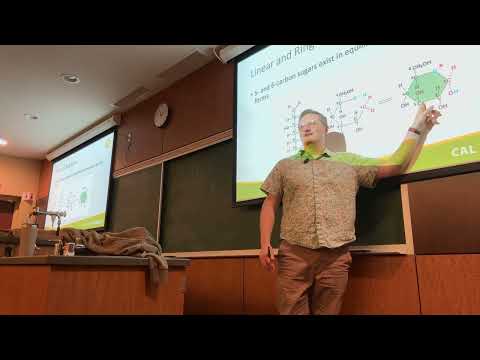 Watch on YouTube →
Overview
Jonathan Montgomery reviews the upcoming BIOL 105 midterm, then explains carbohydrate structure and function, including how glucose monomers form storage and structural polysaccharides. He compares starch, glycogen, cellulose, and chitin, then introduces lipids as hydrophobic molecules and explains how phospholipids and glycolipids contribute to cell membranes and cell recognition.
Key takeaways
- Starch, glycogen, and cellulose are all built from glucose, but different glycosidic linkages produce different structures and functions.
- Plants store carbohydrate mainly as starch, animals store it mainly as glycogen, and plants use cellulose as a principal cell-wall material.
- Cellulose digestion depends on specialized microbial partners in animals such as ruminants and termites, rather than on the animal’s own digestive enzymes alone.
- Chitin provides structural support in arthropod exoskeletons and differs from cellulose because its sugar monomer contains nitrogen.
- Phospholipid amphipathicity drives bilayer formation: hydrophilic regions face watery surroundings while hydrophobic regions remain inside the membrane.
- Glycolipids display carbohydrate labels on cell membranes, helping cells distinguish one another and contributing to blood-type recognition.
Chapters
- Midterm One is scheduled for the following Monday and has 25 multiple-choice questions worth 3 points each, for 75 points total.
- Students need a Scantron 882E or compatible form and a pencil; the exam is closed-note and covers lecture material, not lab content.
- The posted study guide lists about 25 topics; Montgomery recommends using it with the textbook and chapter-end practice questions.
- Carbohydrates primarily provide energy storage, while some, such as cellulose, provide structural support and resist breakdown.
- Most carbohydrates contain carbon, hydrogen, and oxygen, often in a ratio represented as CₙH₂ₙOₙ; for example, glucose is C₆H₁₂O₆.
- The key functional groups to recognize in carbohydrate diagrams are hydroxyl groups and carbonyl groups.
- Sugar names indicate carbon count: trioses have 3 carbons, pentoses have 5, and hexoses have 6.
- The suffix “-ose” commonly identifies sugars and carbohydrates, as in glucose, lactose, and cellulose.
- Sugars can occur in linear or ring forms; biological diagrams commonly show their more stable ring forms.
- Glucose, a six-carbon monosaccharide, is a central carbohydrate monomer and an important energy source.
- Dehydration synthesis joins monosaccharides: two glucose molecules form maltose, while glucose plus fructose forms sucrose.
- A glycosidic linkage connects monosaccharides; its specific arrangement helps determine a polymer’s shape and properties.
- When two glucose molecules form maltose, dehydration synthesis removes H₂O, leaving the formula C₁₂H₂₂O₁₁.
- A monosaccharide is one sugar unit, a disaccharide contains two, and a polysaccharide consists of many monosaccharides.
- Plants store carbohydrate energy mainly as starch, which is a glucose polymer and is more suitable for storage than free glucose.
- Starch includes amylose and branched amylopectin; branching helps starch form storage granules, such as those found in potatoes.
- Amylases are enzymes that break down starch; the “-ase” ending often identifies an enzyme, as in lactase for lactose breakdown.
- Animals store glucose primarily as glycogen, a branched glucose polymer structurally similar to amylopectin.
- When blood glucose is low, animals can break down glycogen and release glucose into the bloodstream.
- Cellulose is a glucose polymer that forms the primary structural component of plant cell walls.
- Starch and cellulose use glucose, but their glycosidic linkages and spatial arrangements differ, giving cellulose greater structural stability.
- Animals generally rely on symbiotic microorganisms to digest cellulose; examples include cellulose-digesting microbes in ruminant stomach compartments and termite guts.
- Trichonympha, a protist associated with termite digestion, is part of a complex gut symbiosis that helps termites access energy from wood.
- Chitin is a structural carbohydrate in arthropod exoskeletons; unlike cellulose, its monomer contains nitrogen.
- Some aquatic arthropods reinforce chitin-rich exoskeletons with calcium, producing harder structures such as crab shells.
- Lipids include fats, oils, and waxes; their nonpolar carbon-hydrogen-rich regions make them hydrophobic.
- Lipid functions include water repellence, long-term energy storage, insulation, cushioning around organs, and serving as precursors for steroid hormones.
- Phospholipids are amphipathic, with hydrophilic regions that interact with water and hydrophobic regions that associate away from it.
- In aqueous environments, phospholipids arrange into bilayers that form the primary structure of cell membranes.
- Glycolipids combine a lipid with a carbohydrate chain; the lipid embeds in the membrane while the carbohydrate can act as a cell-recognition label.
- Carbohydrate labels on cell surfaces contribute to immune recognition and blood-type differences.
Transcript excerpt
0:00 All right, the recording starts. It's September 14th. This is biology 105. Thank you all for making it to another lecture. Uh quick checkin on our schedule. You've got a midterm coming up. It's a week from today. All right. 25 questions, multiplechoice. The study guide is posted. It's a Scantron Examtron. Okay. So, you need to bring with you a Scantron 882E or compatible form. It's the long green one. All right. So, pick up one of these. You're going to have, I believe, three midterms. One, two, three midterms in this course and a final exam. And all
0:49 of them are going to use scantrons. They're great. You'll have your grades same day. That's the best thing about them. Okay. 25 questions, multiple choice, three points each question, 75 point midterm exam coming up a week from today. All right. Study guide is available. Exam one study guide posted right here. If you take a look at this, there's 25 questions. There's about 25 bullet points here. Okay? So, this is a comprehensive study guide. It tells you exactly what is going to be on that first exam. So there's no secrets. There's no tricks here. But you know, there's 25 different topics. So start you start working on it now. All right. It's all lecture. There are no lab things covered in the lecture exams.
1:40 Questions about the upcoming exam. Yes. >> Will we have one of those for all the exams? >> Yeah, you'll get one of these for each midterm and for the final. Awesome. Yes. >> Is there allow for card or >> if you have accommodations for a note card and you've sent me your accommodations memo then I can then then yes but not otherwise. Right. [snorts] So yeah, it's just spew the stuff out of
This is the start of the transcript. Save this video free for the whole transcript, searchable and time-coded.
Related notes
Summary, takeaways, and chapters were generated by AI from the video's transcript and may contain errors. The video belongs to its creator, Jonathan Montgomery.