BIOL 105 Lecture 10 9/16/26
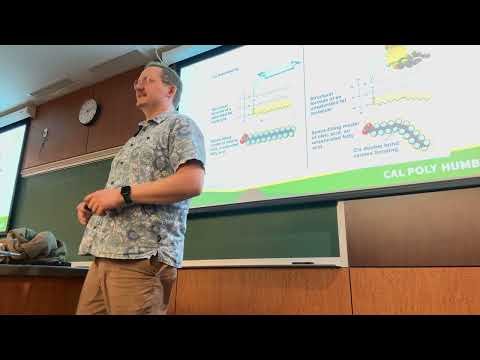 Watch on YouTube →
Overview
Jonathan Montgomery connects lipid structure to physical properties and cell membranes, explaining how fatty-acid geometry affects packing, why partial hydrogenation can produce trans fats, and how phospholipids and cholesterol behave in membranes. He then introduces protein functions, amino-acid side-chain interactions, peptide bonds, and the four levels of protein structure, while reviewing logistics for Monday’s 25-question, 50-minute midterm.
Key takeaways
- Cis double bonds bend fatty-acid chains and limit tight packing, helping explain why cis-unsaturated oils are often liquid at room temperature while saturated fats are often solid.
- Partial hydrogenation can create trans fats alongside saturated fats; the straighter trans chains pack densely and can enter the solid fraction during processing.
- A phospholipid bilayer forms a hydrophobic barrier between aqueous cell interiors and exteriors, preventing many polar molecules from crossing freely.
- Cholesterol embeds in the hydrophobic membrane interior and helps buffer membrane fluidity as conditions change.
- Enzymes determine which chemical reactions can occur in a cell, while transport proteins provide routes for hydrophilic substances across the lipid bilayer.
- Protein function depends on structure: amino-acid sequence and side-chain interactions shape folding through primary, secondary, and tertiary levels, and multiple polypeptides can assemble into quaternary structure.
Chapters
- Monday’s first midterm has 25 questions and a 50-minute limit; students need an A2E or equivalent Scantron and a pencil.
- Open scratch paper is allowed, and students can mark answers on the exam before transferring them to the Scantron.
- Lipids are hydrophobic because they are largely nonpolar; water is polar, illustrating the principle that like dissolves like.
- A fatty acid consists of a long hydrocarbon chain ending in a carboxyl group.
- Saturated fatty acids have no double bonds in the hydrocarbon chain and carry the maximum possible number of hydrogens.
- Unsaturated fatty acids contain one or more chain double bonds, which allow cis and trans isomers that differ in geometry.
- Cis double bonds bend the hydrocarbon chain, while trans double bonds leave it straighter, similar to saturated chains.
- Straight saturated and trans chains pack more tightly than bent cis chains, helping explain why butter is solid and olive oil is liquid at room temperature.
- A triglyceride consists of three fatty-acid chains attached to one glycerol molecule; the fatty acids are building blocks, not a repeating polymer chain.
- Each chain in a triglyceride can be saturated or unsaturated and may contain cis or trans double bonds.
- Saturated and trans fats pack more densely and tend to remain solid at higher temperatures than cis-unsaturated fats.
- Cis-unsaturated fats become liquid more readily, but olive oil can solidify when cooled in a refrigerator.
- Trans fats are triglycerides with at least one trans-unsaturated fatty-acid chain; their straighter structure lets them pack more like saturated fats.
- Montgomery links trans-fat consumption to plaque formation in blood vessels and notes that trans fats can be harder for the body to break down.
- Hydrogenation adds hydrogen to vegetable oils, making them more solid and shelf-stable; partial processing can also generate trans fats.
- Because trans fats pack with the solid fraction, they can be collected along with saturated fats during processing; the lecture also notes that hydrogenation methods have changed over time.
- Omega-3 and omega-6 fatty acids are described as essential because humans need them but do not produce them naturally; dietary sources include seafood and fish-oil supplements.
- The omega number refers to the position of the first double bond, counted from the omega end of the fatty-acid chain.
- A phospholipid resembles a triglyceride but has a phosphate-containing head in place of one fatty-acid chain.
- Phospholipid heads are hydrophilic and tails are hydrophobic, forming a bilayer whose hydrophobic interior restricts the passage of polar molecules between aqueous environments.
- Steroids are lipids with carbon-based ring structures; some, but not all, steroids function as hormones.
- A hormone is described as a molecule transported through the bloodstream that affects development or triggers responses.
- Cholesterol can embed in the hydrophobic region of the phospholipid bilayer because it is a lipid.
- Montgomery describes cholesterol as a membrane fluidity buffer that helps stabilize membranes when temperature or energy changes.
- Proteins perform structural and cellular roles, including forming muscle tissue, keratin in hair and nails, and components embedded in cell membranes.
- DNA directs RNA synthesis, and RNA directs protein synthesis; Montgomery emphasizes proteins as major contributors to organism and cell function.
- Enzymes are biological catalysts that enable particular chemical reactions, so their presence or absence helps determine which reactions occur in a cell type.
- Protein categories covered include amino-acid storage, transport, defense, hormones, receptors, motor and contractile activity, and structural support; transport proteins can provide channels across membranes.
- Amino acids share a core structure with an amino group, a carboxyl group, a central alpha carbon, and a variable side chain or R group.
- Side-chain chemistry determines whether amino acids are nonpolar, polar, positively charged, or negatively charged.
- Hydrophobic side chains can cluster away from water, while oppositely charged side chains can attract and help shape a protein.
- Dehydration synthesis joins amino acids with peptide bonds; a protein chain is also called a polypeptide.
- Primary structure is the amino-acid sequence, which sets up the interactions that contribute to the protein’s final shape.
- Secondary structure includes alpha helices and pleated sheets formed through interactions involving the polypeptide backbone.
- Tertiary structure results from interactions among amino-acid side chains and folds a polypeptide into a three-dimensional form.
- Quaternary structure forms when two or more fully folded polypeptide chains assemble into a functional protein; Montgomery plans to continue with this topic and cell structure on Friday.
Transcript excerpt
0:00 Okay, recording biology 105. It is September 16th. Here we are. Okay, don't forget folks, you've got your first midterm on Monday. You need a scantron form. The scantron is scanron a2e or equivalent. Cool. So, I see somebody's got one right there. going to hold that up in the pie so everybody can see what they look like. That's what the scantrons look like. Very good. Thank you so much. Also, don't forget to have a pencil. Okay. Any questions about that? The study guides already available. Yes. >> Same room, same time. >> Same room, same time, 50 minute limit,
0:47 you know. Yep. Exactly. 25 questions, 50 minutes. There [snorts] you go. Safe. Any other questions about that stuff? Yes. Can you use a open sheet of paper for like doing formulas and equations? >> Totally. You can have bl scratch paper as much as you'd like. You can also write all over the exams. Uh, and if you really don't like using scantrons, one solution is read the exam, circle your answers, and then copy those onto the onto the scantron. I know it sounds simple, but sometimes folks don't think about doing that, you know. Um, yeah. Any other questions there? >> Yes. >> Are we not? >> Nope. all out of your noggin. >> Yeah. So, just review that study guide a bunch. Use the lecture slides. Use the textbook. You'll do well. Hope I hope
1:35 you do well. I hope it's I hope you have a great time. All right. Uh otherwise, let's go ahead and get through the material. It's going to be on that exam. If you remember on Monday, we were in our biological macroolecules talk and we were talking about lipids. Okay. the lipids. They are the fats, the oils, the
This is the start of the transcript. Save this video free for the whole transcript, searchable and time-coded.
Related notes
Summary, takeaways, and chapters were generated by AI from the video's transcript and may contain errors. The video belongs to its creator, Jonathan Montgomery.