BIOL 105 Lecture 23
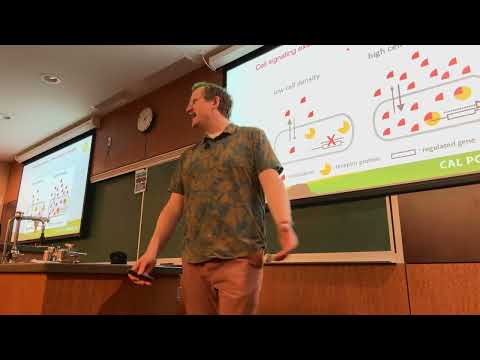 Watch on YouTube →
Overview
Jonathan Montgomery explains how cells detect signals and convert them into responses, covering communication modes, membrane and intracellular receptors, kinase cascades, and second messengers. He also outlines the week nine respiratory and stomatal conductance lab, where students use Excel to analyze class data, make two graphs with error bars and p-values, and submit the figures as a PDF.
Key takeaways
- Cell-surface receptors are generally needed for large or hydrophilic signals, while small hydrophobic steroid hormones can cross the phospholipid bilayer and bind intracellular receptors.
- G proteins switch between active GTP-bound and inactive GDP-bound forms, providing a molecular relay from a G-protein-coupled receptor to downstream targets.
- Receptor tyrosine kinases dimerize and phosphorylate multiple target proteins, enabling one signal to trigger several coordinated cellular responses.
- Kinase cascades amplify signals because each activated kinase can activate many downstream molecules; phosphatases reverse phosphorylation by removing phosphate groups.
- Second messengers such as cAMP and calcium diffuse inside cells to reach multiple targets, converting a receptor event into a broad cellular response.
- For the week nine lab, students must analyze their section's shared data in Excel, produce two graphs with error bars and statistical information, and submit a PDF rather than an Excel workbook.
Chapters
- Students who scored below 70% on an exam can complete a report to recover half of the points they missed.
- The respiratory and stomatal conductance lab requires students to enter their measurements in a shared Google spreadsheet before leaving lab.
- Students download their section's data into Excel, create two graphs with error bars and statistical information including p-values, then upload the figures as a PDF.
- Excel and Microsoft Office are available to students through Cal Poly Humboldt, and campus library computers are an alternative.
- Gap junctions, autocrine signaling, paracrine signaling, endocrine signaling, and synaptic signaling provide different routes for cells to communicate.
- Endocrine signals travel through the bloodstream, while synaptic signaling uses electrical activity for rapid communication such as muscle activation.
- In bacterial quorum sensing, signaling molecules let bacteria detect population density and can trigger behaviors such as host attack.
- Signal transduction changes a signal's form after reception, allowing an external cue to trigger an internal cellular response.
- The common sequence is reception, intracellular signal relay, and response, such as changing gene transcription or activating an enzyme.
- Small hydrophobic signals, including steroid hormones, can cross the phospholipid bilayer and bind intracellular receptors; large or hydrophilic signals generally require cell-surface receptors.
- A G-protein-coupled receptor activates its associated G protein after binding an external signaling molecule.
- A G protein is active when bound to GTP and inactive when bound to GDP; GTP hydrolysis returns it to the inactive state.
- Activated G proteins can relay the signal by activating an enzyme, eventually changing protein activity or gene transcription.
- Receptor tyrosine kinases dimerize after signal binding, bringing their kinase domains together to phosphorylate target proteins.
- Kinases transfer phosphate groups from ATP to other molecules, often changing the target protein's activity.
- Multiple phosphorylated sites can activate different relay proteins and produce several responses, which helps explain how growth-factor signals coordinate complex cell growth.
- A ligand-gated ion channel opens when its ligand binds, allowing ions to cross the membrane down their concentration gradient without direct energy input.
- Calcium stored in a compartment such as the endoplasmic reticulum can flood into the cytoplasm when an ion channel opens and activate many cellular processes.
- Steroid and thyroid hormones are small, hydrophobic signals that can cross the membrane and bind intracellular receptors that act as transcription factors.
- Endocrine disruptors such as BPA can mimic hormones and activate inappropriate signaling, unlike an inhibitor that specifically blocks a process.
- Signal transduction pathways can branch, letting one receptor activate multiple relay proteins and coordinate distinct responses.
- A phosphorylation cascade amplifies a signal: one activated kinase can activate many more kinases, ultimately affecting thousands of enzymes or proteins.
- Protein kinases add phosphates from ATP, while protein phosphatases remove them; phosphorylation often acts as an on-off switch.
- Regulation at multiple pathway steps allows the cell to coordinate responses or inhibit a signal before it reaches its endpoint.
- Second messengers spread within the cell and activate multiple targets; examples include cyclic AMP, membrane lipid derivatives, nitric oxide, and calcium ions.
- Adenylyl cyclase converts ATP into cyclic AMP, which can diffuse through the cell and relay signals; cAMP also features in textbook explanations of caffeine responses.
- Cells can generate second messengers from abundant resources, such as ATP or membrane phospholipids, to rapidly increase signaling.
- In one pathway, a G protein activates phospholipase C, which breaks down a phospholipid to produce a second messenger that opens a calcium channel.
- Signals ultimately change gene expression or metabolism by activating or inhibiting transcription factors and enzymes.
- A phosphorylation cascade can activate a transcription factor, which then initiates transcription of a specific gene.
- Other possible outcomes include cell growth or cell death, depending on the signal and the pathway activated.
- The lecture closes by previewing continued work on signal-response pathways in the next class.
Transcript excerpt
0:00 recording begins. It is October 21st, 2026. This is biology 105. All right. So, here we are in week nine. You just had your second exam. Okay. Uh you should all have seen my announcement about um extra credit opportunities in this class. They're available if you get under 70% on an exam. You can do this report to make up half of the points that you missed. Okay. All the details are in the announcement right here. I do have office hours today after lecture and you're welcome to come and drop by and get your scantron, you know, and get a copy of the exam. But part of
0:50 the deal is you have to come to my office. All right? So, just to make it feel more approachable. That's part of the extra credit is actually showing up in person to the office. So before you send a message, I won't bring it to the lecture unless you have some very extenduating circumstances. If you can't make my office hours, check the syllabus, get your get my office hours and shoot me an email. Okay, cool. Any questions about that extra credit opportunity? You can technically do it for any of the midterms, but I recommend doing it now because near the end of the semester, it's going to be more difficult to motivate to do something like this if I'm being honest with you. Question, please. >> Uh, your office is that cabin right outside. >> Yeah, the cabin. Yeah. Yeah. Yeah. Yeah. Yeah. It's in Brooklyn's house, second
1:36 floor. Totally. I'm going to be walking there right after lecture. So, if you know, even if you don't want to grab your exam, you can watch where I go. Just hang out in the bush, watch where I
This is the start of the transcript. Save this video free for the whole transcript, searchable and time-coded.
Related notes
Summary, takeaways, and chapters were generated by AI from the video's transcript and may contain errors. The video belongs to its creator, Jonathan Montgomery.