BIOL 105 Lecture 24 10/23/26
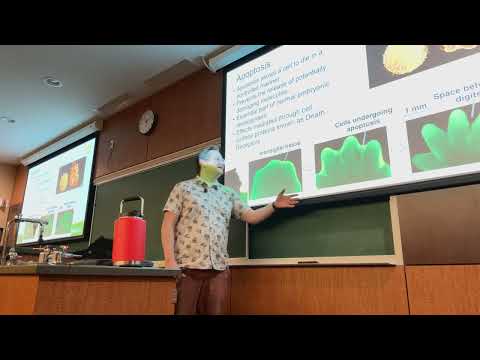 Watch on YouTube →
Overview
Jonathan Montgomery explains how cell signals produce gene-expression, metabolic, growth, and apoptosis responses, then connects signal amplification and specificity to the cell division concepts that follow. He introduces mitosis and meiosis, explains haploid versus diploid cells and somatic versus germ cells, and frames chromosome replication and distribution as the central challenge of the cell cycle.
Key takeaways
- A phosphorylation cascade can turn one epinephrine signal into approximately 100 million glucose molecules by activating successive groups of G proteins, kinases, and glycogen-breakdown enzymes.
- The same signaling molecule can produce different outcomes in different cells because receptor types and downstream pathways vary, and pathway cross-talk can suppress or redirect responses.
- Apoptosis is controlled cell death that supports both organismal development, such as removing tissue between forming fingers, and the removal of malfunctioning cells.
- Mitosis preserves chromosome ploidy and aims to create two genetically matching daughter cells, whereas meiosis reduces ploidy and produces four nonidentical haploid gametes.
- Ploidy refers to the number of copies of each chromosome, not the number of distinct chromosome types; human somatic cells are typically diploid with 46 chromosomes, while sperm and eggs are haploid.
- Accurate chromosome replication and distribution are central to cell division because daughter cells that lack the correct chromosome complement are usually not viable.
Chapters
- Jonathan Montgomery notes the class is ahead of schedule and reminds students that the next midterm is November 16, followed by a final and lab final.
- The lecture resumes cell communication, reviewing membrane and intracellular receptors and signal transduction through G proteins, relay molecules, phosphorylation cascades, and second messengers.
- Phosphorylation cascades can activate transcription factors, which bind DNA and promote gene expression.
- Second messenger cyclic AMP can activate kinases that ultimately activate glycogen breakdown, releasing glucose the cell can use.
- Growth factors stimulate cell growth and often division, while apoptosis is controlled cell death that limits damage to neighboring cells.
- Apoptosis removes interdigital tissue during finger development and can eliminate aged or malfunctioning cells; defective death receptors can prevent a cell from receiving the death signal.
- One epinephrine molecule binds a G-protein-coupled receptor, which can activate about 100 G proteins.
- Activated G proteins stimulate adenylate cyclase; the resulting cascade produces about 10,000 cyclic AMP molecules and activates increasing numbers of kinases.
- The cascade can yield roughly 1 million active glycogen phosphorylase enzymes and about 100 million glucose molecules from the original signal.
- Amplification works because enzymes catalyze multiple reactions rather than being consumed, allowing a small signal to trigger a large cellular response.
- A cell can respond to a signaling molecule only if it has the corresponding receptor.
- Different receptor types can bind the same signal but trigger different responses in different cells.
- One receptor can activate multiple relay pathways, while cross-talk lets one signal inhibit a response triggered by another.
- Montgomery illustrates pathway cross-talk with a hypothetical red-triangle energy source that is used only when a preferred green-circle source is unavailable.
- Scaffolding proteins hold components of a signal-transduction pathway close together, reducing reliance on random collisions in the cytoplasm and speeding signaling.
- Changes to genes encoding receptors or scaffolding proteins can alter cellular responses, illustrating how protein mutations may have broad consequences.
- Montgomery emphasizes that different receptors help explain why cells can respond differently to the same signaling molecule.
- In single-celled organisms, binary fission creates two daughter cells that are independent organisms; in multicellular organisms, division supports development, growth, repair, and renewal.
- Repair replaces cells lost through damage such as a cut, whereas renewal continually replaces aging cells.
- Mitosis is replicative and makes copies; meiosis generates gametes for sexual reproduction.
- Montgomery recommends The Stuff of Life, a graphic guide to genetics, and describes how sexual reproduction creates variation that can help populations resist disease.
- Mitosis aims to produce two daughter cells with the same genetic material as the mother cell; the mother cell becomes the two daughters.
- Ploidy counts copies of each chromosome: haploid cells have one copy of each, while diploid cells have two copies, abbreviated 2N.
- Human sperm and egg cells are haploid; fertilization combines them to form a diploid zygote.
- Meiosis reduces ploidy and produces four haploid, nonidentical daughter cells, while mitosis preserves the starting cell's ploidy.
- Somatic cells are diploid body cells, such as skin and liver cells, and divide by mitosis rather than producing gametes.
- Diploid germ cells undergo meiosis to generate haploid sperm or egg cells.
- A gamete has half the chromosome complement of a diploid cell, so fertilization restores the diploid complement.
- A genome is all genetic material in a cell or organism; eukaryotic nuclear DNA is organized into multiple linear chromosomes.
- Prokaryotes typically have one circular chromosome, while a diploid human cell has 46 chromosomes arranged as 23 pairs.
- Before division, chromosomes must be replicated and accurately distributed so each daughter cell receives a complete set.
- A karyotype displays condensed chromosomes; the example shown is a human diploid karyotype with two X chromosomes.
Transcript excerpt
0:00 Recording begins. It is October 23rd. Boo, it's so close to a spooky time. Uh, it's 2026 and this is biology 105. Uh, we're going to crush cell communication today. No problem. That's going to push us into cell division. That's going to put us like half a lecture ahead. That's incredible in biology 105 and I'm so excited about it. Um, I want to keep you posted on where we are in the schedule. Since we're a little bit ahead, we have a second to double check all this stuff, right? How'd that lab go? Was good. I see lots of thumbs up. Okay, sick. Solid. Fewer people. I didn't A lot of people touch cockroaches. Is that okay? Yeah, they're It was difficult the
0:48 first time I had to do it. I kind of gross, but [clears throat] they're fun. It's a fun lab. Anyway, I hope you enjoyed it. Don't forget that you have to, you know, you get to gain more experience in Excel analyzing data. Follow my video tutorial. I'm going to actually have you do a statistical analysis, which is kind of cool. All right. Anyway, uh, are there any Oh, yeah. And then I want to remind everybody that we do have three midterms in this class. So, your next one is November 16th. I guess that's like three weeks away. just under a month away, right? Uh and then we do have a final and a lab final. Are there any questions about any of that stuff? Your upcoming midterm, final, anything, lab final, anything
1:36 like that? Are we all squared away? [snorts] Okay, we're good then. Let's go ahead and get back into the PowerPoint. cell communication. Okay, we've been talking about cell about receptors, how there can be membrane receptors and there can also be
This is the start of the transcript. Save this video free for the whole transcript, searchable and time-coded.
Related notes
Summary, takeaways, and chapters were generated by AI from the video's transcript and may contain errors. The video belongs to its creator, Jonathan Montgomery.