BIOL 105 Lecture 12 9/23/26
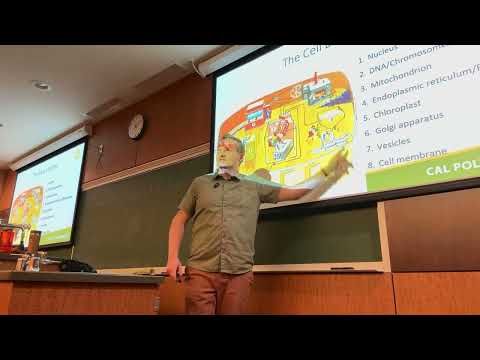 Watch on YouTube →
Overview
Jonathan Montgomery explains how eukaryotic cell structures support compartmentalization, transport, and cellular work, using the cell-as-factory analogy and comparisons between plant and animal cells. The lecture connects phospholipid bilayer properties to diffusion and active transport, then surveys the nucleus, ribosomes, endoplasmic reticulum, Golgi apparatus, lysosomes, and the accepted endosymbiotic explanation for mitochondria and chloroplasts.
Key takeaways
- The hydrophobic core of a phospholipid bilayer lets cells maintain different internal and external conditions, while limiting the free passage of polar, water-soluble substances.
- Diffusion moves materials down concentration gradients without ATP, whereas active transport consumes energy, primarily supplied by ATP, to move materials against gradients.
- Plant cell walls provide structural support, and water stored in the central vacuole generates turgor pressure that helps keep leaves and other tissues firm.
- The endomembrane pathway coordinates protein handling: ribosomes on rough ER produce proteins, and the Golgi modifies, labels, sorts, and ships them in vesicles.
- Lysosomal enzymes work in an acidic compartment; if the compartment leaks, the surrounding cytoplasm can neutralize the enzymes and reduce their activity.
- Endosymbiotic theory explains mitochondria and chloroplasts as descendants of formerly free-living prokaryotes that became mutually dependent with ancestral eukaryotic cells.
Chapters
0:00
Exam Updates and Lab Skills That Will Be Tested
- Exam one grades are posted; students who see a zero should contact Jonathan Montgomery in case scantrons were stuck together.
- There is no lab assignment or reading quiz this week, but Thursday's lab material will appear on the lab midterm and final.
- Students should complete the lab protocol and understand how to determine an isotonic point and use a line of best fit.
2:00
Prokaryotic Cells, Eukaryotic Cells, and the Endomembrane System
- Prokaryotes lack a membrane-bound nucleus and other membrane-bound organelles, but have ribosomes for protein production.
- Eukaryotic cells have membrane-enclosed compartments whose boundaries are phospholipid bilayers.
- Membrane compartments and vesicles can connect when bilayers fuse, enabling cargo to move between cellular locations.
5:40
The Cell-as-a-Factory Model for Organelle Functions
- The factory analogy maps the nucleus to headquarters, DNA to blueprints, and mitochondria to power generators.
- Ribosomes produce proteins, while the endoplasmic reticulum provides a production-associated membrane system.
- The Golgi apparatus modifies, sorts, and packages products into vesicles for delivery; vesicles and vacuoles transport or store materials.
- In photosynthetic eukaryotes, chloroplasts make sugars that mitochondria can use to generate cellular energy.
11:20
Plant and Animal Cell Differences: Walls, Chloroplasts, and Turgor
- Both plant and animal cells have a nucleus, endoplasmic reticulum, Golgi apparatus, and mitochondria.
- Plant cells characteristically have chloroplasts, a large central vacuole, and a cell wall outside the plasma membrane.
- In a hypertonic solution, water leaves a plant cell and its membrane pulls away from the rigid wall, a process called plasmolysis; animal cells can shrink by crenation.
- Water filling the ion-rich central vacuole supports turgor pressure, helping plant tissues stay firm despite lacking a skeleton.
16:57
Phospholipid Bilayers as Selective Barriers
- The plasma membrane's hydrophobic interior is the main barrier to movement between aqueous compartments.
- Small nonpolar molecules such as oxygen can cross the bilayer readily, and hydrophobic steroid hormones can pass through it.
- Polar, water-soluble molecules generally do not cross freely; membrane proteins and other embedded components provide additional functions.
- Membrane proteins, cholesterol, glycoproteins, and glycolipids are associated with the bilayer, with hydrophobic regions helping embed molecules in it.
23:00
Diffusion, Osmosis, and ATP-Powered Active Transport
- Diffusion moves molecules down a concentration gradient, from high to low concentration, without requiring cellular energy.
- Water crosses membranes despite the hydrophobic bilayer interior because it is abundant and can also travel through aquaporin channels.
- Active transport uses energy to move substances against concentration gradients and build up concentration differences.
- ATP is identified as the cell's primary energy currency for active transport.
30:28
Nuclear Pores, RNA, Ribosomes, and the Endoplasmic Reticulum
- The nuclear envelope has inner and outer membranes, and regulated nuclear pore complexes control movement into and out of the nucleus.
- RNA is a key cargo exported through nuclear pores; the nucleolus is a site of ribosomal RNA production and ribosome assembly.
- Ribosomes, made of ribosomal RNA and protein, read messenger RNA to assemble amino acids into polypeptides.
- Rough ER has attached ribosomes and is associated with protein production; smooth ER lacks ribosomes and supports other functions, including lipid synthesis and calcium storage.
37:38
Golgi Sorting, Lysosomal Digestion, and Cellular Recycling
- The Golgi apparatus modifies products received from the ER, packages them into vesicles, and adds labels that guide their destinations.
- Vesicle attachment sites can connect cargo to motor proteins, which use ATP to move along cytoskeletal elements.
- Lysosomes contain hydrolytic enzymes that digest material after fusion with food vacuoles; their acidic interior helps keep the enzymes functional.
- Phagocytosis brings large material into a cell, while autophagy encloses and breaks down damaged components such as malfunctioning mitochondria.
46:32
Endosymbiosis and the Origins of Mitochondria and Chloroplasts
- Endosymbiotic theory proposes that mitochondria and chloroplasts descended from free-living prokaryotes that remained inside ancestral host cells.
- An aerobic bacterium could provide ATP, while a photosynthetic cyanobacterium could supply sugars to its host.
- Over time, the host cells and these internal organisms became dependent on one another, yielding organelles that no longer live independently.
- Membrane infolding may have helped form the nucleus, but the lecture notes that the precise sequence of early cell-evolution events is uncertain.
Summary, takeaways, and chapters were generated by AI from the video's transcript and may contain errors. The video belongs to its creator, Jonathan Montgomery.