BIOL 105 Lecture 11 9/18/26
 Watch on YouTube →
Overview
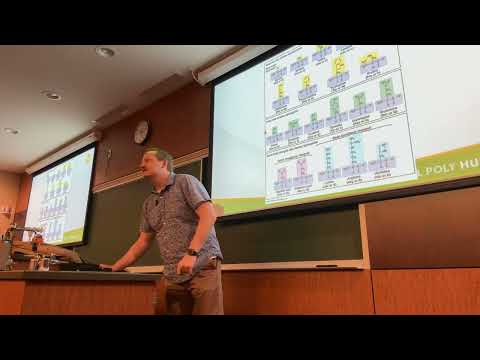
Jonathan Montgomery reviews protein structure and denaturation, nucleotide chemistry and DNA organization, then introduces cell types, size limits, and phagocytosis. The lecture emphasizes how amino acid sequence can alter protein shape and function, how DNA differs from RNA, and why surface-area-to-volume ratio limits cell size; it also flags the Monday midterm and its 882E-compatible scantron requirement.
Key takeaways
- A protein's amino acid sequence determines its side-chain composition, which affects folding; a single sequence change can alter hemoglobin interactions and red blood cell shape.
- Protein denaturation changes structure and therefore function; heat, salts, and extreme pH can cause it, as seen when egg albumin cooks or acid curdles milk.
- DNA and RNA differ in both sugar and one base: DNA has deoxyribose and thymine, while RNA has ribose and uracil.
- DNA's complementary strands run antiparallel, with a 5′ end opposite a 3′ end; DNA synthesis extends a strand at its 3′ end.
- Cell size is constrained by surface-area-to-volume ratio because exchange across the membrane must supply metabolism and remove waste.
- Phagocytosis encloses external material in a food vacuole, which fuses with an enzyme-filled lysosome for digestion.
Chapters
0:00
Week Four Setup and Monday Midterm Logistics
- May, the SI leader, is holding a Saturday review session, with contact information available in the syllabus.
- The first midterm is scheduled for Monday during the regular lecture time.
- Students should bring a pencil and a skinny 882E-compatible scantron, often green or blue.
1:58
Protein Structure Levels, Hemoglobin, and Denaturation
- Primary structure is the amino acid sequence; secondary structure forms backbone hydrogen bonds, including alpha helices and pleated sheets.
- Tertiary structure comes from side-chain interactions, while quaternary structure forms when multiple folded polypeptides associate.
- Structural stability generally declines from primary to secondary to tertiary to quaternary; heat, salts, and extreme pH can disrupt protein structure.
- A mutation that changes hemoglobin's primary structure can expose hydrophobic regions, promote aggregation, and contribute to sickle-shaped red blood cells.
13:26
Nucleotide Chemistry, DNA Pairing, and Antiparallel Strands
- Nucleotides contain a sugar, phosphate group, and nitrogenous base; the repeating sugar-phosphate backbone supports a sequence of bases.
- DNA uses deoxyribose and bases A, T, C, and G; RNA uses ribose and substitutes uracil for thymine.
- DNA base pairing is complementary: A pairs with T through two hydrogen bonds, while G pairs with C through three.
- DNA strands are antiparallel because the 5′ end of one strand lies opposite the 3′ end of the other; new nucleotides can be added only at the 3′ end.
25:48
Macromolecule Review and Microscopy Methods
- The lecture summarizes monomers and polymers: amino acids form polypeptides, nucleotides form polynucleotides, and monosaccharides form polysaccharides.
- Lipids are described as triglycerides made from a backbone and fatty acid chains, rather than as polymers of fatty acid monomers.
- Light microscopes and electron microscopes offer different ways to examine cells; electron microscopy can visualize molecules but typically requires samples to be frozen or otherwise not living.
- A central challenge in microscopy is achieving high resolution while observing living cells.
26:41
Prokaryotic and Eukaryotic Cells, Organelles, and Cytoplasm
- The key distinction is that eukaryotic cells have a nucleus and membrane-bound organelles, while prokaryotic cells lack both.
- Both cell types carry out DNA-to-RNA-to-protein information flow and have RNA polymerase and ribosomes.
- Ribosomes contain RNA and protein and are not membrane-bound, so their presence does not contradict the prokaryotic-cell distinction.
- Cytoplasm refers to the cell contents outside internal membrane compartments; fluid inside a chloroplast is distinct from the surrounding cytoplasm.
29:01
Surface-Area-to-Volume Ratio Sets a Limit on Cell Size
- As a spherical cell grows, its volume increases faster than its surface area, so its surface-area-to-volume ratio decreases.
- The plasma membrane is the exchange surface for resources entering and waste leaving, limiting how large a cell can become.
- Eukaryotic cells can often grow larger because they process energy more efficiently, but they still face exchange constraints.
- Long, narrow cells such as neurons can have different surface-area-to-volume relationships than spherical cells.
35:55
Phagocytosis, Food Vacuoles, and Lysosome Digestion
- In phagocytosis, the plasma membrane folds around external material and pinches off to form a food vacuole.
- A vacuole is a membrane-enclosed compartment; smaller membrane bubbles are often called vesicles.
- The food vacuole fuses with a lysosome containing digestive enzymes, allowing the engulfed material to be broken down.
- The fused digestive compartment is identified as a lysosome in the lecture and is highlighted as material to know for the Monday exam.
Summary, takeaways, and chapters were generated by AI from the video's transcript and may contain errors. The video belongs to its creator, Jonathan Montgomery.