BIO105 Introductory Biology, Mond., Oct. 21st, David Champlin, USM
Overview
David Champlin returns BIO105 exams and introduces cellular respiration by connecting energy flow, chemical reactions, enzymes, and ATP. He explains how organisms capture energy from glucose through stepwise catabolism rather than losing it all as heat, then previews glycolysis, which takes place in the cytoplasm and yields a net two ATP and NADH per glucose. Along the way, Champlin clarifies exam expectations and grading, and emphasizes understanding the energetic logic of pathways over memorizing enzyme names or molecular structures.
Key takeaways
- Cellular respiration breaks glucose down through multiple enzyme-catalyzed steps, capturing some released energy for cellular work instead of losing it all as heat.
- Enzymes accelerate reactions by lowering activation energy; their active sites bind specific substrates and help them reach a lower-energy transition state.
- ATP hydrolysis typically releases about 7.3 to 7.4 kilocalories per mole, allowing cells to couple energy-requiring reactions to a larger energy-releasing process.
- Glycolysis occurs in the cytoplasm through 10 reactions, consumes ATP during its investment phase, and produces a net two ATP plus NADH per glucose.
- Humans cannot digest cellulose because they lack the necessary enzymes, while bacteria in termite microbiomes can provide cellulose-digesting capability.
- Plants use sunlight to make sugars from carbon dioxide, storing chemical energy that moves through food chains when animals consume plant material.
Chapters
- Champlin returns the first exam and clarifies that students were tested on material covered in class, including the chapter 8 energy graph.
- Chapter 9 focuses on cellular respiration: organisms use oxygen to break down food and release carbon dioxide.
- The bunny eating a plant illustrates how animals obtain energy stored in plant nutrients.
- Champlin will post an answer-key video on Brightspace with explanations and the class score distribution.
- Students must write a few sentences about 20 incorrect or difficult exam questions, due one week later in class or by email.
- Students who still have questions can bring them to class, email Champlin, meet with him, or ask a tutor at the learning center.
- The exam is scored out of 80 points, and Champlin assigns grades by evaluating the score distribution and exam difficulty, not fixed 90/80/70/60 cutoffs or a curve.
- The answer-key video will show anonymized student scores so students can see how their grade compares with the class distribution.
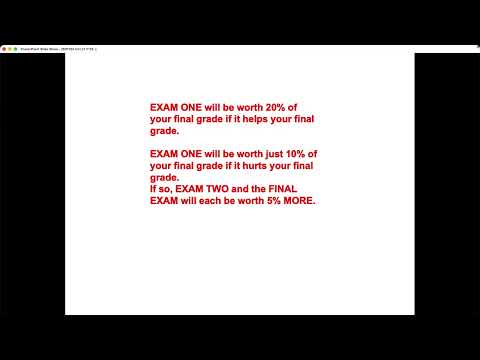
- If exam one lowers a student's final grade, Champlin may reduce its weight from 20% to 10% and increase exam two and the final by 5% each.
- Class content is fair game for exams, even if Champlin mentioned a concept only once; the first exam mostly tested material discussed in class and the book.
- For future exams, students should review class recordings, use the textbook to deepen core topics, and then explore additional textbook details.
- Champlin recommends tutoring support for improving study planning and effort, and notes that the cumulative final can revisit earlier material.
- Plants use photons from sunlight to make sugars in their leaves, then transport sucrose to roots that cannot photosynthesize.
- Sucrose consists of glucose and fructose; plants use stored sugars to sustain metabolism when it is dark or cloudy.
- In biological chemistry, the starting molecules are commonly called substrates and the resulting molecules are products.
- The overall breakdown of sugar with oxygen produces carbon dioxide and water, as does burning wood, but cells divide the process into steps to capture usable energy.
- The change in Gibbs free energy, delta G, describes the energy change between substrates and products; exergonic reactions release energy and endergonic reactions require it.
- Enzymes lower activation energy and increase reaction rate, allowing stable molecules such as sucrose to be broken down when needed.
- Photosynthesis is an energy-requiring, endergonic process, while catabolism breaks molecules down and releases energy that supports anabolism and cellular work.
- Dried wood is about 50% cellulose, a polymer of glucose, and about 25% hemicellulose; combustion with oxygen yields carbon dioxide, water, and heat.
- Humans lack the enzymes needed to digest cellulose, so it passes through the digestive system as dietary fiber, although some bacteria can break it down.
- Plants build much of their biomass from carbon dioxide in the air, which Champlin characterizes as turning air into solid wood.
- Glucose carbon shares electrons relatively equally with carbon and hydrogen, while carbon dioxide carbon bonds to more electronegative oxygen; this energy shift helps explain why glucose breakdown releases energy.
- Most enzymes are proteins with a specific three-dimensional shape; the substrate binds in a pocket called the active site.
- The active site lies within a catalytic domain, where amino-acid side chains and noncovalent interactions help position the substrate.
- Substrate binding commonly changes the enzyme's shape through induced fit, bringing reactive chemical groups into proximity.
- Enzymes are specific: each chemical reaction depends on an enzyme with compatible active-site chemistry.
- Carboxypeptidase in the small intestine helps digest dietary proteins by hydrolyzing peptide bonds into smaller pieces and amino acids.
- In the example mechanism, a positively charged zinc ion attracts an oxygen in the substrate, helping weaken its bond to carbon.
- Other enzyme side chains provide alternative bonding partners, making the peptide bond easier to break and lowering the activation-energy barrier.
- Zinc is a cofactor, a non-protein component required for an enzyme's function; vitamins can also support enzyme pathways.
- Termites can digest cellulose with help from bacteria in their microbiome, illustrating how microbial partners provide digestive capabilities the animal lacks.
- Champlin connects cellulose breakdown to biotechnology questions about accessing energy in dietary fiber and other plant material.
- Some origin-of-life research considers whether environmental metals such as zinc could have catalyzed reactions before enzymes evolved.
- The transition state is the temporary, higher-energy arrangement a substrate passes through; an enzyme provides a lower-energy route to products.
- Catabolism breaks down nutrient molecules, and cells temporarily capture part of the released energy in ATP.
- ATP, adenosine triphosphate, can lose a phosphate to become ADP, adenosine diphosphate; cells continuously recycle the two forms.
- ATP acts as an energy intermediate or currency, powering tasks such as muscle movement, vesicle transport, and the synthesis of proteins and DNA.
- ATP hydrolysis typically releases about 7.3 to 7.4 kilocalories per mole under cellular conditions.
- An endergonic reaction with a delta G of plus 3.4 kilocalories per mole can proceed when coupled to ATP hydrolysis, which releases about 7.3 kilocalories per mole.
- Adding the two changes gives an overall delta G of about minus 3.9 kilocalories per mole, making the combined process energetically favorable.
- Champlin compares coupling to a waterwheel that uses downhill water flow to pump milk uphill: energy released in one process drives work in another.
- Cells use energy-releasing catabolism to regenerate ATP, then use ATP to drive endergonic cellular reactions.
- Glycolysis is the pathway that breaks down glucose in the cytoplasm of cells, using a sequence of 10 chemical reactions.
- The pathway has an energy-investment phase: its first five reactions consume ATP to prepare stable glucose-derived molecules for breakdown.
- The later reactions recover energy; because one glucose splits into two three-carbon molecules, ATP production occurs twice at certain steps.
- Champlin advises focusing on the pathway's energetic logic rather than memorizing the structures, substrates, products, or most enzyme names.
- Glycolysis yields a net gain of two ATP per glucose after accounting for ATP consumed in the investment phase.
- The pathway also produces NADH, an energy intermediate that cycles with NAD+ and can carry more energy than ATP.
- A reaction that synthesizes ATP must release enough energy to drive that synthesis, about 7.3 to 7.4 kilocalories per mole under the values discussed in class.
- Champlin uses this energy accounting to preview how cellular respiration captures glucose energy in stages rather than releasing it all at once.
Transcript excerpt
0:08 All right. Shoot. Well, sorry about this, but uh this little pan is a struggling little thing. That's a bummer. So, here we are. And um um And uh yeah, let's go right. Um all right, so um I have your exam graded. I'll hand that back to you in class today. And uh so, we're going to talk about that some and um and then move on to our next stuff. And uh so, what should you do this week? All right, so we already talked pretty significantly about chapter eight. Chapter eight is what a person would call bioenergetics. And that's the concept of energy flow through living systems. And uh that's
0:57 the number one thing that in intro bio, we want to emphasize and understand. And we're going to go on to chapter nine today, and chapter nine is called cellular respiration, and it's what is happening in our body as we digest uh food and nutrients, and um um uh there's a specific pathway that's focused on in chapter nine, and we want to navigate our way through that pathway with this appreciation of what we already talked about about energy flow through the system. And it's like when the bunny eats the dandelion, and the bunny is just going to break down all of the energy that that uh plant has stored in nutrients. Yes? >> Yeah, I just had a question about the
1:44 exam. >> Yeah. >> Uh I could totally be wrong, but I I thought you had said that chapter eight would be on the exam, too. >> So, what I said is that what we covered in class was going to be on the exam. And so, we talked some on the Wednesday before break about chapter eight, but students didn't need to look at chapter eight.
This is the start of the transcript. Save this video free for the whole transcript, searchable and time-coded.
In this course
Related notes
Summary, takeaways, and chapters were generated by AI from the video's transcript and may contain errors. The video belongs to its creator, The New Evolution for Everyone.