BIO105 Introductory Biology, Mond., Nov., 2nd, David Champlin, USM
Overview
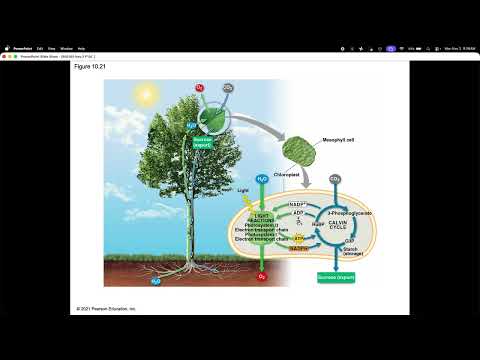
David Champlin connects photosynthesis to core bioenergetics: light excites electrons in photosystems II and I, electron transport builds a proton gradient for ATP synthesis, and ATP plus NADPH power the Calvin cycle to fix carbon dioxide into a three-carbon sugar. He then introduces cell signaling through epinephrine's effects on muscle glycogen, showing how a hormone binds a membrane receptor and triggers a kinase cascade that activates glycogen breakdown.
Key takeaways
- Photosystem II splits water to replace lost electrons, releasing oxygen; photosystem I then uses a second photon-driven boost to reduce NADP+ into NADPH.
- In both chloroplasts and mitochondria, an electron transport chain builds a proton gradient across a membrane, and ATP synthase converts that gradient into ATP.
- The Calvin cycle uses ATP, NADPH and carbon dioxide to produce a three-carbon sugar; RuBisCO catalyzes the entry of carbon dioxide into the cycle.
- Cyclic electron flow through photosystem I can increase ATP production without making NADPH or oxygen, so the NADPH-dependent Calvin cycle pauses.
- Epinephrine triggers a muscle response without entering the cell: receptor binding starts a signaling cascade, and kinase phosphorylation activates an enzyme that breaks glycogen into glucose.
- Glycogen lets muscle store many glucose units in a compact polymer, reducing the osmotic burden compared with keeping the same glucose as separate molecules.
Chapters
- The class will finish Chapter 10 on photosynthesis, with a drawing assignment due the following week.
- A fermentation quiz is scheduled for the end of class; later topics move from cell communication to molecular biology and classical genetics.
- David Champlin describes drawing and physically building biological processes as a way to learn beyond multiple-choice exam preparation.
- In a redox reaction, reduction gains electrons and oxidation loses electrons; photosynthesis reverses the overall direction of cellular respiration.
- Fats contain more energy than sugars because their carbons are more reduced and hold electrons closer to their nuclei.
- As carbon is oxidized to carbon dioxide, oxygen gains electrons; this electron transfer underlies energy changes in metabolism.
- Photosynthesis occurs in chloroplasts: the Calvin cycle takes place in the stroma, while light reactions occur in thylakoid membranes.
- Stacks of thylakoids provide extensive membrane surface area, similar in principle to the folded inner membrane of mitochondria.
- Chlorophyll absorbs photons, exciting electrons that are transferred to a primary electron acceptor instead of simply releasing energy as heat.
- Photosystem II passes energized electrons through an electron transport chain embedded in the thylakoid membrane.
- Electron transport pumps hydrogen ions into the thylakoid lumen, making it acidic and creating a concentration gradient.
- ATP synthase uses the flow of hydrogen ions down that gradient to make ATP, a mechanism also used in mitochondria.
- The Z scheme traces electrons through photosystem II, an electron transport chain, and photosystem I; photosystem II acts first despite its number.
- Photons excite electrons at each photosystem, and the energy released as electrons move through the chain helps drive ATP production.
- Photosystem I raises electron energy enough to produce NADPH, a high-energy reducing agent used in carbon fixation.
- Photosystem II uses light and water; water supplies replacement electrons, and its splitting releases oxygen.
- Electrons from photosystem II travel through the transport chain, supporting ATP production before reaching photosystem I.
- Photosystem I uses light and incoming electrons to produce NADPH; it does not split water or directly produce oxygen.
- Oxygenic photosynthesis by ocean bacteria contributes a major share of global photosynthesis and helped oxygenate Earth's atmosphere.
- The Calvin cycle occurs in the chloroplast stroma and uses ATP and NADPH from the light reactions to drive endergonic reactions.
- RuBisCO catalyzes the attachment of carbon dioxide to a carbon chain; the cycle's direct sugar product is a three-carbon molecule, not glucose.
- ATP hydrolysis supplies energy for some steps, while oxidation of NADPH supplies additional reducing power for sugar production.
- Plants can transport sugars to roots or store them for later use; leaf cells also contain mitochondria that break down sugars.
- When a plant needs extra ATP rather than sugar, cyclic electron flow sends electrons from photosystem I back into the electron transport chain.
- This cycle builds a proton gradient and produces ATP, but it does not produce NADPH or oxygen.
- Because the Calvin cycle requires NADPH, it pauses during this mode; a growing seedling may use ATP immediately for growth instead of storing energy as sugar.
- Champlin corrects his initial explanation: the cyclic pathway involves photosystem I, not photosystem II.
- The photosynthesis drawing assignment will compare how different plant species manage photosynthesis through the day.
- The textbook also covers light measurement and spectrophotometers; Champlin notes these may appear on the exam even though they are not central to the class's core model.
- The next course unit begins with Chapter 11 on cell communication and uses a rare skin cancer case as a broader biological example.
- Hormones such as epinephrine, also called adrenaline, are released by source cells into the blood and affect target cells elsewhere in the body.
- The example traces epinephrine from cells in the adrenal gland to muscle cells during a threat response.
- Hormones are also called endocrine factors; endocrinologists study hormone-related conditions such as disrupted insulin signaling in diabetes.
- Muscle cells store glucose as glycogen, a large polymer that stores many glucose units while counting as relatively few particles for osmotic concentration.
- Epinephrine binds a receptor on the muscle-cell surface rather than entering the cell, initiating signal transduction.
- A kinase adds a phosphate group to a target enzyme, activating it to break glycogen into glucose for rapid energy production.
- The local release of glucose supports muscle activity for running or fighting without requiring a body-wide rise in blood sugar.
- The epinephrine receptor is a transmembrane protein, likely synthesized through the rough endoplasmic reticulum using a signal sequence.
- Beta-adrenergic receptors belong to the larger G protein-coupled receptor family, which also includes many odor receptors.
- Kinases add phosphate groups to target proteins, a mechanism linked to the fermentation material assigned for the class quiz.
- Champlin asks students to spread out for quizzes as they do for exams.
Transcript excerpt
0:07 All right, we're going to get started. And here we are. And not working. So, just keep rolling and rocking. And we have a quiz class. I set my alarm for 10:30. Remind me if um that fails somehow. And what's that quiz about? It's about fermentation and the fermentation video. And so we're going to have that quiz at the end of class. And uh that's the thing. Um this uh week you should read chapter 10. And that's photosynthesis. And we've already uh talked uh um kind of a decent amount already into the photosynthesis chapter because
0:56 again you're assigned to read the whole chapter and the chapter covers more than I could expect you to learn more details but that's biology and and the intro bio course is really uh uh needs to be taken time to [clears throat] get you to practice reading and so I really encourage you before you read the book to have watched the videos so you can see some introduction to it and help navigate through it. Okay. So, uh you'll see that after photosynthesis we just chain a huge chunk of uh chapters and topics into a woman who had skin cancer probably back in the 1960s and what was the deal with her skin cancer. So in the
1:45 same way that we really focused on aquaporin to use and learn uh general principles of protein biology, we're going to focus in on what happens underneath a scab, every scab, and how the skin heals quickly like that. Okay? And so to get there, I have two videos. They're short. Each one is only 10 or 11 minutes long, and I'll get those posted on Brightpace. and we're going to have a quiz on that at the end of class um a week from
This is the start of the transcript. Save this video free for the whole transcript, searchable and time-coded.
In this course
Related notes
Summary, takeaways, and chapters were generated by AI from the video's transcript and may contain errors. The video belongs to its creator, The New Evolution for Everyone.