BIO105 Introductory Biology, Fermentation, David Champlin, USM
Overview
David Champlin explains fermentation as an alternative pathway that allows cells to keep glycolysis producing ATP when oxygen is insufficient for oxidative phosphorylation. He connects this process to broader metabolic regulation, including substrate buildup, enzyme inhibitors, phosphorylation, enzyme abundance and location, and compares fermentation in human muscle, yeast, and bacteria.
Key takeaways
- Fermentation restores NAD+ from NADH, preserving the NAD+ needed for glycolysis when oxygen-dependent oxidative phosphorylation cannot keep pace.
- Glycolysis yields a net 2 ATP per glucose, compared with more than 30 ATP from aerobic respiration, making fermentation a low-yield way to sustain ATP production.
- Competitive inhibitors reduce enzyme activity by occupying the active site and can be countered by more substrate; noncompetitive inhibitors bind elsewhere and are not overcome that way.
- Kinases add phosphate groups and phosphatases remove them; Champlin notes that phosphorylation regulates about 85% of human metabolic enzymes.
- Cancer cells can support fermentation by increasing glycolytic enzyme production and clustering enzymes, while yeast can assemble glycolytic enzymes into cytoplasmic G bodies.
- Lactate can be reused when oxygen returns, transported to the liver for conversion to glucose, or used as fuel by tissues such as the heart.
Chapters
- Aerobic respiration comprises glycolysis in the cytoplasm, the citric acid cycle in mitochondria, and oxidative phosphorylation.
- When oxygen is insufficient, oxidative phosphorylation cannot recycle NADH efficiently, and fermentation provides an alternative route for glycolysis products.
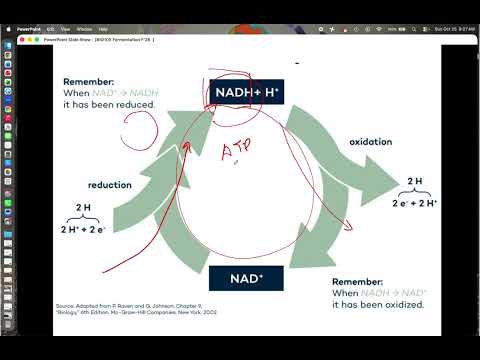
- Fermentation converts pyruvate into products such as lactate in animals or ethanol in yeast while restoring NAD+.
- A metabolic pathway can slow when downstream reactions stop consuming its products, causing molecules to accumulate and upstream reactions to approach equilibrium.
- During fermentation, pyruvate is not processed through aerobic respiration as usual, so pathway traffic backs up and cells use fermentation as a detour.
- Champlin frames pathway regulation as cellular traffic management that determines how molecules from food and synthesis are used.
- Competitive inhibitors bind an enzyme's active site and compete with the substrate; increasing substrate concentration can reduce their effect.
- Noncompetitive inhibitors bind elsewhere and interfere with enzyme shape changes or catalysis, so adding more substrate does not overcome inhibition.
- In feedback inhibition, an end product can bind an early enzyme in its pathway and slow further production.
- Phosphorylation covalently adds a phosphate group to a target protein and can either activate or inhibit its activity.
- A kinase transfers a phosphate, typically from ATP, to a target protein; a phosphatase removes it.
- Champlin notes that about 85% of human metabolic enzymes can be regulated by phosphorylation, with roughly 600 kinases in humans.
- Cancer cells can increase production of glycolysis and fermentation enzymes, supporting high fermentation rates even when oxygen is available.
- PET scanners can detect unusually high metabolic activity associated with cancer cells' increased glucose metabolism.
- Yeast can cluster glycolytic enzymes into cytoplasmic G bodies during fermentation, while cancer cells can also bundle pathway enzymes to improve transfer of products between steps.
- Glycolysis runs through about 10 reactions, splitting one six-carbon glucose into two three-carbon pyruvate molecules.
- Without oxygen, oxidative phosphorylation slows, NADH accumulates, and the available NAD+ pool falls, limiting a required input to glycolysis.
- Aerobic respiration yields more than 30 ATP per glucose, while glycolysis alone nets 2 ATP after its 2-ATP investment and 4-ATP payoff.
- Fermentation uses pyruvate to convert NADH back to NAD+, allowing glycolysis to continue producing its net 2 ATP per glucose.
- Animal cells produce lactate; when oxygen returns, some lactate can become pyruvate and fuel ATP production, while some travels to the liver or heart.
- Lactic acid bacteria contribute to the sour tang of yogurt and are used in sourdough starters.
- The central purpose of fermentation is NAD+ regeneration, not high ATP yield; glycolysis supplies only a small amount of ATP compared with aerobic respiration.
- Yeast fermentation converts pyruvate to acetaldehyde, releases carbon dioxide, and then produces ethanol.
- The main fermentation products differ by organism: lactate in animals and some bacteria, and ethanol plus carbon dioxide in yeast.
Transcript excerpt
0:01 Okay, great. So, this is going to be a video about fermentation and uh the book puts fermentation in at the end of chapter nine. And the reason is um it's good to talk about it and what happens during fermentation and helps us understand the metabolic pathway that is the focus of chapter nine, which is this aerobic respiration. And uh so, fermentation is an alternative to aerobic respiration. The other thing is that um the book also wants to introduce idea of regulating metabolic pathways. And um the book does that kind of briefly and and doesn't describe it in much detail, but I want to dwell on this a little bit um because um
0:50 uh when um folks are interested in metabolism, they're really typically interested in the regulation of metabolic pathways. And in uh biology and college and um and and in biochemistry and college, I think the emphasis tends to be a little bit on the metabolic pathway that itself. Uh whereas I think people out, you know, in the um you know, general population are particularly interested in this regulation of metabolic pathways. So, you know, when we eat some food and whatever what's our body decide to do with those calories? You know, is it going to use them to make muscle or, you know, store them as fat or burn them like that? And so, I'm going to talk just a little bit about that to get a little foundation for some of that uh
1:37 principles of regulating metabolic pathways. And so, uh spend a little time on that. And so, here's what we're looking at. And um this is this pathway for aerobic uh um respiration, uh cellular respiration that is the big focus of chapter nine. And it fits into three parts. And so,
This is the start of the transcript. Save this video free for the whole transcript, searchable and time-coded.
In this course
Related notes
Summary, takeaways, and chapters were generated by AI from the video's transcript and may contain errors. The video belongs to its creator, The New Evolution for Everyone.