BIO105 Introductory Biology, Mond., Oct., 26th, David Champlin, USM
Overview
David Champlin connects introductory biology’s metabolism unit to earlier lessons on cells, macromolecules, and enzymes, emphasizing how cells capture energy through linked chemical reactions. He explains enzyme catalysis, energy coupling, glycolysis, and the locations and outputs of cellular respiration’s major stages, while clarifying what students should focus on for exams and a fermentation quiz.
Key takeaways
- Glycolysis occurs in the cytoplasm and converts one six-carbon glucose into two three-carbon pyruvate molecules, yielding a net of two ATP and two NADH.
- The citric acid cycle takes place in the mitochondrial matrix, while oxidative phosphorylation occurs at the folded inner mitochondrial membrane.
- Substrate-level phosphorylation directly couples an exergonic substrate reaction to endergonic ATP synthesis, and the combined reaction must have a negative delta G.
- Most enzymes are proteins, but ribosomal RNA catalyzes peptide-bond formation, making the ribosome a ribozyme.
- Cellular respiration captures energy in stages: carbon dioxide is released as glucose is broken down, while NADH and FADH2 carry energy to oxidative phosphorylation for ATP production.
- A mildly endergonic reaction can proceed within a metabolic pathway when a downstream reaction rapidly removes its product, pulling the overall sequence forward.
Chapters
- Students should review 20 exam questions they missed or found difficult, using the answer-key video to explain correct answers and optionally why distractors are wrong.
- David Champlin moved the follow-up assignment deadline to Wednesday; students may submit it in class or by email.
- He frames exam review as preparation for the cumulative final, advanced biology courses, and practical confidence in learning unfamiliar material.
- Chapters 8, 9, and 10 form a metabolism unit: Chapter 8 introduces bioenergetics, Chapter 9 covers cellular respiration, and Chapter 10 covers photosynthesis.
- Cellular respiration occurs in plants, animals, and other eukaryotes; bacteria and Archaea also carry out metabolism, though their pathways are outside this course’s focus.
- A fermentation video supports a quiz planned for the following Monday, and a related assignment deadline was extended by a week after a posting issue.
- Earlier course material covered building molecules and cell structures; metabolism explains how cells break down food molecules and build their own molecules from simpler components.
- Mitochondria are central to cellular respiration, while chloroplasts carry out the plant photosynthesis discussed in Chapter 10.
- Metabolism consists of enzyme-regulated sequences that break down or synthesize molecules, with cells switching pathways according to their needs.
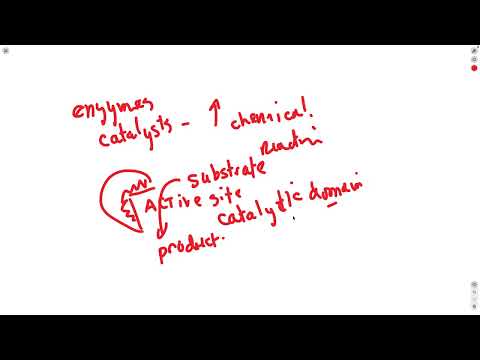
- Enzymes are catalysts that speed specific reactions by binding substrates at an active site and producing products.
- In protein enzymes, the active site lies within a larger catalytic domain; substrate binding can cause a shape change known as induced fit.
- Catalytic mechanisms weaken or destabilize substrate bonds by positioning chemical groups near the substrate, sometimes with a cofactor such as a zinc ion.
- Carboxypeptidase in the small intestine provides an example: it clips remaining protein fragments into amino acids.
- Most enzymes are proteins, but some RNA molecules fold into shapes with active sites and catalyze reactions.
- Ribosomes use messenger RNA (mRNA) as a template to assemble amino acids into proteins such as hemoglobin.
- Ribosomes contain ribosomal RNA (rRNA) and many proteins; the rRNA catalyzes peptide-bond formation, making the ribosome a ribozyme.
- Champlin distinguishes the active site, where chemistry occurs, from the larger catalytic domain that helps position and shape the reaction.
- ATP synthesis from ADP and inorganic phosphate is endergonic, requiring about 7.3 to 7.4 kilocalories per mole under the values used in class.
- A reaction coupled to ATP synthesis must release more energy than ATP formation requires, so the combined reaction retains a negative overall delta G.
- Substrate-level phosphorylation occurs when one enzyme couples an exergonic substrate reaction directly to ATP synthesis.
- Some exergonic steps release too little energy to make ATP; they can still move a metabolic pathway forward by preparing molecules for later reactions.
- NADH and NAD+ cycle between reduced and oxidized forms, carrying energy between reactions much like ATP and ADP.
- Using the course’s simplified accounting, one NADH can yield three ATP during oxidative phosphorylation, so producing NADH captures substantial energy.
- Glycolysis occurs in the cytoplasm and converts one six-carbon glucose into two three-carbon pyruvate molecules.
- Its net yield is two ATP and two NADH: four ATP are produced in later steps after two ATP are invested at the start.
- Champlin recommends making a large, clearly labeled pathway diagram to support recall of locations and energy flow; glycolysis belongs in the cytoplasm.
- The glycolysis summary should show glucose becoming two pyruvate, with a net gain of two ATP and two NADH.
- Because glucose is split into two three-carbon molecules, downstream reactions after the split occur twice, accounting for the two NADH and net ATP figures.
- The enzymes for glycolysis are cytoplasmic proteins made by free ribosomes, like hemoglobin and cytoskeletal proteins.
- Glycolysis-derived NADH can feed into oxidative phosphorylation, which uses oxygen in its final step and produces much of the cell’s ATP.
- Fermentation is an alternative when oxygen is unavailable; it does not proceed through the mitochondrial stages described for aerobic respiration.
- Cellular respiration is organized into three major stories: glycolysis, the citric acid cycle, and oxidative phosphorylation.
- Pyruvate enters the mitochondrion and is converted to a two-carbon acetyl group, releasing carbon dioxide before the citric acid cycle.
- Mitochondria have an outer membrane and a folded inner membrane, both made from phospholipid bilayers.
- The citric acid cycle occurs in the mitochondrial matrix, the fluid-filled space inside the inner membrane.
- Oxidative phosphorylation takes place at the inner mitochondrial membrane, whose folds provide substantial surface area for its components.
- The space between the two membranes is the intermembrane space, distinct from both the matrix and the site of the citric acid cycle.
- Pyruvate is glycolysis’s product: each glucose molecule yields two three-carbon pyruvate molecules.
- The net glycolysis output is two ATP and two NADH; the NADH is later converted to ATP elsewhere, so it should not be counted as ATP made directly by glycolysis.
- Students should distinguish glycolysis products from later oxidative phosphorylation products when interpreting pathway diagrams or exam questions.
- Champlin explains the two-ATP net by balancing four ATP produced against two ATP used during the pathway.
- Most metabolic reactions are exergonic, but a pathway can include a mildly endergonic step that prepares a molecule for a later reaction.
- Removing the endergonic step’s product through a subsequent spontaneous reaction can pull the pathway forward.
- Chemical reactions are reversible; an unfavorable forward reaction may still occur slowly, while rapid product removal shifts continued reaction in the forward direction.
- The overall pathway’s energy change, rather than the direction of every isolated step, determines whether the sequence proceeds favorably.
- A negative delta G means the reacting molecules lose free energy; the amount released can drive an endergonic reaction with positive delta G.
- For example, coupling a reaction with delta G of negative 7.5 kilocalories per mole to ATP synthesis at positive 7.3 gives an overall delta G of negative 0.2.
- The net coupled reaction proceeds spontaneously when the energy-releasing reaction is sufficiently favorable to keep the combined delta G negative.
- Champlin stresses tracking energy changes in molecules and adding reaction delta G values, rather than confusing a negative delta G with energy being gained by the reactants.
- The citric acid cycle, also called the Krebs cycle after Hans Krebs, occurs in the mitochondrial matrix and processes the two-carbon acetyl input through a series of reactions.
- The cycle releases carbon dioxide and captures energy in ATP, NADH, and FADH2; the course uses an estimate of two ATP per FADH2 and three per NADH.
- Carbon from glucose is ultimately released as carbon dioxide, which diffuses into the blood, travels to the lungs, and is exhaled.
- Oxidative phosphorylation converts NADH and FADH2 into ATP at the inner mitochondrial membrane; the lecture closes with assignment reminders and a direction to watch the fermentation video.
Transcript excerpt
0:02 All right, we can get started. And so here we are and I had a couple of issues with assignments and so the first one was that I I thought more about this follow-up on exam one and realized well that's kind of a big assignment. So it was due today. I updated it and said let's have it do on Wednesday. And so it's going to be due on Wednesday. Either you can hand it in here or you can send it to me in an email. And it's to identify 20 questions that you either got wrong or that are hard questions on the exam that you follow up on and you follow up by watching the answer key video. So everybody should watch this answer key
0:48 video no matter what in order to understand you know the material better and understand the plan and expectation for our course better. And and so as part of that is this follow-up assignment. And you should write a few sentences of what explain the right answer. You can also explain why the you know wrong answers are wrong. That type of thing. And the goal of it of course is not to just grind through an assignment but to actually have it be some value for you to model what to do with an exam rather than just try to walk away from it. And the reasons for following up on this are well the final covers everything and two there is a real strong expectation for you to understand this in more advanced courses and three
1:36 this is just good knowledge about our bodies and about life on Earth to carry with you as much as possible. You know you already know a lot about plants and animals and this is more about that
This is the start of the transcript. Save this video free for the whole transcript, searchable and time-coded.
In this course
Related notes
Summary, takeaways, and chapters were generated by AI from the video's transcript and may contain errors. The video belongs to its creator, The New Evolution for Everyone.