AU26 CHEM 2310 - Lecture 2 - August 27 - Quiz 1 - Gen Chem Review
 Watch on YouTube →
Overview
Dr. Jennifer Walters reviews the general-chemistry foundations needed for CHEM 2310 Quiz 1, connecting atomic structure and electron behavior to Lewis structures, bonding, polarity, and valency. The lecture also places the review in the course sequence, introduces Friedrich Wöhler’s synthesis of urea from ammonium cyanate, and previews the recurring organic-chemistry strategy of tracking electrons to predict reactions.
Key takeaways
- The core organic-chemistry problem-solving habit is to locate electron-rich and electron-poor sites, connect them, and then assess whether the resulting arrangement is more stable.
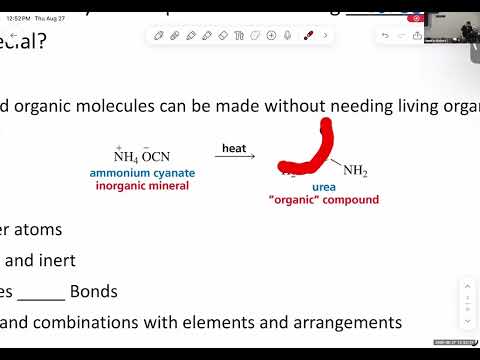
- Friedrich Wöhler’s conversion of ammonium cyanate into urea demonstrated that an organic compound could be synthesized from an inorganic material.
- Valence electrons drive bonding and reactivity; for main-group elements in this course, count across the s and p blocks while skipping the transition metals.
- A polar covalent bond has unequal electron sharing: the dipole arrow points toward the more electronegative atom, and the arrow tail marks the partially positive end.
- The lecture’s bond-classification rule treats an electronegativity difference of 0.4 or less as nonpolar and a larger difference as polar; C–H is the standard nonpolar shortcut.
- Useful introductory valencies are carbon four, nitrogen three, oxygen two, and hydrogen and halogens one; hydrogen and helium instead reach stability with two electrons.
Chapters
- The attendance code for Top Hat is 5515.
- Quiz 1 lecture notes are under the course Modules section, with annotated notes to be added there.
- Dr. Jennifer Walters encourages students to write down unfamiliar terms and ask questions in class or office hours.
- Quiz 1 reviews Chapter 1 and general chemistry, with Dr. Walters promising to cover the background needed for the course.
- The first homework is due September 10; Quiz 1 opens September 11 and is due September 13.
- Quiz 1 has one attempt during this opening period; multiple-attempt windows occur only at designated times during the semester.
- Organic chemistry focuses on compounds containing carbon and hydrogen, with carbon’s ability to form strong bonds enabling extensive molecular diversity.
- Friedrich Wöhler heated inorganic ammonium cyanate and produced urea, demonstrating that an organic compound could be synthesized from an inorganic starting material.
- Urea is a component of urine; its synthesis showed that it could be obtained without harvesting it from living organisms.
- Methylamine is one contributor to the characteristic fishy odor and is a small covalent molecule that can enter the air and be smelled.
- Adding acidic lemon juice or vinegar can protonate methylamine, forming a methylammonium salt that is ionic and far less volatile.
- The example connects an everyday cooking technique to acid-base chemistry and changes in a molecule’s physical properties.
- After general-chemistry review, the course will develop organic terminology and recurring reaction patterns.
- The planned sequence includes alkanes, alkenes, alkynes, benzene, stereochemistry, substitution and elimination, and functional groups.
- Dr. Walters frames organic reaction prediction as identifying electron-rich and electron-poor sites, bringing them together, and reassessing the products for stability.
- Atoms contain electrons, protons, and neutrons; protons and neutrons each count as approximately one mass unit, while electron mass is treated as zero for introductory calculations.
- The number of protons defines an element, while changing neutrons produces isotopes and changing electrons produces ions.
- Electrons occupy probabilistic clouds and energy levels; their arrangement controls bonding and reactivity, while opposite charges attract and like charges repel.
- Element symbols have one capital letter, so Co means cobalt while CO means carbon monoxide.
- Nuclear notation places mass number at upper left, atomic number at lower left, charge at upper right, and atom count at lower right.
- Cations are positively charged and anions negatively charged; isotopes retain the same proton count but differ in neutrons.
- Ordinary hydrogen has one proton, one electron when neutral, and zero neutrons in its most common isotope.
- Deuterium is a hydrogen isotope with one neutron, so its mass number is two; it is written with H in nuclear notation because it is still hydrogen.
- Isotopes behave similarly in chemical reactions, and deuterium can act as a label for tracking a hydrogen atom.
- Tritium has one proton and two neutrons, giving it a mass number of three while remaining neutral with one electron.
- A hydrogen cation, H+, has lost its sole electron and is essentially a bare proton; hydride, H−, has gained an electron and has two.
- An atom can be both an isotope and an ion, although the class focuses on the common hydrogen forms.
- The periodic table’s s block is Groups 1 and 2, its p block is Groups 13 through 18, and its d and f blocks contain transition metals and inner transition elements.
- For the course’s main-group elements, valence electrons are counted from left to right across the s and p blocks, skipping the d block.
- Group 1 elements such as hydrogen, lithium, and sodium have one valence electron; silicon and lead each have four under this counting method.
- A Lewis dot symbol places the element symbol at the center and represents valence electrons as dots in four positions around it.
- Place one dot in each position before pairing dots; silicon receives four single dots and nitrogen receives five dots, including one pair.
- Unpaired electrons indicate potential bonding sites, while paired electrons are treated as already filled in the introductory model.
- A line in a Lewis structure represents a covalent bond containing two shared electrons.
- The octet rule models stability as filling an outer shell to eight electrons, especially for carbon, nitrogen, and oxygen in this course.
- Hydrogen and helium follow the duet rule because their 1s orbital can hold only two electrons.
- Ionic bonding typically pairs a metal with a nonmetal and involves electron transfer; covalent bonding joins nonmetals by sharing electrons.
- Polar covalent bonds share electrons unequally, creating partial positive and partial negative regions rather than full ionic charges.
- Electronegativity measures an atom’s ability to attract shared electrons; atoms nearer fluorine on the periodic table generally attract them more strongly.
- A metal paired with a nonmetal is the quick identifying pattern for an ionic bond; two nonmetals form a covalent bond.
- For covalent bonds, an electronegativity difference of 0.4 or less is treated as nonpolar, while a difference greater than 0.4 is treated as polar.
- As a course shortcut, C–H bonds are treated as nonpolar, while bonds from carbon or hydrogen to other nonmetals are generally treated as polar.
- A dipole arrow points toward the more electronegative atom; its plus-sign tail sits near the partially positive atom.
- For C–F, C–Cl, C–O, and O–H bonds, the arrow points toward F, Cl, or O respectively; a C–H bond receives no dipole arrow in this model.
- When electronegativity values are unavailable, use the periodic trend toward the upper-right corner, with fluorine as the most electronegative element.
- Ionic bonding is described as electrostatic attraction between oppositely charged ions; covalent bonding involves shared electrons attracted by both nuclei and is generally shorter.
- Valency predicts the number of bonds an atom tends to form while remaining neutral and stable: carbon four, nitrogen three, oxygen two, and hydrogen and halogens one.
- Dr. Walters reminds students to bring a laptop or tablet to recitation for Pearson assignments and gives office hours as Tuesday, 10:30 to 11:30, in Evans Lab.
Transcript excerpt
4:08 Is that too dark or are we going to fall asleep? No. All right. How is everybody doing today? Good. Good. All right. Does anyone have any questions before we get started? Cool. All right. Uh the attendance code is 5515 for today. So hopefully you're able to enter that into Top Hat. Um yeah. Okay. Yeah. Yeah. So the slides if we go into our course if it loads you go under modules and then lecture notes module quiz one.
5:04 Yep. Yeah. No absolutely. And actually, I'm glad you mentioned this uh cuz this is also where I can't highlight, but uh right underneath this, this is where I'm going to add the annotated notes. So, this is where you'll find them in the future uh as well. Sweet. Uh any other questions? Cool. Then, let's go ahead and start organic chemistry. So, quiz one is pretty much just a gen review. Uh, however, depending on who you had gen, uh, when you took Gen Cam, you might be feeling like you're learning it for the first time. That's okay. I'm going to
5:51 teach you everything that you need from Gen Cam for this course. So, hopefully you had a positive experience. Uh, but even if it was less than that, I got you. So, just make sure that anytime you come across a word or a term or anything where you're like, "What is that?" Circle it, write it down. That is something that you'll want to Google uh or come to office hours to ask questions. Um yeah, or raise your hand in the moment. That is also very a great uh opportunity to ask questions as well. All right. So, your first homework is due in two Thursdays. So, in two weeks, it is due September 10th. Your quiz then
This is the start of the transcript. Save this video free for the whole transcript, searchable and time-coded.
Related notes
Summary, takeaways, and chapters were generated by AI from the video's transcript and may contain errors. The video belongs to its creator, Dr. Jennifer Walters.