ACCT 417 (Fall 2026) - Chapter 5 Homework
Overview
Michael Barnes reviews Chapter 5 audit evidence, assertions, working papers, and substantive analytical procedures, emphasizing how an audit test’s direction determines which assertion it addresses. He applies those ideas to evidence-classification questions, a ticket-revenue estimate of $1,922,190 versus $2.2 million recorded, and inventory counts that distinguish completeness from existence.
Key takeaways
- Completeness tests move from source to record, while existence tests move from record to source; the direction determines which discrepancy the auditor is positioned to find.
- Auditor-generated evidence, such as an auditor’s own inventory test count or computation, is generally more persuasive than internal client records or observation alone.
- The audit assurance process combines risk assessment, tests of controls, substantive analytical procedures, and tests of details; the audit report follows that evidence-gathering work.
- An analytical estimate of $1,922,190 did not support recorded ticket revenue of $2.2 million because the roughly $278,000 gap exceeded the $110,000 tolerable difference.
- For inventory, 87 items found on the floor but absent from the records indicate a completeness issue, while 570 items listed in the records but absent from the floor indicate an existence issue.
Chapters
- Michael Barnes says Monday’s exam review will cover the study guide and practice exam, and asks students to complete the practice exam and bring study-guide questions.
- Tuesday office hours are intended mainly to reconcile questions, not to learn material for the first time.
- Barnes describes Chapter 5 as foundational and reminds students that Meet the Firms and the upcoming career expo offer networking opportunities and extra credit.
- Completeness testing moves from source to record, or bottom to top; comparing shipping documents with the sales journal checks whether sales were recorded.
- Existence testing moves from record to source, or top to bottom, such as tracing an accounting record to supporting documentation.
- For accounts receivable confirmations, existence is usually the primary concern because receivables are assets, even though a confirmation could also reveal completeness issues.
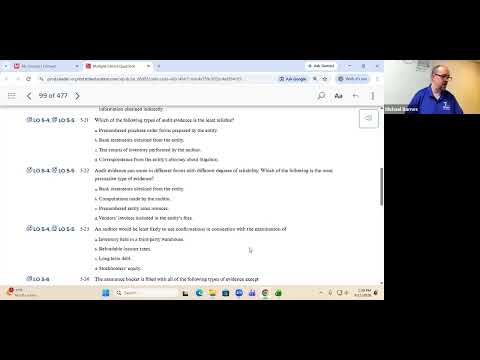
- Barnes ranks evidence using AEIOU: auditor-generated evidence is strongest, followed by external evidence, internal evidence, and observation or inquiry.
- Auditor-performed inventory test counts are more persuasive than entity-prepared purchase orders; auditor computations are stronger than sales invoices prepared by the client.
- The assurance sequence is risk assessment, tests of controls, substantive analytical procedures, and substantive tests of details; the audit report is the final product, not an evidence-gathering phase.
- Current files contain period-specific items such as financial statements, while permanent files retain enduring information such as the accounting-system description; trend analysis examines account changes over time.
- A written request asking customers to report amounts owed is a confirmation used to test account balances, primarily the existence of accounts receivable.
- Inspecting sales invoices from two days before and after year-end tests transactions and the cutoff assertion by checking whether sales were recorded in the proper period.
- Comparing the accounts-receivable subsidiary ledger total with the general ledger is a record comparison, not recalculation; completeness is the textbook answer, though Barnes says valuation, allocation, and accuracy may also be defensible.
- The general ledger aggregates subsidiary-ledger balances, so the subsidiary ledger is prepared first and can serve as the source for a completeness test.
- Discussing the allowance for doubtful accounts with a credit manager is inquiry about an account balance, with valuation and allocation as the key assertion.
- Comparing gross-profit percentages across the current year and the prior four years is an analytical procedure, usually aimed at valuation and allocation.
- Inspecting a newly acquired plastic extrusion machine provides tangible evidence of an asset’s existence; observing warehouse personnel count inventory is less reliable than auditors performing their own test counts.
- A letter from the entity’s attorney about lawsuits is a third-party confirmation concerning contingent liabilities, especially their completeness and valuation.
- The baseline estimate uses 24,000 attendees per daytime game, distributed across box, end-zone, and upper-deck seats, producing $246,000 per game and $984,000 for four games.
- The exercise adjusts attendance, seat mix, and prices for a nationally ranked opponent, an in-state rivalry, and an evening game, yielding total estimated revenue of $1,922,190.
- Recorded ticket revenue is $2.2 million, a difference of about $278,000; the 5% tolerable difference is $110,000, so the estimate does not support accepting the balance.
- Barnes explains that sales analytics become less effective when many inputs vary; simpler estimates, such as depreciation or uncollectible accounts, are more suitable when they use fewer controllable assumptions.
- Floor-to-sheet starts with physical inventory in the warehouse and traces it to the system, testing completeness; sheet-to-floor starts with recorded inventory and checks the warehouse, testing existence.
- In the Las Vegas warehouse example, 87 hiking pants were physically present while the status report showed zero, indicating a completeness problem.
- The backpacking-boots count showed 267 physically present versus 276 recorded, suggesting a transposition error and an accuracy issue.
- A travel-toy ticket kit showed 570 recorded units but none on the warehouse floor, indicating an existence or occurrence problem rather than a completeness issue.
Transcript excerpt
0:00 Oh, >> hey everyone. Happy Friday. >> See a lot of well-dressed individuals today. Apparently enjoyed some meet the firms out there. Went out there. >> Siovana out representing Andrews. We got opportunity at Anders that coming up. Fantastic. Congratulations. >> Yeah, I know Andrew does that pretty regularly. I've had several of the previous students that go up and talk with Anders, but hopefully you got to uh get out there and talk with some firms and uh get some opportunities placed and uh yeah and uh yeah, take care advantage of opportunities where you can get them. Uh just a reminder, if uh you did not get out to meet the firms, then we still have the career expo coming up in a little less than two weeks as another opportunity. Uh I will get the notes of who I was in meet the firms and uh they
0:47 will you'll get the extra credit for that. But if you uh did not get that chance and still want the extra credit, you can do the uh career expo is that if you go to both of those, you don't get extra extra credits. You just get the extra opportunity, the extra networking, which let's be honest, the extra networking has value of itself. Okay? Value on its own. All right. Um just as a reminder, Monday we are going to be preparing for our exam. I gave you a little bit of a rundown of what that's going to look like on Wednesday, but uh that's going to be going over the study guide and the practice exam. Everybody remember the two instructions I gave on Wednesday. Come with your questions on the study guide. Make sure you're prepared to ask questions about that. And then make sure you complete the
This is the start of the transcript. Save this video free for the whole transcript, searchable and time-coded.
In this course
Related notes
Summary, takeaways, and chapters were generated by AI from the video's transcript and may contain errors. The video belongs to its creator, Michael Barnes.