8.3 Simplify Rational Exponents --Lesson 31--FA26--Math190
Overview
Rachel Soyk introduces Math 190 Section 8.3 by connecting rational exponents to radicals, then demonstrates how to simplify expressions using exponent rules. Examples include converting 125^(2/3) to 25, rewriting negative exponents as reciprocals, and simplifying a quotient with fractional exponents to 4x/√y.
Key takeaways
- For a^(m/n), the denominator n determines the root index and the numerator m determines the power: 125^(2/3) = (∛125)² = 25.
- A negative exponent indicates a reciprocal, not a negative value; for example, 16^(−3/2) = 1/64.
- Parentheses determine whether a negative sign belongs to the radicand: (−16)^(1/4) has no real value, whereas −16^(1/4) equals −2.
- For real-valued expressions, an even root requires a nonnegative radicand and denotes the principal, nonnegative root.
- Like-base products add exponents, like-base quotients subtract them, and a power raised to a power multiplies exponents.
- Simplifying inner exponents before applying an outside rational exponent can reduce work; Rachel Soyk presents this as an efficient alternative for the final expression.
Chapters
- Find the least common denominator of 15 and 12 to calculate 7/15 + 5/12 = 53/60.
- Apply the power-of-a-product rule to (4x²y⁵)³, obtaining 64x⁶y¹⁵.
- Rewrite a negative exponent as a reciprocal: 5⁻³ = 1/125.
- Use a^(1/n) = ⁿ√a, so x^(1/2) is √x and y^(1/3) is the cube root of y.
- Translate radicals back to fractional exponents: √(5y) = (5y)^(1/2), and ⁴√(5z) = (5z)^(1/4).
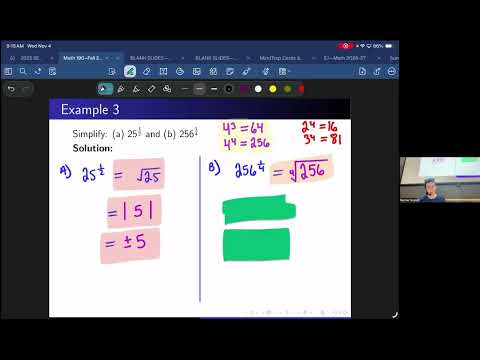
- Evaluate familiar perfect powers, including the principal fourth root of 256, which is 4.
- Distinguish a negative base from a negative sign outside the power: (−16)^(1/4) has no real value, while −16^(1/4) = −2.
- Convert a negative exponent to a reciprocal before evaluating: 16^(−1/4) = 1/2.
- For an even-index radical, the real principal root is nonnegative; a negative radicand has no real even root.
- Interpret the denominator n as the radical index and the numerator m as a power: 125^(2/3) = (∛125)² = 25.
- Evaluate negative rational exponents by taking a reciprocal, as in 16^(−3/2) = 1/(√16)³ = 1/64.
- Simplify 32^(−2/5) by finding the fifth root first, giving 1/(∜[5]{32})² = 1/4.
- Apply exponent multiplication and check the radicand: a negative number raised to a 1/2 power is not real.
- When multiplying like bases, add exponents: x^(1/2)x^(5/6) = x^(4/3), after converting to a common denominator.
- When raising a power to a power, multiply exponents: (z^(2/3))⁹ = z⁶.
- When dividing like bases, subtract exponents; rewrite negative results as reciprocals, so x^(1/3)/x^(5/3) = 1/x^(4/3).
- Distribute an outside exponent across factors, then simplify each exponent; for example, 27^(2/3)u^(1/2·2/3) becomes 9u^(1/3).
- Reduce fractional exponents before converting to radicals, as in (m^(2/3)n^(1/2))^(3/2) = mn^(3/4).
- For the final quotient example, combine like x and y powers before or after applying the 1/2 power; both approaches give 4x/√y.
- Finish by moving any factor with a negative exponent to the opposite side of the fraction, and practice with the recommended Section 8.3 workbook exercises.
Transcript excerpt
0:04 So we have section 8.3 our rational exponents. There are three learning objectives in this section. uh being able to simplify expressions with a to the 1 overn and a to the m overn and then being able to use the properties of exponents to simplify expressions with rational exponents. Let's do some warm-up problems. So the first one again refreshing your memory on adding fractions. When you're adding fractions, what's the most important thing? Yeah, exactly. Finding an LCD. And then again, any side conversations, try and nip that in the butt or step outside and
0:55 you can have a conversation there. So, we need to find an LCD between 15 and 12. Let's use our handy dandy cake method. Set up that first layer of upside down cake. What's a factor that goes into 15 and 12? 3. 3 * what gives you 15 and 3 * what gives you 12? Excellent. Which means our least common denominator is the product of the entire border. And what does that give us exactly? Now that we know that our LCD is 60, let's write these two fractions out once again. We have 7 15 + 5 12ths. That first fraction we need to multiply by a fancy form of 1. What are we going to
1:43 multiply it by? 15 * what gives us 60? 4. So we're going to multiply it by 4 over 4. Whereas that second fraction, we have 52. 12 * what gives you 60? 5. So we're going to multiply that fraction by 5 over 5. And now when we do the denominator is now going to be 60. And so we can combine the numerators. 4 * 7 is 28. 5 * 5 is 25. Add those two up. And what is our final result? 53
This is the start of the transcript. Save this video free for the whole transcript, searchable and time-coded.
In this course
Related notes
Summary, takeaways, and chapters were generated by AI from the video's transcript and may contain errors. The video belongs to its creator, Rachel Soyk.