110526 L2 Chemistry 221 Video Lecture Part III
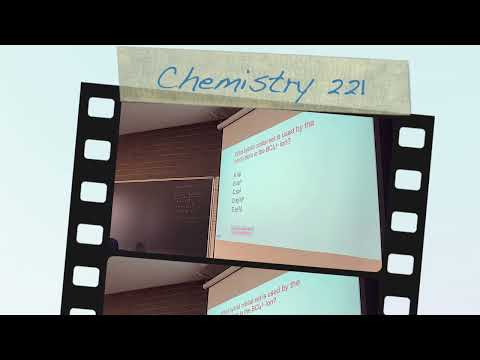
Overview
Michael Russell connects Lewis structures and electron-pair geometry to predict hybridization and bond angles, then uses molecular orbital diagrams to calculate bond order and magnetic behavior. The examples include tetrahedral BCl4− (sp3), cysteine with 13 sigma and 1 pi bond, N2+ with bond order 2.5, and superoxide O2− with bond order 1.5.
Key takeaways
- BCl4− has four bonding electron clouds around boron, producing tetrahedral electron-pair geometry and sp3 hybridization.
- Multiple bonds include a sigma component: one double bond contributes one sigma plus one pi, while one triple bond contributes one sigma plus two pi bonds.
- Cysteine's illustrated structure contains 13 sigma bonds and 1 pi bond; bond angles are inferred from electron clouds rather than the apparent angles in a flat drawing.
- N2+ has bond order 2.5 because removing one electron from N2's sigma 2p orbital leaves 9 bonding electrons and 4 antibonding electrons.
- N2+ is paramagnetic because it has an unpaired electron, and neutral O2 is also paramagnetic because its two pi-star 2p electrons occupy separate orbitals.
- Superoxide O2− has bond order 1.5: its extra electron enters an antibonding pi-star 2p orbital, giving 10 bonding and 7 antibonding electrons.
Chapters
- Count 32 valence electrons for BCl4−: 3 from boron, 28 from four chlorines, and 1 for the negative charge.
- Place boron at the center and connect it to four chlorine atoms; the four bonding regions give boron an octet.
- Four electron clouds form a tetrahedral electron-pair geometry, so boron is sp3 hybridized.
- A single bond contributes one sigma bond through head-on orbital overlap.
- A double bond contains one sigma and one pi bond; a triple bond contains one sigma and two pi bonds.
- The cysteine example has 13 sigma bonds and 1 pi bond, including the sigma component within its double bond.
- At sulfur, two bonding pairs and two lone pairs make four electron clouds and a tetrahedral geometry, giving an approximate bond angle of 109°.
- The carbon with one double bond and two single bonds has three electron clouds, a trigonal planar geometry, and an angle near 120°.
- The amine nitrogen has three single bonds and one lone pair, giving four electron clouds and an approximate angle of 109°.
- Each nitrogen atom has 7 electrons with configuration 1s2 2s2 2p3, giving neutral N2 a total of 14 electrons.
- For N and other elements in the boron-to-nitrogen range, use the ordering with pi 2p orbitals below sigma 2p orbitals.
- Fill molecular orbitals from the bottom upward, placing electrons singly in equivalent orbitals before pairing them.
- Form N2+ by removing one electron from neutral N2's highest occupied molecular orbital, sigma 2p.
- Calculate bond order as one-half of bonding electrons minus antibonding electrons; N2+ has 9 bonding and 4 antibonding electrons, yielding 2.5.
- Filled 1s and 2s bonding and antibonding orbitals cancel in the bond-order calculation, so the 2p orbitals can provide a shortcut.
- Removing one electron from the sigma 2p orbital leaves N2+ with an unpaired electron, making it paramagnetic.
- An orbital with all electrons paired is diamagnetic; at least one unpaired electron makes a species paramagnetic.
- For superoxide, O2−, first construct neutral O2's molecular orbital diagram, then add one electron.
- Each oxygen atom has 8 electrons, with configuration 1s2 2s2 2p4; neutral O2 therefore has 16 electrons.
- For O2 and F2, use the ordering with sigma 2p below the pair of pi 2p orbitals, unlike the N2 ordering.
- Filling the O2 diagram leaves two unpaired electrons in pi-star 2p orbitals, showing that neutral oxygen is paramagnetic.
- Add the seventeenth electron of O2− to a pi-star 2p antibonding orbital, reducing bond order relative to neutral O2.
- The full diagram has 10 bonding and 7 antibonding electrons, so O2− has bond order 1.5.
- For bond order, focus on the occupied 2p bonding and antibonding orbitals when lower 1s and 2s contributions cancel; provide the full diagram when it is requested.
Transcript excerpt
0:00 Another thing you can do with a le structure is figure out the hybridization of the central atom. The central atom uses a different orbital set. The hybrid orbital set to describe how the molecules form. So in this problem, we've got B4 minus1. And I want you to tell me what hybridization literally is on the boron. So draw the le structure. The EPG will tell you what the hybridization answer will be. So start by drawing a Louis structure. We'll talk about this here in just a second. Okay, so this thing boron
2:57 four chlorines around it minus excuse me minus one charge. So like before count up all your electrons. Boron will be in the middle cuz it's less electrogative than boron. So boron is 3, chlorine is 7 there's four of them + one for the extra charge. So 7 * 4 28 + 4 32 veence electrons 16 pairs either way is great. Boron in the middle of the [clears throat] four chlorines. So connect the outer chlorines to the inner boron. Note here that boron is has a full octet which is cool. Boron can do the octet, but we've also seen examples when it can go under. In this case, you'd have a normal octet around boron,
3:44 which is fine. So, 1 2 3 4. I've got 12 pairs left. Three lone pairs off each chlorine. Everybody's got the octet. Boron is happy. This is the B4 minus1 ion. Questions on that Lewis structure? Hybridization is literally based on the electron pair geometry. If [clears throat] you have a linear electron pair geometry, that's where the SP thing would kick in. So every time you see a linear, the 180 angles we were talking about earlier, sp hybridized. In this case though, boron is surrounded
This is the start of the transcript. Save this video free for the whole transcript, searchable and time-coded.
In this course
Related notes
Summary, takeaways, and chapters were generated by AI from the video's transcript and may contain errors. The video belongs to its creator, Michael Russell.