110426 L1 Chemistry 221 Video Lecture
 Watch on YouTube →
Overview
Michael Russell reviews Chemistry 221 material for a 90-minute Midterm 2 covering chapters 4 and 5, including Lewis structures, VSEPR geometry, electronegativity, bond polarity, valence bond theory, and molecular orbital theory. Worked examples use acetylene, formaldehyde, and formate to explain triple-bond geometry, Lewis bond orders, resonance, and how electronegativity differences and molecular symmetry determine polarity.
Key takeaways
- In VSEPR, a double or triple bond counts as one electron group; acetylene therefore has linear geometry and an H-C-C angle near 180 degrees.
- Electronegativity generally increases up and to the right, making fluorine the maximum; the example order is Mg < P < N < F.
- Lewis bond order is the number of bond lines between atoms: formaldehyde has a C-O bond order of 2 and C-H bond orders of 1.
- Formate, HCO2-, has two equivalent resonance structures, which give each C-O bond an average bond order of 1.5.
- A polar bond needs an electronegativity difference, but a molecule can still be nonpolar when symmetry cancels its bond dipoles, as in CO2 and BCl3.
- ClF is polar because chlorine and fluorine attract electrons differently and a two-atom molecule has no other bond dipoles to cancel the overall polarity.
Chapters
- Midterm 2 covers chapters 4 and 5, including Lewis structures, VSEPR geometry, polarity, sp, sp2, sp3 hybridization, and molecular orbital theory.
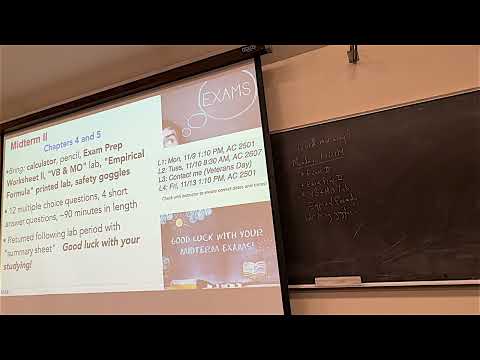
- The exam format matches Midterm 1: 12 multiple-choice questions with five options each, four short-answer questions, and about 90 minutes.
- Exam Prep 2 is a one-page, double-sided assignment requiring questions, answers, and shown work; students are encouraged to contact Michael Russell or tutors for help.
- The empirical-formula lab converts copper chloride to copper metal to determine its formula and initial waters; strong acids and vacuum equipment make goggles essential.
- Acetylene, C2H2, is introduced as a welding-torch fuel, and the problem asks for its approximate H-C-C angle.
- Carbon is placed in the middle and hydrogen on the outside because hydrogen forms only one bond.
- The molecule has 10 valence electrons, or five electron pairs: four from two carbon atoms and one from each hydrogen.
- After connecting the atoms, the initial single-bond structure leaves carbon short of an octet, so additional bonds are needed.
- Acetylene's carbon-carbon triple bond consists of one sigma bond and two pi bonds.
- For VSEPR, a double or triple bond counts as one electron group, so each carbon has two groups: one C-H bond and one C-C bond.
- The two electron groups arrange linearly, giving acetylene an H-C-C angle of approximately 180 degrees.
- The triple bond's high stored energy helps make acetylene useful in welding torches.
- Electronegativity generally increases up and to the right across the periodic table, with fluorine as the most electronegative element.
- For the example set, increasing electronegativity is magnesium, phosphorus, nitrogen, then fluorine.
- Noble gases are generally excluded from basic electronegativity comparisons because they rarely form compounds.
- When two elements lie in opposing trend directions, such as nitrogen and sulfur, Russell recommends checking actual tabulated values rather than relying on the trend alone.
- For formaldehyde, H2CO, carbon is the central atom because hydrogen cannot be central and carbon is less electronegative than oxygen.
- The 12 valence electrons form a structure with two C-H single bonds and an oxygen attached to carbon.
- Oxygen receives lone pairs to complete its octet, then shares a lone pair with carbon to give carbon its required four bonding pairs.
- The resulting C-O double bond has Lewis bond order 2, while each C-H single bond has bond order 1; this differs from the molecular-orbital bond-order formula.
- The formate ion, HCO2-, has 18 valence electrons: one from hydrogen, four from carbon, twelve from two oxygens, and one added for the negative charge.
- Hydrogen stays outside the structure, carbon is central, and the outer atoms receive lone pairs to complete their octets.
- Carbon initially has only three electron pairs, so an oxygen lone pair forms a C=O double bond and completes carbon's octet.
- The double bond can be placed on either oxygen because the two oxygen atoms are equivalent.
- The two equivalent Lewis structures for HCO2- are resonance structures, with the C=O double bond alternating between the two oxygen atoms in the drawings.
- Across the two resonance positions, three bonding pairs are distributed over two C-O bonds.
- Each C-O bond therefore has an average bond order of 3/2, or 1.5, rather than being a fixed single or double bond.
- A bond order of 1.5 indicates a bond stronger than a single bond but weaker than a double bond.
- Bond polarity depends on the electronegativity difference between the two bonded atoms: equal atoms such as F-F form a nonpolar bond.
- Among the listed combinations involving boron, oxygen, fluorine, nitrogen, and carbon, B-F is the most polar because the elements are farthest apart in electronegativity.
- B-C is the least polar option because boron and carbon have relatively similar electronegativities.
- When numerical electronegativity values are available, subtract them to find the difference; periodic trends can provide a useful estimate when they are not.
- CO2 is nonpolar because its two polar C=O bonds point in opposite directions and their dipoles cancel.
- N2 is nonpolar because it contains identical nitrogen atoms, and BCl3 is symmetric with three equivalent B-Cl bonds.
- ClF is polar because fluorine attracts electrons more strongly than chlorine and there is no second bond or symmetric structure to cancel the dipole.
- Neon is an isolated element rather than a molecule; the examples also connect polarity to the tendency of polar substances such as water and nonpolar substances such as oil to mix poorly.
Transcript excerpt
0:00 Good morning. I hope your morning has been going well. Super cool to have you here. Uh we are in the process of going through an exam review because next week uh midterm exam 2 is popping up and like we talked about on Monday and we'll talk about more and more. This midterm is only chapters four and five. So basically problem sets four and five. And so it'll be things like Lewis structures, vesper geometry, uh polarity, uh definitely it'll have stuff on veilance bond theory, SPS, SP2, SP3 kind of stuff and molecular orbital theory. [clears throat] So for everybody in this room, uh the midterm exam will be next Monday afternoon. So we won't go over problem set six, quiz six, all that
0:49 kind of jazz. [snorts] uh instead you'll take the second midterm at the same time exam prep two will be due. So just like before the first midterm there was an exam prep. It was a single page double-sided basically questions followed by the answer. Show your work how to go from the question to the answer. I'm hoping once again that that's not going to be a big deal. But you see number four and you're like what the don't be afraid to reach out to me to the tutors and stuff like that for help. It's not a problem. I want everybody to have this skill set before you take the midterm. All right, that's kind of the idea. And then the midterm itself in format will be identical to the first midterm. 12 multiple choice questions where each question has five possible answers. There'll be like a
1:36 spot to put your letter answer in. [clears throat] I also recommend that you circle the letter just as like a backup. And then at the end, there'll be
This is the start of the transcript. Save this video free for the whole transcript, searchable and time-coded.
In this course
Related notes
Summary, takeaways, and chapters were generated by AI from the video's transcript and may contain errors. The video belongs to its creator, Michael Russell.