102626 Lecture Video
 Watch on YouTube →
Overview
Tim Johann develops the Michaelis-Menten equation from a simple enzyme-substrate model, using the steady-state assumption, conservation of total enzyme, and algebra. He explains how to interpret Vmax and KM, including KM as the substrate concentration at half Vmax, then derives the Lineweaver-Burk form for estimating kinetic parameters from a straight-line plot.
Key takeaways
- The Michaelis-Menten equation is V₀ = Vmax[S]/(KM + [S]), derived from E + S ⇌ ES → E + P using the steady-state assumption and total-enzyme conservation.
- KM equals (k₋₁ + k₃)/k₁ under the steady-state model; it approximates a dissociation constant only when product formation is slow relative to ES dissociation.
- At [S] = KM, the initial rate is half of Vmax, making KM readable from the substrate concentration at the half-maximal point on a rate-versus-substrate graph.
- Vmax = kcat[E]ₜ, so increasing total enzyme increases Vmax linearly, while changing substrate concentration does not change kcat.
- The Lineweaver-Burk plot graphs 1/V₀ against 1/[S]; its slope is KM/Vmax, its y-intercept is 1/Vmax, and its x-intercept is −1/KM.
- Michaelis-Menten curves assume noncooperative behavior; cooperative or allosteric systems, illustrated by hemoglobin's oxygen binding, do not follow the same simple model.
Chapters
- A cystathionine beta-synthase enzyme, abbreviated CBS, that binds vitamin B6 weakly is introduced as a case that may respond to high-dose B6.
- Michaelis-Menten kinetics can help characterize how tightly an enzyme binds a molecule; B6 is a cofactor example, not the enzyme's actual substrate.
- The equation relates initial rate, V₀, to substrate concentration, [S], using Vmax and the Michaelis constant, KM.
- Vmax is the maximum reaction rate for a given enzyme concentration, while V₀ is measured before substrate depletion noticeably slows the reaction.
- The practical rule of thumb for an initial-rate measurement is to use the interval in which no more than about 5% of the substrate is consumed.
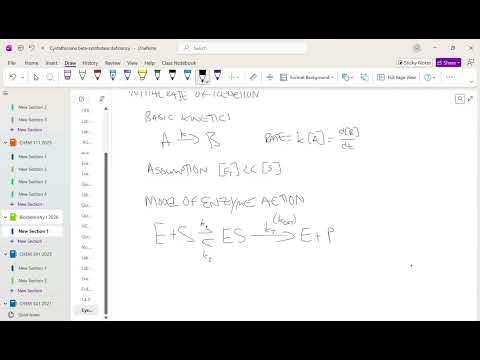
- For a simple reaction A → B, the rate is k[A], or equivalently the rate of product formation can be expressed as d[B]/dt.
- The enzyme model is E + S ⇌ ES → E + P, with k₁ for binding, k₋₁ for dissociation, and k₃ for product formation.
- The derivation assumes total enzyme concentration is much lower than substrate concentration, so enzyme is the limiting component.
- Product formation is expressed as the rate constant k₃ multiplied by the concentration of enzyme-substrate complex, [ES].
- Because [ES] is difficult to measure directly, the steady-state assumption sets its formation rate, k₁[E][S], equal to its breakdown rate, (k₋₁ + k₃)[ES].
- The lecture contrasts this steady-state approach with the fast-equilibrium approximation, which treats k₃ as slow compared with binding and dissociation.
- Rearranging the steady-state expression gives [E][S]/[ES] = (k₋₁ + k₃)/k₁.
- The combined rate-constant expression is defined as KM, giving KM = (k₋₁ + k₃)/k₁.
- KM resembles a dissociation constant, and approximates one when k₃ is much smaller than k₋₁.
- Total enzyme concentration is [E]ₜ = [E] + [ES], because enzyme is either free or bound to substrate in the model.
- Substituting [E] = [E]ₜ − [ES] into the KM relationship removes the hard-to-measure free-enzyme concentration.
- Algebraic rearrangement produces the factor KM + [S], which becomes the denominator of the Michaelis-Menten equation.
- The reaction rate is kcat[ES], with kcat treated as equivalent to k₃ for this course's model.
- At saturation, all enzyme is in the ES complex, so Vmax = kcat[E]ₜ.
- Substituting these rate definitions yields V₀ = Vmax[S]/(KM + [S]); the derivation relies on measurable rates and total enzyme rather than direct [ES] measurements.
- A product-concentration-versus-time curve rises quickly at first and then flattens as substrate is consumed and the reaction slows.
- A plot of initial rate V₀ against substrate concentration [S] rises hyperbolically and approaches Vmax as enzyme active sites become saturated.
- Setting V₀ = ½Vmax in the equation gives [S] = KM, so KM can be estimated at the substrate concentration corresponding to half the maximum rate.
- Kcat remains constant as substrate concentration changes, so a plot of kcat against [S] is horizontal under the stated conditions.
- Vmax depends on the amount of enzyme, and Vmax = kcat[E]ₜ predicts a linear relationship between Vmax and total enzyme concentration.
- Michaelis-Menten behavior can fail for cooperative or allosteric systems, such as hemoglobin's oxygen-binding behavior.
- Taking reciprocals gives 1/V₀ = (KM/Vmax)(1/[S]) + 1/Vmax, a straight-line form of y = mx + b.
- On a plot of 1/V₀ versus 1/[S], the slope is KM/Vmax and the y-intercept is 1/Vmax.
- Setting 1/V₀ to zero gives an x-intercept of −1/KM, which can be used to estimate KM from a hand-drawn or fitted line.
Transcript excerpt
0:00 case where we have vitamin B6 not being bound tightly. >> B6. >> Yeah, you you'd mega dose B6. Okay. So, so this form can be treated by high doses of vitamin B6. Okay. if only all treatments were that simple. Okay, but in this case you can treat it with that. So why am I bringing this up? Well, we're going to talk about Michaelis Menton kinetics today and that is one way that you could determine that your enzyme, your CBS, it's called CBS is the abbreviation, but your CBS enzyme um
0:49 actually doesn't bind V6. Well, okay, that's how you figure out how tightly it bound various things and you could come up with a treatment. questions. Okay. So, we are going to then spo spend most of the rest of the time here deriving the uh maleis meant equation. I'm not going to expect you to derive this from scratch, but I am going to expect you to understand bits of it. Okay? So we're going to be talking about Michaelis Menton kinetics today and we're going to use the
1:35 Michaelis Menton equation in doing that. This is the this is what we're going to derive right here. I'll talk about what the parts are. S is a substrate concentration. This is a big K. Okay. So this is substrate concentration. All right. Vmax is the maximum rate. for a given concentration of enzyme. Okay. V knot is the initial rate
2:39 of >> the rate of the reaction. Okay. And that's the same for the maximum rate. It's rate of reaction. And this is initial rates. You did initial rates last week in lab, right? You determined last week you did protein concentrations. Two weeks ago, you did initial rates. Remember, you had to get straight lines. And the straight line is
This is the start of the transcript. Save this video free for the whole transcript, searchable and time-coded.
Related notes
Summary, takeaways, and chapters were generated by AI from the video's transcript and may contain errors. The video belongs to its creator, Tim Johann.