090426 Lecture Video
 Watch on YouTube →
Overview
Tim Johann connects chemistry concepts, especially charge and Le Chatelier’s principle, to kidney function and acid-base chemistry. He explains nephron filtration, reabsorption, secretion, and excretion; shows how bicarbonate treatment makes aspirin more ionized for urinary removal; and derives the relationship between pH, pOH, and ion concentrations using water’s equilibrium constant, Kw = 1.0 × 10^-14 at 25°C.
Key takeaways
- The nephron filters small solutes at the glomerulus, reabsorbs useful substances into blood, secretes additional wastes into the tubule, and excretes the remaining fluid as urine.
- Opposite directions of fluid and blood flow support concentration gradients that help the nephron recover solutes such as potassium.
- Bicarbonate treatment for aspirin poisoning raises urinary pH, shifting aspirin toward its ionized form, which crosses membranes less readily and is more readily excreted.
- At 25°C, water’s ion product is Kw = [H3O+][OH−] = 1.0 × 10^-14, so pH + pOH = 14.
- A solution at pH 4.9 has pOH 9.1, hydronium concentration about 1.26 × 10^-5 M, and hydroxide concentration about 7.94 × 10^-10 M.
Chapters
- Tests generally cover material since the previous test, while the final covers the full course.
- Tim Johann identifies entropy, charge, Le Chatelier’s principle, and oxidation as core course ideas.
- The kidney serves as an example for applying charge and equilibrium concepts.
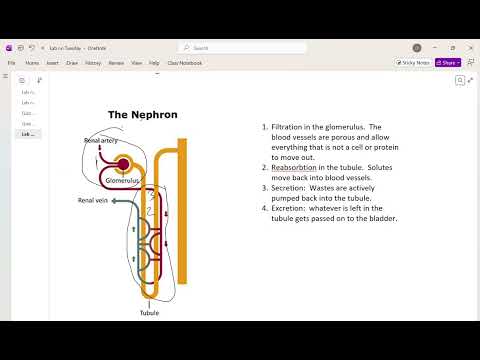
- The nephron is the kidney’s basic functional unit, and each kidney contains millions of nephrons.
- Filtration occurs at the glomerulus, where porous blood vessels allow water and small solutes to enter the nephron while retaining cells and proteins.
- The explanation connects movement of dissolved substances to concentration gradients and entropy.
- During reabsorption, useful solutes move from the tubule back into nearby blood vessels.
- During secretion, wastes are actively transported from blood into the tubule.
- The four stages are filtration, reabsorption, secretion, and excretion, with remaining fluid ultimately passing to the bladder.
- The kidney can retain needed substances such as potassium while directing waste toward excretion.
- Blood vessels run opposite to fluid flow through the nephron, supporting solute exchange along the tubule.
- Johann uses potassium to illustrate how concentration gradients can favor recovery across successive regions.
- The countercurrent arrangement is presented as a mechanism that helps maintain favorable gradients for reabsorption.
- Aspirin’s carboxylic acid group can lose a proton, producing a negatively charged form.
- The uncharged, more hydrophobic form crosses cell membranes more readily and can return from the nephron to the blood.
- Bicarbonate given by IV raises urinary pH and shifts aspirin toward its charged form, which crosses membranes less readily and is more likely to be excreted.
- This treatment example applies Le Chatelier’s principle to an acid-base equilibrium.
- In the Brønsted-Lowry model, acids donate H+ and bases accept H+; in water, base reactions can produce hydroxide.
- Acetic acid transfers a proton to water, forming acetate and hydronium.
- Ammonia accepts a proton from water, producing ammonium and hydroxide.
- Common structures in biochemistry include negatively charged oxygen with one bond, neutral oxygen with two bonds, neutral nitrogen with three bonds, and positively charged nitrogen with four bonds.
- Two water molecules can exchange a proton to form hydronium, H3O+, and hydroxide, OH−.
- The equilibrium constant expression incorporates liquid water’s effectively constant concentration.
- At 25°C, Kw = [H3O+][OH−] = 1.0 × 10^-14.
- Knowing either hydronium or hydroxide concentration allows the other to be calculated from Kw.
- pH is −log[H+], while pOH is −log[OH−]; at 25°C, pH + pOH = 14.
- For coffee at pH 4.9, the corresponding pOH is 9.1.
- The concentrations are approximately [H+] = 1.26 × 10^-5 M and [OH−] = 7.94 × 10^-10 M.
- The worked example demonstrates using base-10 logarithms and inverse logarithms to convert between pH values and molar concentrations.
Transcript excerpt
0:00 tests will cover everything before the test and then a test generally doesn't cover things that were on the last test. If it did, if some if people did really bad on something that I felt you had to know, I might pull it over and I would tell you I was doing that and then the final covers everything. >> Great question. Okay. So today what we're going to do is we're going to take remember the thing thing that I like about chemistry is we take a small number of concepts and we apply them to as many things as possible. And so our big concepts in this class are for big three. >> Entropy is always >> okay that's the giantest biggest concept over everything else. Entropy is always increasing. Right? So we have used that some but really we filter down and then
0:47 we're going to be applying these three concepts. One of which was you can explain most of chemistry using >> charges. That's one. Another one is Lachet Leier's principle, right? Okay. And then the other one is going to be that things get oxidized in reactions. We're going to apply the first two. Okay. Charges and Lachet Leier's principle are going to be important today. And I want to give you an example of why they would be important. So we're going to talk a little bit about as an example of why this stuff's important. We're going to talk about the kidney today. And so the basic unit of the kidney is what's called a nephron. Okay. So essentially when we look at a
1:35 kidney like this, it's just millions of these things. Okay. And the nefron is going to purify. I'm going to talk about how that works and for talking about that. So, this is
This is the start of the transcript. Save this video free for the whole transcript, searchable and time-coded.
Related notes
Summary, takeaways, and chapters were generated by AI from the video's transcript and may contain errors. The video belongs to its creator, Tim Johann.