090926 Lecture Video
 Watch on YouTube →
Overview
Tim Johann explains how pH and pKa predict the protonation, charge, and relative abundance of acids and conjugate bases, then derives and applies the Henderson-Hasselbalch equation. Worked examples use Tylenol with pKa 9.5 and phosphate with pKa 7.2; the lecture then connects buffer capacity and the bicarbonate system to blood pH, including how metabolism and breathing affect acidity.
Key takeaways
- When pH equals pKa, an acid and its conjugate base are equally abundant; below pKa the protonated form dominates, and above pKa the deprotonated form dominates.
- Henderson-Hasselbalch, pH = pKa + log([A−]/[HA]), converts a known pH and pKa into the conjugate-base-to-acid ratio.
- At pH 8.0, Tylenol with pKa 9.5 has an A−/HA ratio of about 0.0316, corresponding to roughly 97% protonated and 3% deprotonated forms.
- A buffer is most effective when both conjugate forms are present at substantial concentrations and their ratio is between approximately 1:10 and 10:1.
- The phosphate buffer pair H2PO4−/HPO4²− has pKa 7.2, making it relevant near physiological pH; a tenfold excess of acid places pH one unit below that pKa.
- The bicarbonate system links respiration to blood acidity: CO2 production increases H+, while CO2 exhalation shifts the equilibrium toward lower H+.
Chapters
- Amide bonds generally do not gain or lose protons at biological pH, so they should not be treated as ionizable groups in these problems.
- The Tylenol group discussed has a pKa of 9.5, the negative logarithm of its acid dissociation constant.
- At pH equal to pKa, the protonated acid and deprotonated conjugate base are present in equal amounts.
- Below a pKa, higher H+ availability favors the protonated form; above a pKa, the deprotonated form dominates.
- For the Tylenol example, the neutral protonated form dominates below pH 9.5, while the negatively charged form dominates above it.
- Le Chatelier’s principle explains the shift: added H+ drives the acid-base equilibrium toward the protonated species.
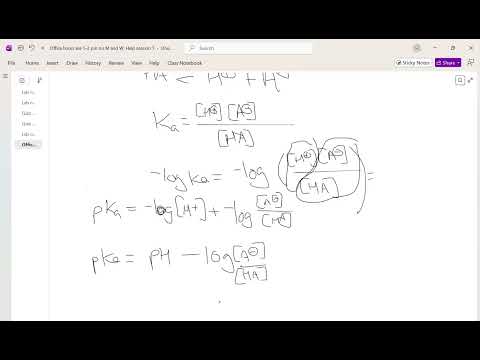
- For HA ⇌ H+ + A−, the acid dissociation constant is Ka = [H+][A−]/[HA].
- Taking negative logarithms and rearranging yields pH = pKa + log([A−]/[HA]).
- The equation follows from the equilibrium expression and logarithm rules, rather than being an unrelated formula.
- With Tylenol pKa 9.5 and pH 8.0, Henderson-Hasselbalch gives log([A−]/[HA]) = −1.5.
- Taking 10 to the power of −1.5 gives [A−]/[HA] ≈ 0.0316, so the protonated form is much more abundant.
- The result is a useful check: pH is below pKa, so HA should dominate.
- Combining the ratio 0.0316 with a total abundance of 100% gives approximately 97% HA and 3% A−.
- For a total Tylenol concentration of 55 mM, the lecture estimates about 53 mM HA and 2 mM A−.
- The same ratio method works with a specified total concentration by setting total concentration equal to [HA] + [A−].
- Buffers resist substantial pH changes when acid or base is added by shifting the conjugate acid-base equilibrium.
- The phosphate pair H2PO4−/HPO4²− has a relevant pKa of 7.2, close to blood pH around 7.4.
- Effective buffers need both acid and conjugate base at relatively high concentrations; the lecture gives 10 mM as a practical minimum and 50 mM as preferable.
- For phosphate with pKa 7.2, a 10:1 acid-to-base ratio gives pH 6.2, while the reversed ratio gives pH 8.2.
- One pH unit from the pKa corresponds to a 10:1 or 1:10 ratio; two units correspond to 100:1 or 1:100.
- The lecture treats ratios within 10:1 as a useful buffer range and approximates the dominant species as 100% when pH is at least two units from pKa.
- Carbon dioxide reacts with water to form carbonic acid, which dissociates into H+ and bicarbonate; the carbonic acid pKa is given as 6.4.
- Cellular respiration produces CO2, shifting the bicarbonate equilibrium toward H+ and lowering pH, especially in metabolically active tissues.
- Exhaling CO2 in the lungs shifts the equilibrium toward reduced H+, making lung pH about 7.6; tissues are about 7.2 and blood averages about 7.4.
- Because blood pH 7.4 is above the carbonic acid pKa of 6.4, bicarbonate is the dominant species.
Transcript excerpt
0:02 Okay. Where Where is this going thing going to lose a proton? The hydroxyl, right. Okay. So, for that peptide bond there, right? It's not a peptide bond, but the amide bond amides never deprotonate or protonate for that matter. They are really unreactive at the pH's that we talk about biological systems, and so you should never try to remove those. All right. So, you get a negative charge here. Okay. And the pKa for this group is
0:54 going to be 9.5. Remember, pK is the negative log of KA. So, let's talk about what that pKa means. So, when the pH is equal to So, we talk about this, we have the acid and its conjugate base, right? When we look at this, type this cuz it'll be easier. So, when the pH equals the pKa, the concentrations of acid and conjugate base are equal. All right. So, in other words, when the
1:57 pH is seven for this for Tylenol is 9.5, you're 50% of this form and 50% of that form. Now, I did not I left out something up here that's important for our discussion. And that's that the matter cannot be created or destroyed, right? And charge is not created or destroyed. I have to have the same charge on this side as that side. All right, so now let's think about if we were to draw a little pH scale here. Let's say this is a pH scale where I have zero down here and I have 14 up here and then right here is where that pKa is, right? This is 9.5. For the Tylenol, which form is present at lower pHs?
2:48 The one on the left, the protonated form. So, if you have more protons around at lower pH, they stick to things
This is the start of the transcript. Save this video free for the whole transcript, searchable and time-coded.
Related notes
Summary, takeaways, and chapters were generated by AI from the video's transcript and may contain errors. The video belongs to its creator, Tim Johann.