091126 Lecture Video
 Watch on YouTube →
Overview
The lecture develops the structure and chemistry of DNA and RNA, from distinguishing nucleosides and nucleotides to drawing nucleotide polymers, identifying base pairs, and explaining RNA backbone cleavage and DNA polymerization. It connects these mechanisms to cellular energy use and PCR, including how primers, antiparallel strands, and repeated amplification cycles support COVID-19 testing.
Key takeaways
- RNA's 2′-OH can attack a neighboring phosphate after deprotonation, enabling backbone cleavage and making RNA less stable than DNA.
- DNA polymerases add nucleotides only to a growing strand's 3′ end, which makes antiparallel strand orientation central to DNA synthesis and PCR primer design.
- Standard A-T and G-C pairing is supported not only by hydrogen bonds but also by the geometric fit of those pairs in DNA polymerase active sites.
- DNA polymerization releases pyrophosphate, and hydrolysis of pyrophosphate to two inorganic phosphates, with a standard free-energy change near −19 kJ/mol, helps drive the reaction forward.
- PCR uses denaturation, primer annealing, and polymerase extension; repeated cycles amplify a target sequence exponentially, while real-time PCR tracks amplification with fluorescence.
- COVID-19 antigen tests detect nucleocapsid protein, while PCR tests detect viral genetic material after reverse transcription converts RNA into DNA.
Chapters
- Nucleosides contain a sugar and base, while nucleotides also contain one or more phosphate groups; students should match structures with names such as adenosine diphosphate.
- RNA uses ribose with a 2′ oxygen and uracil, while DNA uses deoxyribose and thymine, which has a methyl group where uracil has hydrogen.
- The four bases divide into purines, adenine and guanine, with two rings, and pyrimidines, cytosine, thymine, and uracil, with one ring.
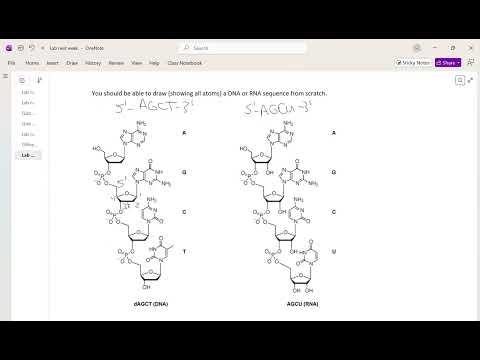
- A nucleotide polymer has a phosphate, sugar, and base, connected through the sugar and phosphate backbone; the base must attach at the correct sugar position.
- Practice drawing sequences such as 5′-CAG-3′ with all atoms and correct line-angle structures, including phosphodiester connections between nucleotides.
- For grading, atom placement and connectivity matter, but wedge stereochemistry and electron pairs are not required; drawing efficiently leaves more exam time.
- RNA is less stable than DNA because its 2′-OH can act as an internal nucleophile, a feature absent from DNA's deoxyribose.
- A base removes the 2′-OH proton, allowing the resulting oxygen to attack a neighboring phosphate and break the RNA backbone.
- The same nucleophilic chemistry helps explain catalytic RNA, where RNA can participate directly in chemical reactions.
- DNA serves as the durable genetic blueprint, while shorter-lived RNA copies carry instructions used to make proteins.
- Standard DNA base pairs are adenine-thymine, with two hydrogen bonds, and guanine-cytosine, with three; students may need to draw the base atoms and bonding.
- The major groove is wider and more accessible than the minor groove, and proteins can recognize DNA by the different functional groups exposed along each groove.
- DNA is a right-handed double helix, which can be identified with the right-hand rule by curling fingers in the helix direction while the thumb points along its axis.
- The two DNA strands are antiparallel: one runs 5′ to 3′ while its partner runs 3′ to 5′.
- DNA and RNA polymerases extend chains at the 3′ end, so strand direction is essential when drawing sequences or planning primers.
- Although different base combinations can form hydrogen bonds, DNA polymerase active sites favor the shape and geometry of standard A-T and G-C pairs.
- An enzyme pocket that fits a standard pair can clash with atoms in mismatched pairs or leave excessive space, helping enforce accurate DNA synthesis.
- RNA can form more varied structures and base-pairing patterns than the predominantly double-helical DNA discussed in this lecture.
- During DNA synthesis, the growing strand's 3′-OH attacks the incoming nucleotide's phosphate, and pyrophosphate leaves as the new phosphodiester bond forms.
- The incorporated nucleotide becomes a monophosphate in the polymer, releasing pyrophosphate and accounting for the loss of two phosphate groups from the incoming NTP.
- Cellular pyrophosphatase converts pyrophosphate into two inorganic phosphates; the hydrolysis has a standard free-energy change of about −19 kJ/mol and drives polymerization forward.
- At-home COVID-19 antigen tests detect the virus's nucleocapsid protein, whereas PCR tests detect genetic material by amplifying a targeted sequence.
- Because SARS-CoV-2 has an RNA genome, PCR workflows first make DNA from the RNA using reverse transcriptase before amplifying the DNA.
- PCR amplification can make enough target DNA to detect on a gel or through other readouts.
- PCR separates double-stranded DNA by heating, allows short primers to bind during cooling, then uses DNA polymerase to extend from each primer's 3′ end.
- Primers must bind antiparallel to the templates with their 3′ ends pointing into the target region; extension in the wrong direction would not copy the desired segment.
- Repeated PCR cycles can double the target DNA each round, producing a theoretical 2, 4, 8, 16 progression; real-time PCR monitors fluorescent signal as product accumulates.
- COVID-19 real-time PCR uses primers targeting DNA made from viral RNA, so amplification indicates that the target sequence was present in the sample.
Transcript excerpt
0:04 All right. So, we're going to move into chapter I think it's probably chapter three in the book. It talks about DNA and nucleotides and nucleotides. Um, nucleotides are just a little different. They don't have the phosphates on them, but otherwise they are nucleotides. So, what I've got here is a picture of the four. These are the ribboucleotides. So, what that the difference there? Well, there's a couple differences there. Uh but so what you do need need for below is you need to know need to be able to draw the following with all atoms. Okay, when I say all atoms I mean like it's shown. Okay, so correct line angle structure for for all counts for all atoms. But need to be able to draw the
0:52 poly with all atoms. need to be able to do need to be able to do a mix and match problem with the names. All right? So, if I gave you structures and then I gave you names, I'd expect that you could line them up. And specifically, you know, a dentalate, right? I'm not going to ATP. This is AM, right? I'm not going to ask you to say, "Hey, give me the exact name." And if you say adenazine, you're wrong. But I might I might give you a denazine, which is the nucleioide. Nucleioides don't have the phosphates on them. Nucleotides do have the phosphates on them. Okay?
1:40 That you could mix and match these. And if it turned out I gave you, let's say I gave you this instead. Okay. Let's say it gave you that one instead for this one. What would you call that? [clears throat] >> Yeah. denazine diphosphate. Okay, so you should be able but mix and match for that. Not not you have to name
This is the start of the transcript. Save this video free for the whole transcript, searchable and time-coded.
Related notes
Summary, takeaways, and chapters were generated by AI from the video's transcript and may contain errors. The video belongs to its creator, Tim Johann.