090226 Lecture Video A
 Watch on YouTube →
Overview
Tim Johann connects water’s molecular structure to its behavior in cooking and biochemistry: hydrogen bonding explains water’s high energy requirements for melting and vaporization, while polarity lets water dissolve salts and other polar substances. He then uses entropy and the hydrophobic effect to explain protein binding, amphipathic fatty acids, oil-water separation, and the transition toward biological membranes.
Key takeaways
- Water's polarity comes from oxygen's greater electronegativity than hydrogen, allowing water molecules to form a network of hydrogen bonds.
- Water requires substantial energy to change phase because melting disrupts some hydrogen bonds and vaporization separates water molecules from nearly all of them.
- Water dissolves sodium chloride by orienting its partial charges around Na+ and Cl−, replacing the crystal's ionic attractions with many water-ion interactions.
- Hydrophobic binding can be driven by entropy: bringing nonpolar surfaces together releases ordered water molecules into the more flexible bulk solution.
- Oil and water separate because a layered arrangement reduces their contact area and the amount of water constrained at hydrophobic surfaces.
- Maillard browning requires temperatures around 120°C or above, so evaporation and the local availability of water help determine when food surfaces can brown.
Chapters
- The quiz is Friday; students should know cell parts and their functions at the depth shown in class diagrams, and may need to draw a cell and label four parts.
- Tim Johann holds office hours Monday and Wednesday from 1:00 to 2:00 p.m., with appointments available by email.
- A Thursday 8:00 to 9:00 p.m. Teams help session is planned, but Johann may log off if nobody joins during the first 10 minutes.
- The lab report is due on paper at the start of Tuesday lab, at 8:30; next week's lab meets in the classroom.
- Johann uses preference for cooked meat to practice a natural-selection explanation: cooking reduces bacteria, lowering the risk of illness or death and increasing the chance of having offspring.
- The selected trait is a preference for cooked meat; the relevant genes may contribute to taste preference, rather than being a single known gene.
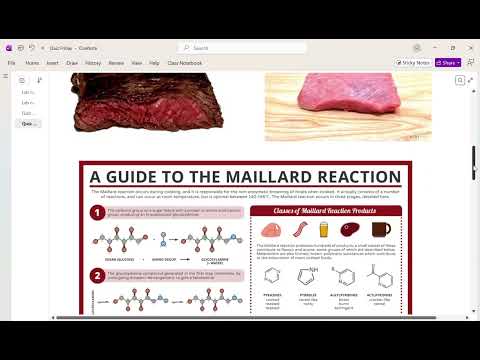
- Maillard reactions combine sugars or other carbohydrates with amino acids to produce aromatic compounds that contribute to cooked meat's smell and flavor.
- The reactions require temperatures around 120°C or higher, above water's 100°C boiling point at standard pressure.
- A pure-water heating curve has plateaus at 0°C during melting and 100°C during boiling; temperature rises again after each phase change finishes.
- Heat of fusion is the energy needed to melt a solid, while heat of vaporization is the energy needed to turn liquid into gas.
- Dissolved solids can raise a solution's boiling point; Johann uses fudge, which reaches roughly 234 to 236°F as water evaporates and sugar becomes concentrated.
- During cooking, energy can go into vaporizing water rather than raising temperature, so browning may begin rapidly once enough water has evaporated.
- Water is polar because oxygen is more electronegative than hydrogen: Johann gives approximate electronegativities of 3.5 for oxygen and 2.1 for hydrogen.
- A water molecule can participate in about four hydrogen bonds; in ice it forms four on average, in liquid water about 3.5, and in water vapor essentially zero.
- Breaking hydrogen bonds helps explain why melting and especially vaporizing water require substantial energy.
- The average of 3.5 hydrogen bonds in liquid water describes a fluctuating network, not a literal half-bond on every molecule.
- In sodium chloride, water's partially positive hydrogen ends orient toward chloride ions, while its partially negative oxygen end orients toward sodium ions.
- Water dissolves the crystal by surrounding the separated ions with many polar interactions, while dispersing the ions increases entropy compared with the ordered crystal.
- When a molecule binds to a protein, it can displace water molecules that were constrained in ordered cages around the binding surfaces.
- Johann identifies entropy as important to biochemical binding, including drug-protein interactions, and to the formation of membranes.
- Amphipathic molecules have both polar and nonpolar regions; a fatty acid provides an example with a hydrophilic, negatively charged head and a hydrophobic hydrocarbon tail.
- Water molecules next to a hydrophobic surface have fewer ways to hydrogen-bond with other waters, creating a more ordered, lower-entropy arrangement.
- When a hydrophobic drug binds to a hydrophobic patch on an enzyme, it can release constrained water back into solution, increasing entropy.
- Johann describes this release of water, or solvation effect, as a major driver of many hydrophobic molecular interactions.
- Shaking oil and water disperses oil into droplets, increasing the oil-water contact area and the number of water molecules forced into ordered arrangements.
- When the mixture settles into layers, it minimizes contact between oil and water; the reduction in constrained water is more favorable for entropy despite the layered appearance.
- A classroom illustration compares roughly 33 ordered-cage water interactions around separate fatty-acid tails with about 13 after the hydrophobic tails come together.
- Johann closes by introducing membrane lipids as a more complex biological structure that reduces water's exposure to hydrophobic regions.
Transcript excerpt
0:00 Um, I'm using a I've decided I'm going to try to use this pad over here. It's I'm still learning and it's going to be a little bit awkward, but I should get hopefully we'll get better. I need to be able to draw smaller than that. The I'm able to draw using the the the glove and the other thing cuz I have to use my It's just My old machine My old machine was much better and I wish they'd let me keep it. Uh, but anyway, uh, so we got a quiz on Friday. Can everybody see this? Is that big enough? >> Verruca. Verruca. >> Okay, quiz on Friday. I'll remind you my office hours are Monday and Wednesday 1:00 to 2:00 p.m. Or by appointment if you can't make that. Email me um, if you want to try to make some sort of appointment or just come
0:47 talk to me after class. Happy to do that. Um, and then I also have a help session tomorrow night, the night for the quiz, help session um, Thursdays. So, um, that's going to be 8:00 to 9:00 p.m. for you guys um, on Teams. And I'll remind you if nobody it doesn't mean I'm going to be there 8:00 to 9:00 p.m. If nobody's there for the first 10 minutes, like I said I've said before, I'm going to take a nap or something. Okay, I will log off. I'm not going to stay the whole time. Um, so, um, that's what that is and then we have a lab report due next week. And that's on Tuesday at the beginning
1:34 of lab. Uh, what is it? 8:30? On paper. Okay, so I it's a paper report you're going to hand to me. That's the only one that's going
This is the start of the transcript. Save this video free for the whole transcript, searchable and time-coded.
Related notes
Summary, takeaways, and chapters were generated by AI from the video's transcript and may contain errors. The video belongs to its creator, Tim Johann.