102826 Lecture Video
 Watch on YouTube →
Overview
Tim Johann reviews how to calculate total protein and specific activity for crude, desalted, and most-active enzyme fractions, then works through a Lineweaver-Burk analysis of creatine kinase data. The example yields an estimated Vmax of 55 mM/s, a KM of 100 μM for ADP, and a kcat of about 11,000 s⁻¹; the lecture then introduces competitive inhibitors, their transition-state-like binding, and their effect on kinetic plots.
Key takeaways
- For each purified enzyme fraction, calculate total protein as the standard-curve concentration multiplied by the dilution factor and by that fraction's total recovered volume.
- The Lineweaver-Burk y-intercept is 1/Vmax and the x-intercept is -1/KM, allowing both kinetic parameters to be estimated from a reciprocal plot.
- In the creatine kinase example, the hand-drawn plot estimates Vmax at 55 mM/s and KM for ADP at 100 μM.
- Using 5.0 μM enzyme and Vmax of 55 mM/s gives an approximate kcat of 11,000 s⁻¹ after converting enzyme concentration to 0.0050 mM.
- Competitive inhibitors occupy the active site and can be overcome by increasing substrate concentration; they leave Vmax unchanged, so the Lineweaver-Burk y-intercept stays the same.
- Enzymes bind transition states rather than simply stabilizing substrates, which is why transition-state-like molecules can make strong competitive inhibitors.
Chapters
- Submit a course-section preference form before registration if a particular section is needed to avoid a schedule conflict.
- A required course conflict that threatens on-time graduation can be resolved, but less critical preferences may not be accommodated after sections fill.
- Biochemistry II lab is scheduled for Tuesday morning, so students should check how the change affects their other plans.
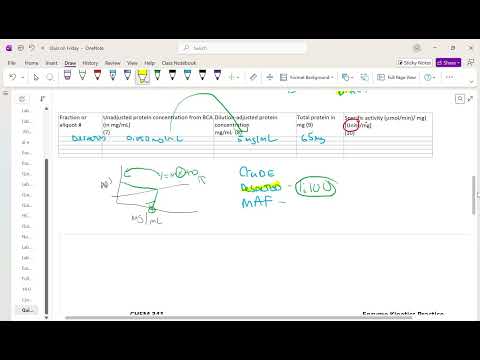
- The protein calculations use data from the lab conducted the previous week, while the activity calculations come from the earlier enzyme assay.
- Use the standard-curve equation, y = mx + b, to solve for the protein concentration from the measured absorbance rather than estimating from the graph.
- Convert micrograms to milligrams, then adjust the concentration for the dilution used for each crude, desalted, or most-active fraction.
- A desalted sample measured at 0.050 mg/mL after a 1:100 dilution corresponds to 5 mg/mL in the original sample.
- Calculate total protein by multiplying the dilution-corrected concentration by the total volume for that purification step; the example uses 13 mL to obtain 65 mg.
- Use each fraction's own volume: an example crude volume is 53.7 mL, while the collected most-active fractions total 5 mL.
- Use the total crude supernatant volume recorded after centrifugation, including the volume removed for aliquots, rather than substituting 5 mL.
- The volume used in total-protein calculations should match the full amount recovered at that purification step.
- The lab report combines protein data from the later lab with activity data from the earlier lab, so students should keep the two data sources distinct.
- The Lineweaver-Burk equation is 1/v = (KM/Vmax)(1/[S]) + 1/Vmax, in the straight-line form y = mx + b.
- Convert every substrate concentration and initial velocity to its reciprocal before plotting.
- The example varies ADP while holding creatine phosphate at a high, constant concentration; the plotted units remain reciprocal versions of the original units.
- Start both axes at zero so the y-intercept can be read and the line can be extended to the x-intercept.
- The example's reciprocal substrate values extend to about 0.05, while reciprocal velocities reach about 0.1; the chosen scale uses five divisions on each axis.
- Plot the reciprocal data and draw a best-fit straight line; a curved pattern can indicate an axis or plotting problem.
- Extend the fitted line into negative x values to locate the x-intercept, which equals -1/KM.
- An estimated y-intercept of 0.018 gives Vmax ≈ 1/0.018 = 55 mM/s; hand-drawn precision supports reporting about two significant figures.
- An x-intercept near -0.01 μM⁻¹ gives KM ≈ 100 μM, and the relevant substrate is ADP because its concentration was varied.
- KM describes how tightly an enzyme binds a substrate and is relevant to enzyme deficiencies and designing drugs that compete with substrates.
- Calculate kcat from Vmax = kcat × total enzyme concentration, first converting the example's 5.0 μM enzyme concentration to 0.0050 mM.
- Using Vmax ≈ 55 mM/s gives kcat ≈ 11,000 s⁻¹, the number of substrate-to-product turnovers per enzyme molecule each second.
- Drug development often uses enzyme inhibitors, although some compounds instead prevent two proteins from binding to each other.
- The lecture distinguishes covalent inhibitors, which permanently disable an enzyme, from noncovalent inhibitors, the main focus of the kinetics material.
- The four noncovalent categories introduced are competitive, noncompetitive, uncompetitive, and mixed; the active site is where substrates bind and the reaction occurs.
- A competitive inhibitor binds in the enzyme's active site, preventing substrate from occupying the same pocket.
- Enzymes bind transition-state shapes especially tightly; effective competitive inhibitors can imitate that shape and its charge distribution.
- Adding more substrate can outcompete a reversible competitive inhibitor because substrate and inhibitor binding are equilibria.
- On a Michaelis-Menten plot, competitive inhibition slows the reaction at a given substrate concentration, but sufficiently high substrate can restore the same Vmax.
- On a Lineweaver-Burk plot, unchanged Vmax means the inhibited and uninhibited lines share the same y-intercept, since that intercept is 1/Vmax.
- The inhibited line lies higher at low substrate concentrations because its reaction velocity is lower and its reciprocal velocity is larger; the upcoming quiz covers straight-line kinetic calculations, not inhibitor types.
Transcript excerpt
0:03 All right, preference forms. Um, did I send you an email for this or just my gen camemers? I think I'm not sure whether I sent you an email on this. This is the preference form that you can use if you if you need a certain section of a course next term. And there there are multiple sections. You want to get this in before registration. Okay. Um, this is how you get that get the course you want. If you wait until after registration and then you have some conflict and you didn't get the class because of the specific section because it filled up, um, you know, if it's going to stop you from graduating, it'll get fixed. Okay? If it'll stop you from graduating on time, if it means you have to take some course that you didn't want to take, like goat yoga, here I got the goat yoga for that. If it means you have to take the goat yoga class instead of something else, um
0:51 you're gonna get stuck with the goat yoga class if it doesn't stop keeps you on graduation. Okay. There isn't there isn't more than >> there is there is such a thing as goat yoga. There it isn't a class here. But >> my daughter went to a birthday party that had puppy yoga. >> They should do that here. >> Is that equal to like Pam? >> What was that? >> Is this >> instead of Pcam? you get you get goat we'll sub in goat yoga >> I I will I will tell Dr. Anderson, that that was what was suggested in my class. Um, >> I didn't say it. >> Anyway, fill out the form if you have a conflict, okay? It'll be a mess later
This is the start of the transcript. Save this video free for the whole transcript, searchable and time-coded.
Related notes
Summary, takeaways, and chapters were generated by AI from the video's transcript and may contain errors. The video belongs to its creator, Tim Johann.