090226 Lecture Video B
 Watch on YouTube →
Overview
Tim Johann connects amphiphilic lipid self-assembly to cell membranes and mRNA vaccine delivery: lipid carriers shield negatively charged RNA from water and help it enter cells, where the RNA can direct protein production. He then compares ionic, hydrogen-bond, dipole-dipole, and London dispersion interactions, explaining their charge patterns with examples including acetone, water, and argon.
Key takeaways
- Amphiphilic lipids self-assemble so polar heads remain exposed to water while hydrophobic tails are hidden, reducing water's contact with nonpolar molecules.
- Because mRNA carries a negatively charged backbone, lipid-based carriers can protect it from the aqueous environment and support its delivery into cells.
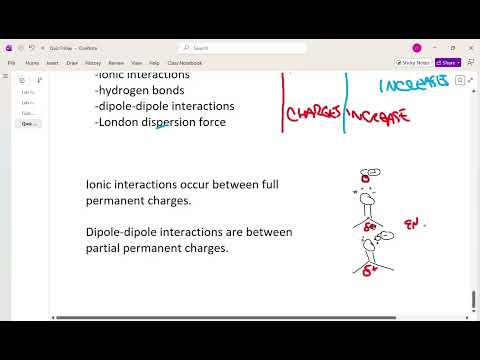
- Ionic attractions involve full permanent charges, whereas dipole-dipole attractions involve partial permanent charges, as illustrated by sodium chloride and acetone.
- Hydrogen bonds are a specific, strong form of dipole-dipole interaction involving hydrogen bonded to F, O, or N and another F, O, or N atom.
- London dispersion forces result from temporary electron imbalances that induce charge shifts in nearby atoms; these weak attractions help argon condense when cooled.
Chapters
- Amphiphilic lipids have polar heads that interact with water and nonpolar fatty-acid tails that avoid it.
- Micelles hide hydrophobic tails in their interior, while cell membranes and liposomes arrange lipid tails away from water; these structures can also carry hydrophobic drugs.
- mRNA has a negatively charged backbone and cannot readily cross a cell's lipid bilayer on its own.
- Lipid-based delivery particles shield mRNA in a hydrophobic interior and present polar heads to surrounding water, helping deliver the RNA into cells for protein production.
- The four forces introduced are ionic interactions, hydrogen bonds, dipole-dipole interactions, and London dispersion forces, ordered from stronger to weaker in the lecture's comparison.
- Ionic interactions attract full permanent charges, as between sodium ions with a +1 charge and chloride ions with a -1 charge.
- Dipole-dipole interactions occur between partial permanent charges; acetone molecules can orient their partially negative oxygen regions toward partially positive regions on neighboring molecules.
- Acetone evaporates faster than water because its intermolecular attractions are weaker; the lecture compares a carbon-oxygen electronegativity difference of 1.0 with water's 1.4.
- Hydrogen bonds are treated as especially strong dipole-dipole interactions involving hydrogen bonded to fluorine, oxygen, or nitrogen and an additional fluorine, oxygen, or nitrogen atom.
- Carbon-bonded hydrogens do not meet the lecture's hydrogen-bond criteria; orbital overlap also contributes to why hydrogen bonding is more complex than electronegativity differences alone.
- London dispersion forces arise when temporary electron imbalances create transient charges that induce corresponding charge shifts in neighboring atoms.
- Argon atoms have eight outer-shell electrons; momentary electron distributions can create weak attractions that help explain why argon liquefies when cooled.
Transcript excerpt
0:01 I don't have the snippet together skills. This is this is low production value. All right. So, but when we think about this, hold on, let me get this. I want to draw. So, often when we talk about membrane lipids, we talk about you look at things and you have one or two tails on them. So, it's a a polar head with two fatty acid tails, okay? Um and we'll go to the into these the structures of these in great detail later on in the course. But right now we're going to cartoonify them. Okay? So, what we've got here is I'm just keep that. We've got a polar head. Might be charged, might just be like
0:49 OHs, and we have a uh a nonpolar tail. Okay? We've got a polar head and a nonpolar tail. Well, you can get all sorts of interesting structures that fall form. So, this is a micelle right here. Here we have all the little tails on the inside, okay? This is a great place if you you could use these sorts of things to to uh deliver drugs. So, you could put a very hydrophobic drug in here and then hope it's going to make it there. Um liposomes, when I was getting out of grad school, one of the faculty uh at my grad school actually had a company that had started where they were using liposomes to deliver things and they were actually putting drugs in here. They were actually using it for diagnostics at the time. Um and
1:37 then when we think about cells, cells form this structure, okay? And the deal here is once again, we are minimizing the surface area of contact between water and hydrophobic molecules. So, in this case, we've got a polar head,
This is the start of the transcript. Save this video free for the whole transcript, searchable and time-coded.
Related notes
Summary, takeaways, and chapters were generated by AI from the video's transcript and may contain errors. The video belongs to its creator, Tim Johann.