100826 L2 Chemistry 221 Video Lecture Part II
Overview
Michael Russell’s Chemistry 221 lecture builds the quantum-mechanical model of the atom from de Broglie’s matter waves and Heisenberg’s uncertainty principle to Schrödinger wavefunctions and probability-based orbitals. It explains the allowed values of the four quantum numbers, how orbital labels and nodes follow from them, and how the Pauli exclusion principle accounts for the capacities of s, p, and d subshells.
Key takeaways
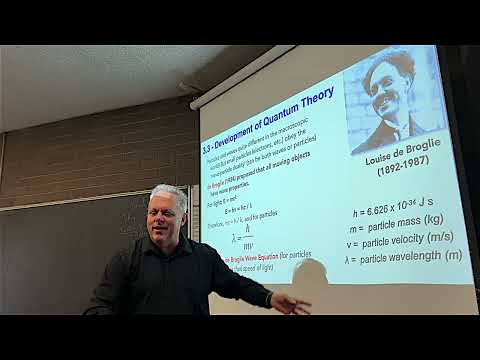
- The de Broglie relation λ = h/(mv) predicts measurable wave behavior for electrons because their low mass allows a much larger wavelength than that of everyday objects.
- An orbital is a probability distribution, not a planetary path; the lecture uses regions containing an electron more than 90% of the time as a practical visualization.
- Allowed quantum numbers are linked: n is a positive integer, l ranges from 0 to n − 1, mₗ ranges from −l to +l, and mₛ is either +½ or −½.
- Node counts can be calculated directly from an orbital label: planar nodes = l and radial nodes = n − l − 1, so a 4p orbital has three nodes total.
- The number of orbitals in a subshell follows the mₗ values: s has 1, p has 3, and d has 5, allowing capacities of 2, 6, and 10 electrons under Pauli’s exclusion principle.
- Unpaired electrons produce paramagnetic behavior, illustrated by liquid oxygen’s attraction to a magnetic field; paired electrons produce diamagnetic behavior, as in liquid nitrogen.
Chapters
- De Broglie combined ideas associated with Einstein’s energy equations to derive the matter-wave relation λ = h/(mv), where a particle’s wavelength depends on its mass and speed.
- Large objects and even protons have wavelengths too small to observe readily, while fast, low-mass electrons can show measurable wave behavior.
- For an electron moving at 0.75 times the speed of light, the lecture calculates a wavelength of about 3.23 × 10⁻¹² m.
- Heisenberg’s uncertainty principle limits how precisely a small particle’s position and momentum can be known simultaneously; the lecture connects momentum to energy.
- Schrödinger brought together ideas from Bohr, Einstein, and de Broglie in wavefunctions that produce quantized states such as n = 1, 2, and 3.
- The course uses the results of Schrödinger’s mathematics rather than solving the differential equations, which require advanced calculus.
- An orbital represents a region of high electron probability, commonly drawn to show where an electron is found more than 90% of the time.
- The planetary model incorrectly suggests that electron paths and locations can be predicted precisely.
- Wavefunctions also produce nodes, regions with zero electron probability, which matter when considering how atoms bond.
- The principal quantum number n is a positive integer beginning at 1; larger n generally means an electron occupies a region farther from the nucleus.
- The angular momentum quantum number l begins at 0 and can rise only to n − 1, so l can never equal n.
- Subshell letters map to l values: s = 0, p = 1, d = 2, f = 3, and g = 4; s, p, d, and f orbitals have spherical, dumbbell-like, and more complex shapes.
- The periodic table’s periods broadly correspond to shell numbers, such as period 2 covering lithium through neon.
- The magnetic quantum number mₗ ranges in integer steps from −l through 0 to +l; for a p subshell with l = 1, its three values correspond to three orbital orientations.
- The spin quantum number mₛ has only two allowed values, +½ and −½, often represented by up and down arrows.
- Paired opposite spins produce diamagnetic behavior, while unpaired electrons can make a species paramagnetic and attracted to a magnetic field.
- The lecture contrasts diamagnetic liquid nitrogen, which passes through a magnetic field, with paramagnetic liquid oxygen, which is held by the field.
- Check mₛ first: only +½ and −½ are allowed; then verify that n is a positive integer.
- Next verify that l is an integer from 0 to n − 1, and finally that mₗ is an integer from −l to +l.
- In the example, n = 2 and l = 2 is invalid because l must be at most 1; mₗ = 0 is valid whenever it falls within the allowed range.
- In notation such as 3s or 3p, the number gives n and the letter gives l: 3s means n = 3, l = 0, while 3p means n = 3, l = 1.
- The nℓ label identifies the shell and subshell but does not specify an individual orbital’s orientation; mₗ distinguishes orientations such as the p orbitals.
- The lecture connects labels such as 1s and 2p to the subshell notation used in electron configurations.
- The number of planar nodes is l, while the number of spherical or radial nodes is n − l − 1.
- A 2s orbital has one radial node because 2 − 0 − 1 = 1; a 1s orbital has no nodes.
- A 4p orbital has one planar node and two radial nodes, for three nodes total.
- Nodes have zero electron density, so they identify regions where an electron cannot be found.
- Orbitals with larger n generally extend farther from the nucleus, so 3s is larger than 2s and a 4f orbital is larger in overall extent than the lower-n choices discussed.
- For n = 3, the allowed l values are 0, 1, and 2, giving the 3s, 3p, and 3d subshells.
- The respective subshells contain 1, 3, and 5 orbitals because their mₗ values run from −l to +l; the n = 3 shell therefore contains 9 orbitals in total.
- Pauli’s exclusion principle requires each electron in an atom to have its own set of four quantum numbers.
- Each orbital can hold at most two electrons, with opposite mₛ values; this gives the 1s and 2s orbitals capacities of two electrons each.
- A p subshell has three orbitals and holds up to 6 electrons, while a d subshell has five orbitals and holds up to 10.
Transcript excerpt
0:00 Did anybody think of any questions over the break they wanted to ask? I know this stuff is kind of tricky. It's uh All right. So, in the last week's adventure, we saw that Bohr introduced the quantum level n, and n was used to describe where electrons could be relative to the nucleus. So, Joanna is my nucleus. I can be n equals 1 as an electron. I can be n equals 2, but I can't be like 1.5 or I can't be 2 and 1/3. n is actually one of the quantum numbers that we're going to talk about. But before we do that, I also need to talk about this guy. His name is de Broglie. And de Broglie makes me very jealous. And here's why. de Broglie [clears throat] took two
0:46 equations. We saw earlier how E equals HC over lambda. From Einstein's work, E equals MC squared. This is one of Einstein's equations. And he thought, "Hmm, energy equals MC squared, energy equals HC over lambda." When you combine those, one of the C's goes away, and instead of uh speed of light, which is for electromagnetic radiation, >> [clears throat] >> he realized that we could think about this in terms of particles. Now, nothing in theory can go the speed of light. So, he changed the remaining C to the velocity, how fast it's going, and he got this thing, which is called the de Broglie wave equation, where the wavelength, which is the wavelength in
1:34 meters and stuff like that, equals Planck's constant divided by the mass divided by the speed that it's traveling. And why this is cool >> [clears throat] >> is that if you watch me walk, all right, you probably don't see me with a wave, all right? Like I've had a lot of
This is the start of the transcript. Save this video free for the whole transcript, searchable and time-coded.
In this course
Related notes
Summary, takeaways, and chapters were generated by AI from the video's transcript and may contain errors. The video belongs to its creator, Michael Russell.