100826 L2 Chemistry 221 Video Lecture Part I
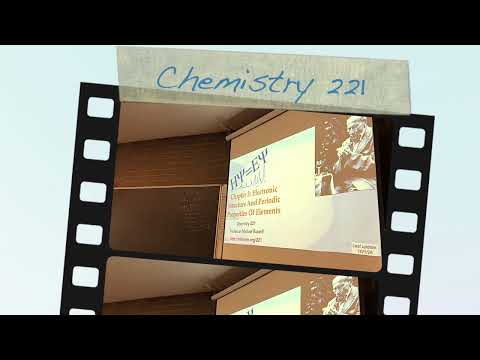 Watch on YouTube →
Overview
Michael Russell introduces the development of atomic theory through light, from Maxwell’s electromagnetic waves and Planck’s quantized energy to Einstein’s photoelectric effect and Bohr’s hydrogen atom. The lecture connects wavelength, frequency, and energy with equations such as c = λν and E = hν, then shows how electron transitions explain hydrogen’s sharp spectral lines, including a 2-to-1 transition that emits light at about 122 nm.
Key takeaways
- For electromagnetic radiation in a vacuum, c = λν; using c = 2.998 × 10⁸ m/s requires converting wavelength into meters before calculating frequency.
- Photon energy follows E = hν = hc/λ, so short-wavelength ultraviolet, X-ray, and gamma radiation carries more energy per photon than long-wavelength radio radiation.
- Planck’s constant is 6.626 × 10⁻³⁴ J·s; multiplying it by frequency in s⁻¹ produces energy in joules.
- A 700 nm photon has an energy of about 2.84 × 10⁻¹⁹ J, equivalent to roughly 171 kJ per mole of photons.
- Element-specific sharp-line spectra arise when excited electrons release energy during transitions to lower states, creating characteristic wavelengths useful for identifying elements.
- Bohr’s model explains hydrogen spectral series through quantized electron levels, but it does not adequately describe atoms with multiple electrons.
Chapters
- Michael Russell previews a chapter on light, atomic structure, and nomenclature.
- For the next Tuesday session, students are asked to bring problem set 3 and the nomenclature lab, complete seminar self-quiz 3 and quiz 3, and attend the hydrogen spectrum lab.
- The Chemistry in the Library assignment is due the next Tuesday and supports research references for the final element presentation paper.
- Atoms are roughly 10⁻¹⁰ meters across, too small to observe with an ordinary biological microscope.
- Isaac Newton used a prism to show that white sunlight contains multiple colors.
- James Maxwell’s work connected visible light with the broader electromagnetic spectrum, including radio waves, X-rays, and gamma rays.
- Light exhibits wave-particle duality, a central idea for understanding atomic behavior.
- Wavelength, represented by λ, is the distance between equivalent points on successive waves.
- Frequency, represented by ν, counts waves passing per second and is commonly measured in hertz.
- Russell emphasizes the speed of light as c = 2.998 × 10⁸ m/s and recommends using at least four significant figures.
- Wave amplitude and nodes are introduced, with wavelength and frequency identified as the main properties for upcoming chemistry calculations.
- A longer-wavelength visible wave completes fewer cycles over the same time than a shorter-wavelength ultraviolet wave.
- Wavelength and frequency vary inversely: as one increases, the other decreases.
- Frequency means the number of waves passing per unit time, while amplitude describes wave strength and is not the focus of the calculations.
- Visible colors correspond to different wavelengths: blue is roughly 400 nm and red roughly 700 nm.
- The human eye detects only a small part of the electromagnetic spectrum; infrared and ultraviolet lie outside ordinary vision.
- The relationship c = λν lets chemists calculate frequency from wavelength, provided units are consistent.
- For 700 nm red light, convert to 7.00 × 10⁻⁷ m before dividing c by λ to obtain a frequency of about 4.28 × 10¹⁴ Hz.
- Classical physics failed to explain how heated objects emit radiation, a problem known as the ultraviolet catastrophe.
- Observed hot objects shift from red toward shorter-wavelength light as temperature rises, rather than following the classical prediction.
- Max Planck proposed that light energy comes in discrete packets called quanta.
- Planck’s constant is h = 6.626 × 10⁻³⁴ J·s, and the energy of a quantum is E = hν.
- Combining E = hν with ν = c/λ gives E = hc/λ.
- Higher frequency means higher energy, while longer wavelength means lower energy.
- Gamma rays and X-rays have short wavelengths and high energies; radio waves have long wavelengths and relatively low energies.
- To identify the highest-energy option, choose the shortest wavelength, converting units such as nanometers and meters as needed.
- In the photoelectric effect, light of sufficient frequency strikes a metal and ejects electrons, producing a measurable current.
- Einstein explained the effect using light quanta, later called photons, which transfer energy to electrons.
- The effect depends on light frequency, not simply on increasing the amount of light; adding more light above the threshold changes the current.
- Einstein received the Nobel Prize for his explanation of the photoelectric effect, rather than for relativity.
- For 700 nm red light, the frequency is approximately 4.28 × 10¹⁴ Hz, giving a photon energy of about 2.84 × 10⁻¹⁹ J using E = hν.
- Multiplying energy per photon by Avogadro’s number, 6.022 × 10²³ mol⁻¹, gives about 171 kJ/mol.
- A joule is an energy unit, while joule-seconds are the units of Planck’s constant; multiplying h by frequency cancels seconds.
- The calculation sequence for the hydrogen spectrum lab is nanometers to meters, c/λ for frequency, hν for photon energy, then Avogadro’s number and conversion to kilojoules per mole.
- Light from individual elements produces sharp-line spectra rather than the continuous spectrum of white light.
- Hydrogen, mercury, and neon each produce distinct spectral lines that can identify elements, even in distant stars.
- Heating salts or applying electricity excites atoms; characteristic colors appear when the atoms release energy.
- Examples include yellow sodium emission, green barium emission, and red strontium emission, as seen in flame tests and fireworks.
- Niels Bohr proposed that electrons occupy only specific allowed energy levels, labeled by whole-number quantum values such as n = 1, 2, and 3.
- Electrons absorb energy to move to a higher state and emit light when they fall to a lower state.
- The lowest energy level is the ground state; higher levels are excited states.
- Bohr’s model linked hydrogen’s discrete emission lines to specific transitions rather than arbitrary electron orbits.
- For a hydrogen electron transitioning from n = 2 to n = 1, the energy change is about −984 kJ/mol, indicating energy release.
- The negative sign marks the decrease in electron energy; the emitted photon’s frequency and wavelength are treated as positive values.
- Converting the transition energy to photon frequency and wavelength yields approximately 122 nm, matching a hydrogen Lyman-series line.
- Bohr’s model connects visible Balmer lines to transitions ending at n = 2 and infrared Paschen lines to transitions ending at n = 3.
- Hydrogen’s spectral lines can be organized by electron transitions from higher energy levels to lower ones.
- Bohr’s quantized energy levels introduced the quantum-number framework used in later atomic models.
- The model works for hydrogen and hydrogen-like one-electron ions, such as He⁺, but does not adequately describe multi-electron atoms such as carbon, oxygen, or nitrogen.
- The lecture closes by positioning Bohr’s work as a starting point for the more complete quantum theory developed in the following material.
Transcript excerpt
0:00 Good morning. I hope your morning has been going well. I'm really glad to have you here. Um, [clears throat] what we're going to do today is basically go over chapter 3. Chapter 3 is one of the longer chapters. Just going to let you know, but uh we'll get through it, take care of business, be good to go. And then next Tuesday morning at 8:30 in this room, uh, several things happening. You'll turn in problem set number three, which is what this material will be over. >> [clears throat] >> You'll also turn in, excuse me, the nomenclature lab that we started last Tuesday. Uh, as before, we'll take seminar self quiz 3 followed by quiz number three, and we will go next door and do the hydrogen spectrum lab, [clears throat] which is kind of cool. So, bring a printed copy. Also though, next Tuesday, there's one special
0:46 assignment due. It's called chemistry in the library. It's part of the class presentation packet that I gave you on the first day. It's basically going to make you go to the Mount Hood Libraryies chemistry databases and look up articles. This will help you on your class presentation final paper. Um, it's an easy process to do once you see how it works. At first, it can be a little bit weird. The library will absolutely help you out. So will the tutors. Um, send me information. You can do this on uh on campus, which is a little bit more chill because you don't have to log in always. You can also though do this at home. I think you need to enter your MHCC portal information. It might be email. I always get those mixed up. I'm really sorry, but one of those two and
This is the start of the transcript. Save this video free for the whole transcript, searchable and time-coded.
Related notes
Summary, takeaways, and chapters were generated by AI from the video's transcript and may contain errors. The video belongs to its creator, Michael Russell.