091626 Lecture Video
 Watch on YouTube →
Overview
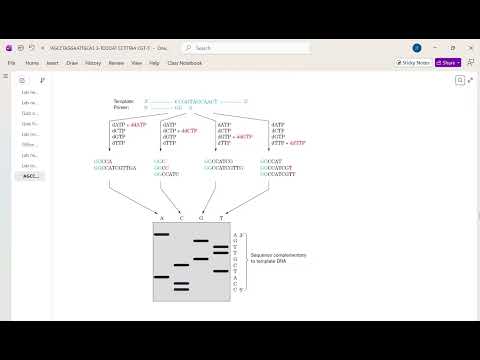
Tim Johann explains Sanger sequencing by showing how dideoxynucleotides (ddNTPs) terminate DNA strand extension because they lack the 3′-OH needed to add another nucleotide. He demonstrates the classic four-reaction setup, how fragment lengths reveal sequence on a gel, and how missing or altered reagents change the products students must predict.
Key takeaways
- Sanger sequencing generates a ladder of DNA fragments by mixing standard dNTPs with a low proportion of one base-specific ddNTP.
- A ddNTP terminates DNA synthesis because it lacks the 3′-OH required for adding the next nucleotide.
- In the classic four-tube method, each reaction identifies the positions where one particular base is incorporated into the newly synthesized strand.
- Gel electrophoresis separates fragments by length; shorter fragments migrate farther, allowing the sequence to be reconstructed from the band order.
- Omitting a standard dNTP blocks extension at the first position that requires it, while adding only its ddNTP permits one terminating incorporation but no continued extension.
Chapters
- DNA polymerase extends a primer by adding nucleotides to the growing strand.
- A dideoxynucleotide lacks the 3′-OH needed to form the next phosphodiester bond, so its addition terminates the strand.
- Sanger sequencing uses these termination events to produce DNA fragments ending at particular bases.
- The classic method uses four separate tubes, one each for A, C, G, or T termination.
- Each tube contains a primer, DNA polymerase, all four standard dNTPs, and a small amount of one matching ddNTP.
- Because ddNTPs compete with extendable dNTPs, fragments stop at different occurrences of the selected base.
- Tim describes radioactive labeling as the historical approach and fluorescence as the modern alternative.
- The four reaction products are separated by length on a gel, with shorter fragments migrating farther than longer ones.
- Reading the bands in size order identifies the nucleotide added at each termination position.
- A reaction lacking a required standard dNTP cannot extend past the first position that needs that nucleotide.
- Commercial sequencing kits supply optimized ratios; Tim gives roughly 1:100 as an approximate ddNTP-to-dNTP ratio.
- Tim gives the class a template, a matching primer, all four standard dNTPs, and ddCTP.
- Every product includes the primer, then extends complementary to the template until a C is incorporated as a terminating ddC.
- Multiple products can form because each C position may receive either extendable dCTP or terminating ddCTP.
- The exercise emphasizes drawing the full products rather than reporting only how many fragments form.
- In the second exercise, the reaction contains ddTTP but lacks ordinary dTTP.
- The strand can add a terminating T once, but cannot continue through that position because no extendable dTTP is available.
- Without either dTTP or ddTTP, extension stops before the first position requiring a T.
- The examples test the distinction between standard dNTPs, which permit extension, and ddNTPs, which terminate it.
Transcript excerpt
0:00 for some reason. Okay. So, we're going to talk talk now. Actually, I'm going to go to another Well, I'll go a quick I'm going to show you something and then I'm going to go to another animation. Um, so this is going to be interesting. I think we're going to have a lot of different videos for today, which is okay for I it'll be frustrating for you. Maybe I'm hoping it won't be frustrating for me. So when we look at DNA, DNA has, if we think about it, I'm just going to draw a B for base here. Okay. Um, so some base got some DNA strand here. Got the phosphate on it. Um, and then that's going to go up to some other some other base up there,
0:49 right? And this is the end of the DNA. And DNA is deoxy ribboucleic acid. So it's deoxy. It's missing an O, right? It's missing the two prime O. So, it has an O here, but not in the other place. So, we're going to go ahead and extend this. We could extend with this, right? But what if I put in, let's say I extend it, but let's say, so this this thing can act as a nucleophile with the help of an enzyme. But I can bring in another base, let's say. And let's say the next base I bring in that gets attached. All right. So, this is base. Let's make
1:41 this base two. Okay. Let's say that one doesn't have any hydroxil on it. Let's say I've chemically engineered it to do that. This would, by the way, this H would lose me some points if I left that on on a test. So now, let's say I've engineered that next base. It gets attached, right, for
This is the start of the transcript. Save this video free for the whole transcript, searchable and time-coded.
Related notes
Summary, takeaways, and chapters were generated by AI from the video's transcript and may contain errors. The video belongs to its creator, Tim Johann.