091626 Lecture Video First?
 Watch on YouTube →
Overview
Tim Johann explains how PCR uses denaturation, primer annealing, and DNA polymerase extension to amplify a chosen DNA region, emphasizing antiparallel strands and writing primers 5′ to 3′. He also covers how cycle-by-cycle doubling works, how primer extensions can add restriction enzyme sites for cloning genes into plasmids, and begins a transition to DNA sequencing.
Key takeaways
- PCR proceeds through denaturation, primer annealing, and extension; the demonstrated temperatures are about 95°C for denaturation, 55 to 70°C for annealing, and 72°C for Taq extension.
- Primers must be designed to bind complementary, antiparallel template sequences, and their sequences should be written 5′ to 3′.
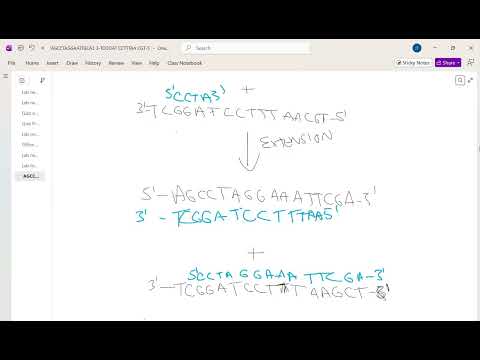
- DNA polymerase extends from the primer’s 3′ end by adding nucleotides complementary to the template, so diagrammed extensions should continue along any omitted template region.
- PCR doubles the DNA amount in each cycle, beginning with one molecule and yielding two after one round.
- A nonmatching 5′ primer tail can add a restriction enzyme recognition site to the amplified DNA, supporting insertion of the target gene into a plasmid.
- Amplifying a gene and expressing it in bacteria can provide protein in quantity without isolating it from human tissue.
Chapters
- The first PCR step heats double-stranded DNA to about 95°C to separate its strands.
- Primers bind complementary sequences antiparallel to the DNA template, and students should write each primer 5′ to 3′.
- The worked example uses short primers including CCTA and AAT to show how primer orientation determines where each one binds.
- During extension, DNA polymerase adds complementary nucleotides to each primer’s 3′ end, following the template strand.
- Annealing commonly occurs around 55 to 70°C, depending on primer properties; extension for Taq polymerase is about 72°C.
- Denaturation is about 95°C, and the enzyme’s temperature tolerance determines suitable PCR conditions.
- For worksheet diagrams, draw denatured strands apart and double-stranded products side by side.
- When abbreviating long DNA regions, include several flanking nucleotides and use a line to indicate the omitted sequence.
- Tim Johann asks students to show denaturation, annealing, and extension explicitly rather than skipping directly from separated DNA to extended products.
- A line standing for omitted DNA must extend far enough to show that polymerase continues copying the template beyond the displayed bases.
- PCR starts with one DNA molecule and doubles the amount each cycle, producing two copies after the first round.
- Students can compare their diagrams with the worksheet answer key and ask about differences in how the products are represented.
- PCR can amplify a specific human gene from a small DNA sample, after which the product can be placed in a plasmid and used in bacteria to produce protein.
- A primer can include a nonmatching 5′ tail containing a restriction enzyme site; once copied into the PCR product, that site can be used to cut and insert the gene into a plasmid.
- The lecture transitions to DNA sequencing at about 25:12 and ends as a student asks whether the original strand remains after 16 PCR cycles.
Transcript excerpt
0:00 say at noon or midnight Thursday. >> Midnight. >> Midnight. Okay. Like five minutes late. >> It's okay. >> Okay. So, >> as long as it's only five minutes. >> Yeah. I'll be end pick up at 7:00. So, I'll be running over there. >> Okay. So, what we would do is the first step here in PCR is what? >> It'll help if I redraw this. What we we have primers come in. I'm having you design primers. But the first thing is we denature it. We separate the strands. Right. So, I've got a five prime A G C T uh A G G A A T G C A like that. And then that's going to be
0:47 plus the other strand [clears throat] which is going to be the complement to that. So, it's going to go three prime T C G A T C C T T T T T T T T T T T T T T T T T T T T T T T T T T T T T T T T T T T T T T T T T T T T T T T T T T T T T T T T T T T T T T T T T T T T T T T T T T T T T T T T T T T T T T T T T T T T T T T T T T T T T T T T T T T T T T T T T T T T T T T T T T T T T T T T T T T T T T T T T T T T A A C G T. If anybody sees me make an error
This is the start of the transcript. Save this video free for the whole transcript, searchable and time-coded.
Related notes
Summary, takeaways, and chapters were generated by AI from the video's transcript and may contain errors. The video belongs to its creator, Tim Johann.