083126 Lecture Video
Overview
Tim Johann reviews how to calculate actual Gibbs free-energy change, then teaches natural selection as differential survival and reproduction of organisms with heritable phenotype differences. The examples progress from peppered moths to glucose-6-phosphate dehydrogenase (G6PD) deficiency and malaria, then to antibiotic disruption of gut microbiota and Clostridioides difficile.
Key takeaways
- Actual Gibbs free energy depends on both the standard free-energy change and cellular concentrations through ΔG = ΔG°′ + RT ln Q.
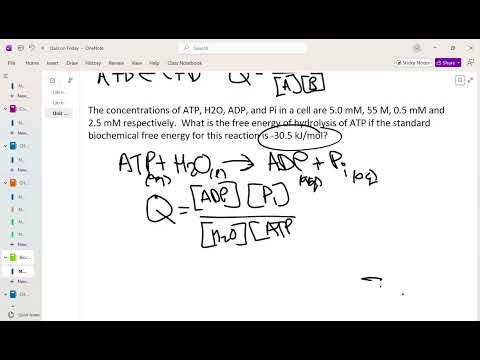
- Using 5.0 mM ATP, 0.5 mM ADP, and 2.5 mM phosphate at 310 K gives an ATP-hydrolysis free-energy change of about −52 kJ/mol, more negative than the standard value of −30.5 kJ/mol.
- A complete natural-selection explanation identifies the heritable trait, explains how it changes survival or reproduction, and states how the trait's genes are passed to offspring.
- After soot darkened tree trunks during the Industrial Revolution, dark peppered moths were better camouflaged from birds and left more offspring in affected areas.
- G6PD deficiency can persist despite its health risks because oxidative conditions in deficient red blood cells make malaria less successful, improving carriers' chances of survival in malaria-endemic regions.
- Antibiotics can select for C. diff indirectly by removing competing gut bacteria, allowing resistant C. diff to proliferate and cause severe disease.
Chapters
- Standard biochemical free energy change is calculated as ΔG°′ = ΔH°′ − TΔS°′ under biochemical standard conditions, including pH 7.
- Actual free energy adds a conditions-dependent term: ΔG = ΔG°′ + RT ln Q, where Q is the reaction quotient.
- Cells maintain conditions far from equilibrium; equilibrium is incompatible with a living cell's ongoing activity.
- For ATP hydrolysis, the example uses ATP at 5.0 mM, ADP at 0.5 mM, phosphate at 2.5 mM, and ΔG°′ = −30.5 kJ/mol.
- Liquid water is omitted from Q because it is the solvent and its concentration remains effectively constant.
- After converting concentrations to molar units and using 310 K with R = 8.314 J·mol⁻¹·K⁻¹, the calculation gives approximately −52 kJ/mol.
- Cellular ATP hydrolysis is more favorable than the standard-condition value because cells maintain high ATP relative to ADP.
- A genotype is the DNA instructions associated with a trait; a phenotype is the observable trait produced by those instructions.
- Natural selection is differential survival and reproduction among individuals with different phenotypes.
- A heritable trait becomes more common when its carriers leave more offspring who inherit the relevant genes.
- Before the Industrial Revolution, light, peppered moths were harder for birds to spot on relatively clean tree trunks.
- Soot darkened tree surfaces in some English towns, making dark moths better camouflaged than their peppered counterparts.
- Bird predation favored dark moths in soot-covered environments, allowing more of them to survive and reproduce.
- Identify the specific trait being selected for or against, such as the soot-colored phenotype in moths.
- Explain the selection mechanism, including how camouflage reduces the chance of a moth being eaten by birds.
- State the consequence: survivors reproduce and pass the associated genes to offspring.
- Avoid implying that organisms develop a trait because they need it; selection acts on existing variation.
- G6PD helps support production of NADPH, which recharges antioxidant defenses in red blood cells.
- Without sufficient G6PD activity, blood becomes more vulnerable to oxidative damage and red blood cells can break down.
- Hemoglobin breakdown produces bilirubin, a yellow pigment associated with jaundice.
- Oxidative antibiotics, some bacterial infections, and fava beans can trigger serious red-blood-cell damage in people with G6PD deficiency.
- The lecture estimates that roughly 300 to 400 million people have the deficiency, making its prevalence a natural-selection puzzle.
- G6PD-deficiency distribution maps overlap substantially with maps of malaria prevalence.
- The class compares geographic distributions of G6PD deficiency and malaria to identify a possible selection pressure.
- A sound explanation must connect the deficiency itself to an advantage, rather than claim that malaria causes the inherited deficiency.
- The proposed advantage must ultimately explain why carriers survive and reproduce more often in malaria-endemic regions.
- The malaria parasite is less successful in the more oxidizing environment associated with G6PD-deficient red blood cells.
- People with G6PD deficiency are more likely to survive malaria than people without it, according to the lecture's selection explanation.
- Greater survival permits more reproduction and transmission of deficiency-associated genes, despite the condition's health costs.
- Sickle-cell alleles provide another example of a genetic condition associated with protection against malaria.
- Heterozygous individuals can gain malaria resistance with fewer consequences than people with two copies of the allele.
- The persistence of both sickle-cell and G6PD-related traits illustrates how malaria can favor costly inherited variants.
- The lecture identifies Clostridioides difficile (C. diff) as an antibiotic-resistant bacterium that can cause serious hospital infections.
- Antibiotics can eliminate much of the competing intestinal microbiota, allowing C. diff to expand when ecological checks are removed.
- Overgrowth can cause severe diarrhea and fluid loss; in serious cases, the infection can lead to sepsis.
- The lecture cites about 500,000 U.S. infections and 30,000 deaths annually, and closes by noting that this example can also be analyzed through natural selection.
Transcript excerpt
0:02 We are low production video here. Okay. But uh um all right. So what we're going to do today is we're going to mostly talk about natural selection. But before that I want to talk a little bit more about free energy. Um and so if as you remember from last time we had our equation we we have a couple different equations that we use when we're talking about free energy. All right. So what we have last time we talked about how we have that the free energy in any situation but gener a lot of times we're talking about standard free energy. Okay, that's going to be equal
0:50 and that's standard biochemical free energy where the big deal is that it's pH7, right? Standard free energy is one molar everything which never happens. It hardly happens in lab much less happens in cells. Um but that's going to be equal to the standard biochemical enalpy minus the temperature times the standard entropy biochemical entropy. All right. So, and you should be able to think about what happens depending on what's going on with those. Um, look at that. Let's see. Where was I? There we go. Right. Um, so I'm going to have to remember it's the green one. Um, so we also can talk about the actual free energy, right? Because you're not under standard conditions
1:38 hardly any of the time. So the actual free energy is going to be equal to the standard free energy plus a correction factor for different conditions which is R T * T logarithm of Q which is the reaction quotient. So in this case Q is going to be equal to let's say my reaction was A + B goes to C + D. You're going to write this like you write an
This is the start of the transcript. Save this video free for the whole transcript, searchable and time-coded.
In this course
Related notes
Summary, takeaways, and chapters were generated by AI from the video's transcript and may contain errors. The video belongs to its creator, Tim Johann.