082726 Lecture
 Watch on YouTube →
Overview
Tim Johann introduces biochemistry as the study of how life works at the molecular scale, from atoms to organelles, and explains how to prepare using chapter study guides and recommended textbook problems. He connects life's complexity to the elements and their precise arrangement, introduces homeostasis with examples such as 37°C body temperature and roughly 5 millimolar ATP and glucose, and asks students to reason about chemistry at the molecular level.
Key takeaways
- Tim Johann frames biochemistry as the study of life through molecules, covering scales from atoms to organelles.
- Living systems depend not only on elements such as carbon, oxygen, hydrogen, nitrogen, sulfur, and phosphorus, but also on their precise ratios, structures, and timing.
- Phosphorus is essential to biological molecules such as ATP, which contains three phosphate groups, and also contributes to bones.
- Homeostasis uses energy to keep conditions stable, with lecture examples including body temperature near 37°C and ATP and glucose near 5 millimolar.
- A useful biochemistry answer identifies molecular or atomic mechanisms, as illustrated by the question about why ammonia is less stable in water than ammonium.
Chapters
- Chapter study guides list recommended end-of-book problems and the skills expected on quizzes and tests.
- Tim Johann says at least 90% of quiz or test content will come from the study-guide items, and past exams can show how questions are phrased.
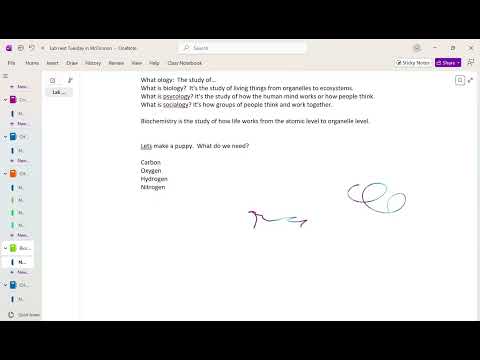
- Biochemistry studies how life works, focusing mainly on molecules from the atomic level up to organelles.
- Carbon, oxygen, hydrogen, and nitrogen are identified as the four most common elements in living things; sulfur and phosphorus are also important.
- Phosphorus is found in ATP's three phosphate groups and in bones; the lecture also notes its relative scarcity in the universe.
- Iron in hemoglobin and calcium in bones illustrate the roles of other elements, alongside trace elements such as copper.
- Having the correct elements and ratios is not enough to make a puppy or cell: the molecules must also be connected in the right structures and coordinated at the right times.
- Homeostasis means maintaining stable internal conditions; examples include a body temperature near 37°C and cellular ATP and blood glucose concentrations near 5 millimolar.
- Illness and injury disrupt internal balance, while the body's ability to restore homeostasis affects recovery; aging can make that restoration more difficult.
- For biochemistry questions, students should explain what atoms or molecules are doing, rather than relying only on broad descriptions.
- The lecture begins an ammonia-versus-ammonium stability question using Lewis structures and charge, asking students to develop a molecular-level explanation with a neighbor.
Transcript excerpt
0:02 All right, we're live. All right, so um this is an example of our study guide for chapter one. Um and um we've got these things that you need to know. So there's I've got recommended problems from the back of the book. Okay? And then um I have a list of topics that things that you would need to know how to do here um for any kind of quiz or test in the class. And so you want to go through those, think about for the lecture what did we cover? And I generally cover them about in order. Mostly mostly in order. What have we covered so far? Do I understand it well enough for for a quiz? Okay? And you have those exams so you can certainly for the quizzes, we're not giving you old quizzes, but you can look at the exams and see what a question would be phrased like.
0:50 Questions about that? So I recommend you look at these and follow them along. And I will mostly I I will almost at least 90% of the test or quiz will come from these items. Okay. All right. So let's go ahead and talk about what is biochemistry then. This is a biochemistry class. What I'm going to do here is I'm going to be typing as much as possible because my writing is um you know, I don't know, kindergarten level writing. So um it's my writing's a little bit messy. Um so I'll type whenever I can. I'll I'll draw when I have to. Um it's also a new computer and I'm getting used to the pen. Okay? So but what what let's talk about what is biochemistry?
1:38 Can everybody see that? Is that big enough or is that Guys in the back, can you see that?
This is the start of the transcript. Save this video free for the whole transcript, searchable and time-coded.
In this course
Related notes
Summary, takeaways, and chapters were generated by AI from the video's transcript and may contain errors. The video belongs to its creator, Tim Johann.