111626 Lecture Video
Overview
The lecture distinguishes proteoglycans, whose glycosaminoglycans perform functions such as collecting clotting factors and lipases, from glycoproteins, whose oligosaccharides act as information-rich tags. It then connects carbohydrate recognition to blood-type O susceptibility to H. pylori attachment and protein clearance, before introducing metabolism through energy conversions, oxidation-reduction, and the convergent nature of catabolism versus divergent anabolism.
Key takeaways
- Proteoglycans use negatively charged glycosaminoglycan chains as functional molecule-collecting structures, including for clotting factors and lipases positioned near cell surfaces.
- Oligosaccharides encode substantial structural diversity because sugars can connect through multiple hydroxyl positions and branch, unlike the more constrained peptide backbone.
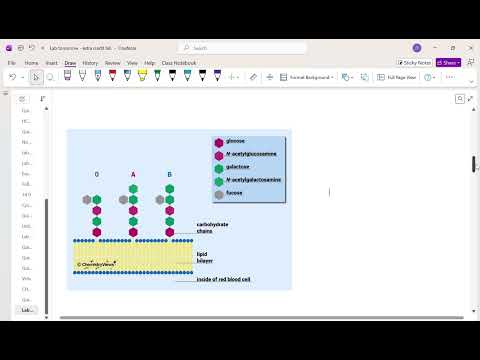
- H. pylori’s lectin binds a blood-type O carbohydrate structure, helping the bacterium adhere to the stomach lining and contributing to the observed increase in ulcer susceptibility.
- Removal of terminal sialic acids provides a molecular timer: once a glycoprotein’s carbohydrate pattern is exposed, a liver lectin can recognize and clear the aging protein.
- Catabolism oxidizes nutrient molecules while reducing carriers such as NAD⁺ and FAD; anabolism uses energy to build more reduced, complex molecules.
- Catabolic pathways converge on shared intermediates such as acetyl-CoA, while anabolic pathways diverge from common precursors to produce many different molecules.
Chapters
- The extra-credit lab is worth 10 points toward lab report scores, slightly less than 10% of the course total.
- The kinetics lab report is due Thursday at 11:59 p.m.; kinetics, including solving for KM and kcat, will appear on the next test and final.
- A regular quiz is planned for Friday, with office hours Monday and Wednesday from 1:00 to 2:00 p.m. and Thursday at 10:00 a.m.
- Students not attending the extra-credit lab are asked to clear their tubes from the refrigerator.
- A proteoglycan consists of glycosaminoglycans attached to a protein anchor; Syndecan is shown as an example.
- Strong negative charges keep glycosaminoglycan chains extended rather than folded into compact shapes.
- Proteoglycans can capture blood-clotting factors and reduce their participation in clotting.
- They also position lipases near cell surfaces so fatty acids released from triacylglycerols can be absorbed locally.
- An oligosaccharide is a relatively short carbohydrate, roughly 20 or fewer monosaccharides, often arranged in a branched structure.
- Polysaccharides are generally longer, mostly linear or slightly branched polymers, and may use one or two kinds of monosaccharides.
- Glycogen is a polysaccharide with about 50,000 glucose residues and branches roughly every 8 to 12 residues.
- Oligosaccharides can function as information-rich tags used in cell signaling.
- A four-residue peptide made from the 20 common amino acids has 20⁴, or 160,000, possible sequences.
- Unlike amino acids in a peptide chain, monosaccharides can connect through multiple hydroxyl positions, creating additional structural possibilities.
- The lecture estimates 5⁷, about 78,000, arrangements for an illustrative carbohydrate-linkage count, while noting that branching and alternative attachment positions add complexity.
- The many possible linkage patterns help explain why oligosaccharide synthesis is harder to automate than peptide or DNA synthesis.
- Lectins are proteins that bind specific carbohydrate structures, allowing them to recognize oligosaccharide tags.
- H. pylori uses a lectin that binds tightly to a blood-type O oligosaccharide found in the stomach.
- That binding can help H. pylori adhere to the stomach lining; people with blood type O were described as about 20% more likely to develop ulcers in a cited study.
- White blood cells also use carbohydrate recognition during rolling and attachment to blood-vessel surfaces.
- A glycoprotein combines a functional protein with an attached carbohydrate tag, which can help direct proteins out of the cell.
- Carbohydrates can attach at sites such as serine or threonine hydroxyl groups and asparagine side chains.
- Blood proteins such as antibodies can carry terminal sialic acids; circulating sialidases remove these sugars over time.
- After sialic acids are removed, a liver lectin recognizes the exposed carbohydrate pattern and promotes removal and breakdown of the protein.
- Photosynthesis converts sunlight into chemical energy stored in organic products such as starch.
- Animals obtain chemical energy by eating plants and storing usable fuel, for example as glycogen.
- Cells break glycogen down to glucose and convert it into ATP, which can power mechanical work such as movement.
- Each conversion loses some energy as heat, so the sequence from sunlight to movement is not fully efficient.
- Catabolism breaks complex molecules into simpler ones and generally involves oxidation of the molecules being degraded.
- Energy released during oxidation is captured as reduced cofactors, including NADH, NADPH, and FADH₂.
- Anabolism builds complex molecules from simpler precursors and generally produces more reduced molecules.
- Anabolic reactions use energy carriers in their oxidized forms to help drive biosynthesis.
- Catabolism is convergent: breakdown pathways funnel many nutrient types toward shared intermediates such as acetyl-CoA.
- Acetyl-CoA can enter the citric acid cycle to support energy production.
- Anabolism is divergent: shared precursor molecules can be used to build many different products, including lipids.
- Pyruvate and other central intermediates can be routed into different pathways depending on which molecules the cell needs to build.
Transcript excerpt
0:00 Thanksgiving. Um, we have lab tomorrow. Okay, which is an extra credit lab. Okay, that's 10 points that could go onto your uh It is actually graded. It's 10 points that could go onto your lab report scores. Okay? Um, so it ends up being a little just a little less than 10% of the course total. Um, the um you've got a lab report due Thursday um at 11:59 p.m. Let me know if you have questions on that. That is it's the kinetics, right? It's doing the kinetics stuff. So it's it's going to be good practice. Feel free to come out and get help with that.
0:47 It's good practice for the next test cuz you're going to have to do kinetics problems on that. Okay? Or solve for KM and K cat and talk about what KM and K cat are. All that stuff isn't going away and it'll be on the final too. Cuz remember kinetics if anybody asks you one question, they're only allowed to ask you one question from this course, it's going to be about kinetics. Okay. So um that's due on Thursday. Um what else do we have? Uh we'll do a quiz on Friday. Regular quiz. Uh usual office hours. Office hours Monday, Wednesday, 1:00 to 2:00 p.m. Um I've got um I've got Thursday.
1:34 I had two people at that one. Thursday morning at 10:00 a.m. Um and then the usual help sessions uh at from what is it? You guys are 8:00 to 9:00 p.m. on Thursdays. Questions? Okay? All right. Um the other thing I want you to if you're not coming to the extra credit lab and you haven't cleaned up all your tubes yet that are in the fridge, need you to come in and clean your tubes out, okay?
This is the start of the transcript. Save this video free for the whole transcript, searchable and time-coded.
In this course
Related notes
Summary, takeaways, and chapters were generated by AI from the video's transcript and may contain errors. The video belongs to its creator, Tim Johann.