111326 Lecture Video
Overview
Tim Johann compares glucose-based storage and structural polymers, explaining how linkage type and branching shape their properties: glycogen branches every 8 to 12 residues, while plant amylopectin branches about every 28. He then connects cellulose, chitin, bacterial peptidoglycan, and negatively charged glycosaminoglycans to digestion, antibiotic action and resistance, blood clotting, and enzyme localization.
Key takeaways
- Glycogen’s alpha 1,6 branches every 8 to 12 residues create many glucose-release ends, whereas amylopectin branches about every 28 residues.
- Storing glucose in polymers such as glycogen lowers the number of dissolved particles and therefore reduces the osmotic pressure that free glucose would create.
- Cellulose’s beta 1,4 linkages form straight structural chains that humans cannot digest; ruminants depend on symbiotic gut bacteria to break them down.
- Penicillins target bacterial peptidoglycan assembly by inhibiting DD-transpeptidase, while beta-lactamase resistance can be countered with clavulanic acid alongside amoxicillin.
- Negatively charged glycosaminoglycans form extended chains, and their binding to proteins can regulate clotting factors or position enzymes such as lipoprotein lipase near cells.
Chapters
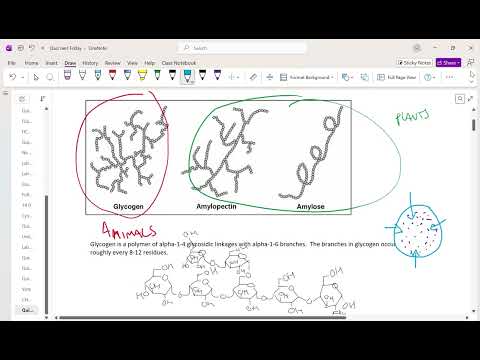
- Glycogen consists of glucose residues joined mainly by alpha 1,4 glycosidic linkages, with alpha 1,6 linkages at branch points.
- Branches occur about every 8 to 12 glucose residues, producing many ends from which the liver can rapidly mobilize glucose.
- For polymer drawings, show the correct glucose stereochemistry and use clear curved or straight bonds rather than angles that could be mistaken for carbon atoms.
- Amylopectin, a component of plant starch, also uses alpha 1,4 chains and alpha 1,6 branches, but branches occur about every 28 residues.
- Glycogen is the animal glucose-storage polymer; amylopectin is found in plants alongside unbranched amylose.
- Packaging many glucose units into one polymer reduces osmotic pressure compared with keeping the same glucose molecules free in a cell.
- Amylose is an unbranched glucose polymer with alpha 1,4 linkages, while amylopectin forms a highly branched structure within starch granules.
- When starch is heated with water, amylose strands separate and tangle, trapping water in a gel-like network.
- Amylopectin molecules swell and move past one another, also increasing viscosity; these effects explain how starch thickens gravy.
- Cellulose is an unbranched glucose polymer with beta 1,4 glycosidic linkages, giving it a straighter chain than alpha-linked storage polymers.
- Hydrogen bonding between cellulose segments supports the straight-chain arrangement and its structural role in plant cell walls.
- Humans lack enzymes to break cellulose’s beta 1,4 linkages, while ruminants such as cows rely on symbiotic gut bacteria to digest cellulose in grass and straw.
- Chitin is an unbranched polymer of N-acetylglucosamine residues connected by beta 1,4 glycosidic linkages.
- Its monomer is a glucose derivative, illustrating how nature reuses glucose-based structures to make distinct polymers.
- The lecture identifies chitin’s basic polymer structure but does not require students to draw it.
- Peptidoglycan consists of carbohydrate strands joined by peptide crosslinks outside the bacterial cell membrane.
- Its repeating carbohydrate unit includes N-acetylglucosamine and a related sugar derivative; the full molecular structure is not required for the course drawing task.
- The enzyme DD-transpeptidase forms peptide crosslinks, making this process a selective target because human cells do not build bacterial peptidoglycan walls.
- Penicillin and amoxicillin inhibit DD-transpeptidase, disrupting the peptide crosslinks that strengthen peptidoglycan.
- Bacterial resistance can spread through natural selection: resistant bacteria survive antibiotic exposure and reproduce while susceptible bacteria are eliminated.
- Beta-lactamase enzymes break the antibiotics’ four-membered beta-lactam ring; clavulanic acid can be co-administered with amoxicillin to inhibit beta-lactamase.
- Amoxicillin can also hydrolyze after exposure to water, which is why protective blister packaging matters; the lecture notes ongoing limits on developing new antibiotics.
- Glycosaminoglycans are unbranched polymers made from repeating disaccharide units, unlike the single-monomer repeats discussed earlier.
- Many are highly negatively charged, and electrostatic repulsion helps keep their chains extended rather than tightly folded.
- A glycosaminoglycan attached to a protein anchor forms a proteoglycan; membrane-spanning protein regions can anchor the structure while its carbohydrate chains extend outside the cell.
- Heparin is a free-floating glycosaminoglycan associated with anticoagulant activity, while heparan sulfate can have related effects.
- Glycosaminoglycan binding changes antithrombin’s shape, enabling it to inhibit activated clotting factor Xa; related interactions can also sequester thrombin and reduce clot formation.
- Heparin produces anticoagulant effects while circulating freely, and the lecture distinguishes this from glycosaminoglycans attached to proteoglycans.
- EDTA prevents clotting in collection solutions by chelating metal ions; the lecture also notes its use in buffers to limit metal-dependent protease activity.
- Proteoglycans can position lipoprotein lipase near cells, where it hydrolyzes triacylglycerols in blood particles so cells can take up fatty acids.
Transcript excerpt
0:00 Yes, I need to get that up. So I'll I will get that up. Send me an email if you don't see it today. Um. All right. So we we talked about carbohydrates and we'd started talking about the polymers. We talked about the linkages for them, but this is this is these are examples for what glycogen looks like and what amylopectin looks like and amylose. Um starch is a mixture of amylopectin and amylose. Okay? Um and so what you get is you get these kind of things entangled in each other and depending on what kind of starch you have, you'll have more of one or the other of these. Um. [clears throat] So let's first talk about the uh let's talk about the structures here then. So we've got this branching structure you see here, right? What
0:48 glycogen is. So glycogen is um a polymer of one alpha 1 4 glycosidic linkages with um alpha 1 6 branches. We'll draw a structure here. Okay, the branches in glycogen happen
1:35 about every 8 to 12 residues. [cough and clears throat] All right, so if I test you on these polymers, we're going to go over a number of them here. Uh I'm going to test you on whether it's you know it's branch. You'd have to draw a branch, okay? Um so if it's if it is a branched polymer. So if we talk about glycogen then, what we've got is it's of glucose. All these things are glucose. Okay, so if I think about I'm going to
2:21 do one to four linkages between glucose. I'll I'll fill in the rest of the bonds here or the rest of the hydroxyls here in a minute. And so like I said before, I like to do these curvy bonds.
This is the start of the transcript. Save this video free for the whole transcript, searchable and time-coded.
In this course
Related notes
Summary, takeaways, and chapters were generated by AI from the video's transcript and may contain errors. The video belongs to its creator, Tim Johann.