110926 Lecture Video
Overview
Tim Johann explains how membrane transport depends on protein structure, electrochemical gradients, and energy use. The lecture contrasts channels with selective, saturable carriers, classifies uniport, symport, and antiport, then demonstrates primary active transport with the sodium-potassium ATPase, which uses ATP to move 3 Na⁺ out and 2 K⁺ into the cell.
Key takeaways
- Spontaneous lipid flip-flop between membrane leaflets is rare, so cells use flippases to move selected membrane components across the bilayer.
- A hydrophilic solute faces a high energy cost when it loses its hydration shell; transport proteins lower that barrier by providing favorable interactions along a membrane-spanning route.
- Electrochemical transport free energy combines a concentration term, RT ln(Cin/Cout), with an electrical term determined by charge and membrane voltage.
- Channels generally provide fast, gradient-driven passage, while binding carriers are more selective, saturable, and capable of participating in active transport.
- Symport and antiport can perform secondary active transport by coupling one solute's downhill movement to another solute's uphill movement.
- The sodium-potassium ATPase directly uses ATP to move 3 Na⁺ out for every 2 K⁺ in, producing net outward positive-charge movement and helping establish the cell's negative interior.
Chapters
- The extra-credit lab is scheduled for the week before Thanksgiving, is completed in pairs during lab time, and is worth 10 lab-report points.
- In the fluid mosaic model, membrane components move laterally within a leaflet, while spontaneous movement between leaflets is uncommon.
- Flippases catalyze transverse movement of lipids and other membrane components, including processes involved in presenting cholesterol outside the cell for HDL uptake.
- A hydrated polar solute must shed its surrounding water molecules before entering the membrane's hydrophobic interior.
- The high-energy step is losing hydration; the solute then crosses the membrane and becomes hydrated again on the other side.
- Transport proteins lower the barrier by providing channels or binding environments with hydrophilic or oppositely charged groups.
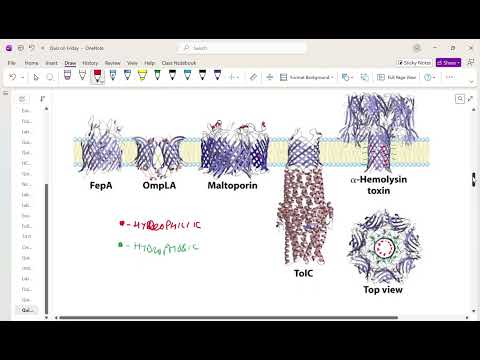
- A beta barrel forms when a beta sheet wraps into a cylindrical structure that spans the membrane.
- Alternating beta-sheet side chains allow hydrophobic residues to face the lipid membrane and hydrophilic residues to line the channel interior.
- Hemolysin is described as a bacterial toxin that forms membrane pores in red blood cells, allowing cellular contents to leak out.
- Bacteriorhodopsin absorbs light and uses that energy to pump protons across a bacterial membrane.
- Protons flowing back through ATP synthase provide energy for ATP production, linking a proton gradient to cellular energy.
- Salt ponds near San Francisco Bay support colorful salt-loving bacteria that use bacteriorhodopsin as part of their energy strategy.
- Bacteriorhodopsin has seven transmembrane alpha helices; a hydropathy index helps identify membrane-spanning regions from a protein sequence.
- The chemical contribution to transport free energy depends on the solute concentration ratio, represented by an RT ln concentration term.
- The electrical contribution depends on solute charge, Faraday's constant, and the voltage across the membrane.
- For a charged solute, the direction of favorable transport reflects both concentration differences and electrical attraction or repulsion.
- Moving positive solutes into a cell with more positive charge inside goes against both the concentration and electrical gradients in the example.
- When a cell interior is negatively charged, positive solutes are electrically attracted inward even if their concentration gradient opposes entry.
- When concentration and electrical forces oppose each other, the net direction depends on their relative contributions to free energy.
- Channels are protein-formed pores that can select solutes by properties such as charge and size.
- A pore may transport a solute especially well when its size fits the channel closely.
- Channels can transport solutes rapidly and, as contrasted in the lecture, do not saturate like binding carriers.
- Because channels do not bind and hand off solutes, they permit movement down an electrochemical gradient rather than pumping against it.
- Carriers bind their solutes, can distinguish closely related molecules, and follow enzyme-like Michaelis-Menten kinetics with a maximum rate.
- A glucose transporter can distinguish glucose from galactose, which differs in stereochemistry at one carbon.
- Carriers may transport solutes down a gradient without spending energy; liver glucose transport is presented as a way to equilibrate glucose with blood.
- Unlike channels, some carriers can use energy or coupled transport to move solutes against an electrochemical gradient.
- Uniport moves one solute, symport moves two solutes in the same direction, and antiport exchanges solutes in opposite directions.
- Channels are described as uniport, while carriers can operate as uniport, symport, or antiport.
- In secondary active transport, one solute moving down its electrochemical gradient can drive another solute uphill through a coupled carrier.
- Passive transport uses no energy and moves solutes down their electrochemical gradients.
- Primary active transport directly consumes an energy source, commonly ATP hydrolysis, to fuel transport.
- Secondary active transport couples downhill movement of one solute to uphill movement of another, often through symport or antiport.
- The sodium-potassium ATPase hydrolyzes ATP to export 3 sodium ions and import 2 potassium ions per cycle.
- With the pump facing the cell interior, it binds 3 Na⁺; ATP-dependent phosphorylation changes its conformation, lowers sodium affinity, and opens it outward.
- The outward-facing form releases sodium and binds 2 K⁺; dephosphorylation returns the pump inward, where potassium is released.
- Net export of one positive charge per cycle helps make the cell interior negative and supports electrical gradients; the pump is estimated to use about 25% of resting energy.
Transcript excerpt
0:00 credit lab the la like the week before Thanksgiving. Is that going to be like an individual thing or are we still doing it in pairs if we let them come in? >> I think I have people do that one in pairs. So, yeah. >> And >> the question was was will the extra credit lab which will be not this week but next week. That's the week before Thanksgiving or is next week Thanksgiving? >> The week before Thanksgiving is >> okay. That's next week. Um so next week um you do that in pairs. be surprised what it is when you get in, unless you've talked to other classes, in which case you know what it is. >> And and you will and the lab report for that will be something you write up in the lab time and you'll be done with it. So it's not >> not a bunch of time outside of that lab. >> Okay.
0:47 >> How much would it be worth? >> It's worth 10 points to your lab reports. >> Um you could get 110. >> You could theoretically get 100. Well, not 110. It's not 10%. It's so think about the first lab was worth 10 lab report was worth 10 points. Second was worth 20. There are a couple 30s maybe another 20. I I don't remember all lab reports at this point but out of that. >> So it may actually be more than that because it may not add up to 100 points. Something it's something around what you said >> for lab reports. [clears throat] >> Other questions. All right let's talk more about membranes then. So we had talked about the fluid mosaic model right um and that that it's fluid right you can move back
This is the start of the transcript. Save this video free for the whole transcript, searchable and time-coded.
In this course
Related notes
Summary, takeaways, and chapters were generated by AI from the video's transcript and may contain errors. The video belongs to its creator, Tim Johann.