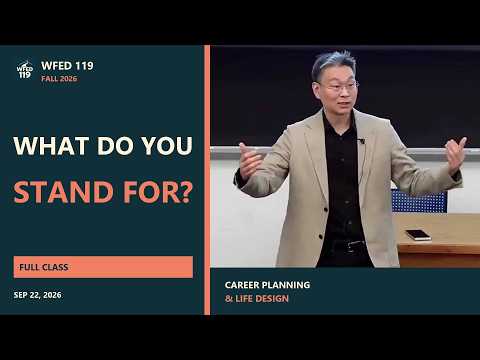
What Do You Stand For? Values & Your Personal Mission | WFED 119 | Sep 22, 2026
Overview
A WFED 119 class guides students through prioritizing terminal, instrumental, and work values, then using those values to draft a personal mission statement. The instructor recommends making the mission concise, durable, and outward-facing, explains a values-selection glitch in the mission-building platform and a manual workaround, and uses student examples from AI sustainability, technology, and cybersecurity to show how a mission can guide career choices.
Key takeaways
- Prioritizing terminal, instrumental, and work values helps separate desired life outcomes from everyday behaviors and job-selection criteria.
- A values list is a starting point, not a definitive inventory: students should modify or add values when the provided options fail to capture what matters to them.
- A workable first mission draft combines three contribution targets, three action verbs, and three selected values, then goes through multiple revisions for clarity and personal meaning.
- Mission statements become more useful for career planning when they describe value delivered to others and can explain why a job aligns with the applicant's life pursuit.
- A mission statement should be concise enough for an eight- or nine-year-old to understand and broad enough to remain relevant decades later.
- When the mission platform loses selections, students can use the assignment document to record choices manually and submit revision rounds two and three plus a reflection by Sunday.
Chapters
- Students check Canvas's People tab, using the web version rather than the app when needed, to find their team number.
- The class organizes up to 16 teams into shared seating areas so members can work together.
- The values exercise sorts priorities into terminal values, which describe desired outcomes, instrumental values, which describe how someone acts, and work values, which guide job decisions.
- The instructor notes that a supplied values list may not capture every student's core values, so students can revise or replace items to better fit what they actually value.
- Students arrange terminal values in ranked columns, moving items until the order reflects their priorities.
- A PowerPoint version is available for students who prefer not to use the AI-supported activity.
- After ranking, students share roughly their top three values with teammates and compare differences without judging them.
- Students discuss how their top values differ from those of their teammates and treat those differences with respect.
- The class identifies value clashes as a possible source of conflict, including partners prioritizing freedom versus family security.
- The instructor frames resolving such conflicts as negotiation that may involve compromise or sacrifice.
- Instrumental values describe preferred behaviors students exhibit in daily life and while pursuing goals.
- Students complete the instrumental-values exercise and share snapshots with their teams before moving on to work values.
- Work values help students make decisions about jobs and employers, complementing terminal and instrumental values.
- After finishing work values, students open the Week 5 mission-statements link in Canvas, which leads to a Google Doc containing examples from the previous semester.
- Students add their first name and one individual mission statement under their team, rather than submitting one statement for the whole team.
- Each student is expected to create a separate mission statement, so a team of six should contribute six distinct statements.
- The mission platform is intended to guide students through selecting targets, action verbs, and values before assembling a draft.
- The instructor asks students to put their own name beside their statement in the shared team document.
- A student reports that selected values disappeared after advancing to the next screen in the mission platform.
- The instructor and Mariam investigate reports of glitches, including selections that fail to carry forward.
- Students are asked to report additional platform problems to Mariam so she can share them with the developer.
- The instructor directs students to the assignment template and asks them to manually record their selected values and other mission components.
- Because the platform may not preserve selections on the next screen, students can reconstruct their choices in the document and continue drafting.
- The Sunday submission should show the revision process, including rounds two and three, plus a reflection; already completed values sections need not be repeated.
- Students choose three contribution targets, adding a custom target in a blank field if none of the listed options fits.
- They select three preferred action verbs and three values from any of the terminal, instrumental, or work-value lists.
- The first sentence can be rough: students rearrange and revise the selected words until the result reads naturally and expresses a life they genuinely want to pursue.
- The instructor encourages students to describe value they provide to other people or society, rather than framing the mission only around personal gain.
- A concise public-facing mission can help explain in a resume or cover letter why a particular job fits a student's life pursuit.
- The recommended test is whether an eight- or nine-year-old could understand the statement; shorter, clearer wording is easier to remember.
- Students review teammates' mission statements and offer feedback on whether the ideas form one coherent sentence.
- The instructor recommends removing unnecessary components and commas, and checking whether a statement will still fit the writer 30 years from now.
- AI Studio or ChatGPT can help generate clearer versions while preserving the statement's essence, but working through revisions without AI may make the result feel more personally earned.
- A mission statement can remain tentative for years until its author feels ready to commit to it.
- Hussein connects AI sustainability, community reinvestment, and spirituality, then reflects on helping people and leaving Earth better than he found it.
- Christian describes using technology and AI to reduce fear and educate people about unfamiliar technology, aiming for a positive impact on society.
- Sean links technology and cybersecurity leadership with educating others and helping businesses grow, alongside personal aims such as financial freedom and family.
- The instructor suggests maintaining a personal mission and, when useful, a more outward-facing public version.
- Students read their mission statements aloud together twice as a way to practice owning and remembering them.
- The instructor describes a mission as a north star or compass for life and career, and encourages students to revise it if it does not yet feel guiding.
- The next class will focus on team-building, including team names, roles, symbols, and ground rules; students should keep their assigned seats.
Transcript excerpt
0:12 We have up to 16 teams. Is it right? Yeah. 16. So, um Okay. Yeah. Go to canvas. Go to people tab. So to check your team maybe you may need to use a web version not the canvas app right. So check your team and uh group one or team one through four uh would know where they need to sit. It's the same as last time. But here let's see how many seats do we have? I I count 1 2 3 4 5 6 7 8 9. Okay. So from here team uh team five 6 7 8 9 10 11 12 13
1:09 15 16. Okay. So we the whole seats here. Okay. And Are you team team one? So team one. Yeah, if you're team one, just stay here. And team three over there. Yeah, please let's vacate the end of the uh the the rows over there. All right, we'll vacate two rows. So, uh, are you team five?
1:55 >> Yeah. >> Here. Yeah, team five. Five. Five. Six. >> Yeah. Five. Six. Seven. Eight. Nine. 10. Just in one. One row. >> Which team are you? >> Team. >> 14. >> 14. 14 will be here. So somewhere here. One, two, three, four, five. Tips go
2:47 from here. One, two, three, four, five. Here. Team 14. 14. >> 12. 14. Here. >> 14. 16. >> 13. Uh. 13. Somewhere over there. Yeah. On this side. Where's >> team 12? >> Team [clears throat] 12. >> This one. Team 12. Fourth one. One, two, three, four. Yeah. Team 12. Here. >> Yeah. Yeah. Team 12. Team 16. 16. Is Team 16. We are 16 here. Yeah. What is here?
3:38 >> Which team? 15 15 will be just let me come back 13. Okay. Okay. 9 team 9 11 here. Team 11 13 15 here.
This is the start of the transcript. Save this video free for the whole transcript, searchable and time-coded.
In this course
Related notes
Summary, takeaways, and chapters were generated by AI from the video's transcript and may contain errors. The video belongs to its creator, Career Planning and Life Design.