Renal Diseases
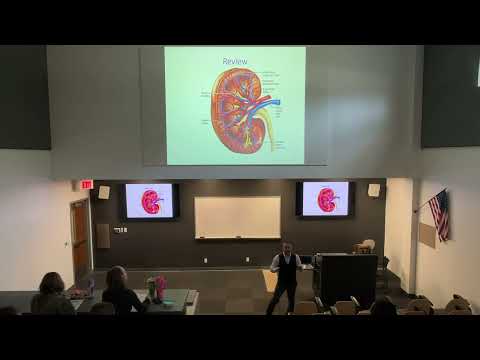
Overview
Robert Kellar, Ph.D., explains how kidney structure and blood supply connect to glomerular disease, renal failure, and infection. The lecture distinguishes circulating from in-situ immune injury, describes hypertension- and diabetes-related nephrosclerosis, organizes acute renal failure into pre-renal, intra-renal, and post-renal causes, and highlights ischemic acute tubular necrosis and ascending infections such as pyelonephritis.
Key takeaways
- Glomerular immune injury can arise from circulating antibody-antigen complexes trapped in the filter or from antibodies binding antigens locally at the basement membrane, producing different immunofluorescence patterns.
- Glomerular disease can cause proteinuria, hematuria, pyuria, and reduced urine output; substantial urinary protein is abnormal because healthy glomerular filtration retains most protein in the blood.
- Chronic glomerulonephritis and nephrosclerosis both impair renal function through scarring or vascular remodeling, but nephrosclerosis particularly involves small arteries and is associated with uncontrolled hypertension and diabetes.
- Acute renal failure is classified by location: pre-renal hypoperfusion, intra-renal tissue damage, or post-renal urinary obstruction.
- Ischemia can damage nephron tubules and reduce GFR, making acute tubular necrosis a major pathway from shock or severe blood loss to oliguria and acute renal failure.
- Ascending infection can progress from the lower urinary tract to pyelonephritis; vesicoureteral reflux, obstruction, diabetes, and repeated UTIs raise the risk of kidney scarring.
Chapters
- The class begins its third unit, covering renal and liver disease this week, respiratory disease next week, and cardiovascular disease after Thanksgiving.
- Kellar says the final will be approximately 80% new material and 20% cumulative review.
- The renal lecture focuses on three broad areas: glomerular disease, renal failure, and infection.
- Glomeruli lie in the renal cortex beneath the capsule, while nephron tubules extend into the medulla.
- The nephron is the kidney's functional and structural unit; the glomerulus filters blood into Bowman's space.
- The kidneys receive about one-third of cardiac output, but nephron tubules are vulnerable to ischemia because they are relatively late in the renal blood-flow pathway.
- Urea is produced through amino-acid breakdown, uric acid through nucleic-acid breakdown, and creatinine through creatine metabolism.
- Azotemia refers to elevated blood urea nitrogen (BUN), while uremia describes illness associated with kidney failure.
- Proteinuria, glycosuria, hematuria, pyuria, and oliguria refer respectively to protein, glucose, blood, white blood cells, and reduced urine output.
- Glomerular filtration rate (GFR) measures blood filtration and contributes to urine production; it is not the same as how often a person urinates.
- Glomerulonephritis is inflammation of the glomeruli and is described as a common cause of chronic kidney disease.
- Diabetic nephropathy thickens the glomerular basement membrane through extracellular-matrix accumulation, reducing filtration.
- Nephrosclerosis damages and remodels small renal arteries, often in association with hypertension or diabetes.
- In circulating glomerulonephritis, antibody-antigen complexes form elsewhere, travel in the blood, and become trapped in the glomerular filter, producing type III hypersensitivity.
- Complement activation recruits neutrophils and other inflammatory cells, promotes tissue injury and fibrin deposition, and can lead to scarring.
- In in-situ disease, antibodies bind antigens at the glomerular basement membrane or nearby structures; Kellar contrasts this with deposited circulating immune complexes.
- Immunofluorescence can distinguish a granular, clustered immune-complex pattern from a more continuous linear staining pattern.
- Rapidly progressive glomerulonephritis can produce cellular crescents that compress glomerular structures and impair filtration; examples include Goodpasture syndrome and lupus.
- Acute diffuse glomerulonephritis can follow a streptococcal infection, often in children ages 6 to 10, with onset roughly one week to one month after infection.
- Chronic glomerulonephritis replaces damaged glomeruli with collagenous scar tissue, can cause nephron loss, and may leave the kidney with a bumpy, cobblestone appearance.
- Untreated glomerular inflammation can contribute to chronic scarring and renal failure.
- Healthy urine can contain water, ions, creatinine, and urea, but appreciable protein in urine is abnormal.
- Glomerular injury may reduce urine volume and produce concentrated urine with proteinuria, hematuria, or pyuria.
- Specific gravity can change as urine concentration changes, and urinary abnormalities may reveal kidney injury even when symptoms are limited.
- Autoimmune conditions such as lupus can affect the kidneys at a different time from skin or other systemic symptoms.
- Nephrosclerosis involves thickening and remodeling of small renal arteries, including hyaline deposition in arteriolar walls.
- Uncontrolled hypertension exposes renal vessels to elevated pressure, prompting wall thickening that can compromise kidney perfusion.
- Diabetes and hypertension commonly occur together and increase the risk of nephrosclerosis.
- Proteinuria and reduced serum protein can result when protein leaks into urine; kidney ischemia may be focal or more widespread.
- Pre-renal failure follows reduced kidney perfusion, such as a severe blood-pressure drop, shock, or major blood loss.
- Intra-renal failure results from direct kidney injury, including inflammation, infection, reduced blood supply, toxins, or damaging drugs.
- Post-renal failure occurs when urine flow is obstructed, for example by kidney stones, a bladder tumor, or urinary tract injury.
- The lecture distinguishes these causes by whether the problem precedes the kidney, damages renal tissue, or blocks outflow.
- Acute tubular necrosis is presented as the most common cause of acute renal failure, with ischemia from shock, trauma, or a heart attack as a major trigger.
- Reduced blood flow can injure renal vessels and tubules, lower GFR, obstruct tubular flow, cause back-leak, and produce oliguria.
- Tubular injury may be reversible or irreversible and can involve necrosis or apoptosis.
- Some intravascular imaging contrast agents can stress the kidneys, so clinicians monitor exposure, especially during catheter-based procedures.
- Kidney infections may be hematogenous, reaching the kidney through the bloodstream, or ascending, traveling from the urethra through the bladder and ureter.
- Ascending urinary tract infections are more common in females; Kellar notes the shorter female urethra and the antimicrobial properties of prostatic fluid as contributing factors.
- Pyelonephritis occurs when infection reaches the renal pelvis, calyces, and kidney tissue; urinary obstruction and vesicoureteral reflux can facilitate ascent.
- Diabetes can increase infection risk because glucose in urine supports bacterial growth, while repeated infections with reflux can cause renal scarring and impaired function.
Transcript excerpt
0:01 So, a couple housekeeping things. We're starting the third unit, which means we're kind of on the downward slope. We're almost done for the semester. So, we got renal and liver this week. Post quiz 10 due tonight. Uh, pre-quiz 10 due tonight, post quiz 10 due Thursday. Then [clears throat] next week, we've got respiratory disease all week. And then Thanksgiving week, we take the whole week off and then we come back, we have one more week together where we do cardiovascular and then we take the final. So, it's pretty much almost done. You with me? Any questions about that? Shouldn't be any surprises. Um, format's very, very similar. Like the
0:50 final will be mostly over the new stuff, maybe like 80% over the new material, but we have fewer weeks. So there'll be a little bit more cumulative in the final. There's a little bit more like in a third exam that's cumulative, but it's probably more like 8020. 80 new content, 20 review. Fair. Okay. Any questions about that? I have three questions for you. What has four wheels and flies? A garbage truck. Four wheels. Fly. Okay. What do you call the hair under a cow's nose? A moose. Very well done.
1:41 What is What do rotten eggs, rotten milk, uh, sorry. What are rotten eggs, rotten milk, and spoiled fruit? What are they collectively? Groceries. I got some tuckles out of that one. Okay, doing better. I think I'm just wearing you down. That's okay. I'll take it. Not sure they're any funnier. >> [clears throat] >> So renal diseases today, liver diseases on Thursday, respiratory next week. That's kind of our schedule for the next two weeks and then we take a little week off. So let's look at some overview of renal.
This is the start of the transcript. Save this video free for the whole transcript, searchable and time-coded.
In this course
Related notes
Summary, takeaways, and chapters were generated by AI from the video's transcript and may contain errors. The video belongs to its creator, Robert Kellar, Ph.D..