Pathology Tissue Repair, Fibrosis & Healing 1of2
 Watch on YouTube →
Overview
Robert Kellar explains how inflammation, extracellular matrix integrity, angiogenesis, and fibroblast activity determine whether injured tissue regenerates or heals with scar. He connects these mechanisms to diabetic foot ulcers and keloids, then describes research using electrospun human elastin and collagen scaffolds seeded with adipose-derived stem cells: full-thickness wounds in mice reached 90% to 100% closure after six days, compared with 63% to 76% for standard care, although the study did not separate scaffold effects from stem-cell effects.
Key takeaways
- Preserved extracellular matrix supports regeneration because it provides both structural organization and signals; damage to cells and matrix together makes scar-forming repair more likely.
- Angiogenesis is essential to wound closure because new vessels supply oxygen and nutrients and remove metabolic waste; poor perfusion contributes to diabetic foot and other chronic ulcers.
- First-intention wounds have approximated edges and generally heal with less scarring, while larger second-intention wounds require more granulation tissue, contraction, and collagen deposition.
- Keloids reflect excessive collagen deposition rather than inadequate wound closure; Kellar describes verteporfin as a research candidate studied in keloid fibroblasts.
- In a mouse study, human elastin or collagen scaffolds seeded with adipose-derived stem cells achieved 90% to 100% closure after six days, versus 63% to 76% with standard care, but the combined treatment design could not isolate each component's contribution.
Chapters
- Kellar opens with brief jokes written by his daughters and checks in with the class.
- He offers Monday office hours or appointments for help with course material or other concerns.
- The lecture introduces Chapter 3 on tissue repair, fibrosis, and healing, with clinical applications to follow.
- Acute inflammation generally lasts hours to days; inflammation persisting for weeks or months suggests a chronic process.
- Early wound inflammation is dominated by neutrophils, followed by macrophages derived from circulating monocytes.
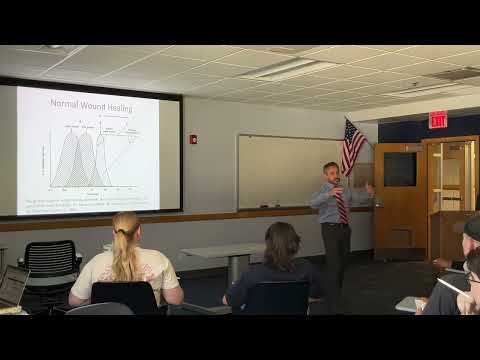
- Normal healing progresses through inflammation, granulation tissue formation, wound contraction, and collagen remodeling that can continue for about 365 days.
- Resolution restores tissue structure and function, while repair closes an injury with scar tissue that may lack native features such as hair follicles and sweat glands.
- First-intention healing occurs when the edges of a relatively clean wound, such as a surgical incision, can be brought together.
- Second-intention healing addresses larger or gaping wounds that cannot be fully approximated and must fill in with granulation tissue and scar.
- Regeneration, also called resolution, is more likely when injury damages cells but leaves the extracellular matrix framework intact.
- Epidermis and gastrointestinal lining turn over on roughly six-to-eight-week schedules, while red blood cells typically last 60 to 120 days.
- Damage to both cells and matrix favors repair and fibrosis; cirrhotic liver is an example of extensive fibrotic remodeling.
- Fibroblasts synthesize and secrete collagen and other connective-tissue proteins, and help contract wounds by connecting and pulling wound tissue.
- The extracellular matrix is an interactive cellular environment, not merely a static support structure; injury to its framework makes full regeneration harder.
- G1/S and G2/M checkpoints help prevent damaged DNA from being copied during cell division, a safeguard relevant to both healing and cancer.
- Autocrine signals act on the cell that releases them, paracrine signals affect nearby cells, and endocrine signals travel through blood to distant targets.
- Basement membranes include type IV collagen, laminin, and proteoglycans; type I collagen forms triple helices in the broader extracellular space.
- Fibroblasts manufacture and release extracellular-matrix proteins, while intracellular proteins such as actin and myosin remain within the cell.
- Integrins link the extracellular matrix to focal adhesion complexes, the cytoskeleton, and ultimately the cell interior.
- Matrix movement or tension can be sensed by attached cells, much like a spider responding to movement in a web.
- Integrin attachments also help cells such as macrophages migrate through tissue, while growth-factor receptors signal cells to proliferate, differentiate, or change shape.
- Angiogenesis is the sprouting of new blood vessels from existing vessels and is essential for perfusion and wound healing.
- In first-intention healing, neutrophils and a clot appear within about 24 hours; over three to seven days, blood vessels expand and macrophages replace neutrophils.
- Second-intention healing follows the same broad sequence but produces more wound contraction, fibrosis, and visible scarring.
- Diabetic foot ulcers, pressure ulcers, and venous ulcers are major clinical problems associated with inadequate tissue perfusion.
- Granulation tissue contains new blood vessels that deliver oxygen, nutrients, and cofactors while removing metabolic waste.
- As an open wound re-epithelializes, collagen deposition helps close and stabilize the tissue, though the repaired area may not fully regain native structure.
- Keloids form when collagen deposition and the healing response exceed what is needed to close a wound, producing raised scars.
- Microscopic images distinguish keloids by thick, broad collagen deposits compared with the more limited collagen in typical healing.
- Kellar describes research by former graduate student Joel, who investigated verteporfin as a possible way to encourage more favorable healing in keloid fibroblasts; keloids are more common in people with darker skin.
- Embryonic stem cells can generate many cell types, but researchers have difficulty controlling their differentiation for a specific repair goal.
- A key clinical limitation is teratoma formation, in which mixed tissues such as hair, teeth, bone, and skin develop instead of the desired tissue.
- Harvesting cells from embryos, including through nuclear transfer, raises consent and ethical concerns; Kellar also notes restrictions on federally funded research in the United States.
- Neonatal stem cells can be collected from umbilical cord, placenta, cord blood, and related birth tissues that are often discarded as biohazard waste.
- Adult stem cells from bone marrow and other tissues may have reduced function with age, motivating interest in younger cell sources.
- Induced pluripotent stem cells reprogram ordinary cells with added genes; Kellar describes hypoxia-inducible factor 1 alpha as an early research avenue, not yet a clinical treatment.
- Liposuction aspirate can be washed and centrifuged to isolate the stromal vascular fraction, which contains adipose-derived stem cells.
- Kellar's research group used electrospinning to build fibrous scaffolds from human elastin and collagen, aiming to recreate extracellular-matrix attachments and signals.
- A syringe pump feeds a protein solution through a needle under roughly 40,000 volts toward a target, forming a porous, randomly arranged fiber network that can be seeded with stem cells.
- Researchers placed human-cell-seeded scaffolds into full-thickness skin wounds in immunodeficient SCID mice to reduce rejection of the human cells.
- After six days, standard-care control wounds were about 63% to 76% healed, while wounds treated with elastin or collagen scaffolds plus adipose-derived stem cells reached about 90% to 100% closure.
- Because the experiment tested scaffolds and stem cells together, it could not determine whether the improvement came from the matrix, the cells, or their combination.
- Kellar closes by previewing coagulation and inflammation, migration and proliferation, and remodeling and maturation as the three phases to examine next.
Transcript excerpt
0:07 What happens? What happens when you eat yeast and shoe polish? What happens when you eat yeast and shoe polish? What is it? No. Die. Yeah, it's probably a bad idea. Before you die, you rise and shine. Why do seahorses only like salt water? I have told you that my daughters wrote some of these when they're little, right? Okay. Why do seahorses only like salt water? Because pepper water makes them sneeze. >> I mean, if you're like seven, that was pretty amazing, right?
0:55 Why did the snake go to the baby toy store? Why did the snake go to the baby toy store? He wanted a new rattle. Of course. Why else? Okay, Thursday there'll be more funny. I promise I might. That's a promise I might break, but I'll do my best. Okay. How we doing? Well, I think thumbs down, not well. Oh, boy. I'm sorry. You know, sometimes like, isn't it funny in this culture, we say, "How are you?" And everyone's always like, "Oh, great. How are you?" And you could be having the worst day ever, huh?
1:42 But that's what we're supposed to say. So, if you're having a rough day, I really am sorry about that. Okay. I hope it I hope hope this is a highlight of your day to talk about healing repair after wounds. Okay. There's some pictures here where uh we're going to get into some clinical stuff um as the lecture goes on into Thursday and and you're you're doing better than some of these people. Okay. Um I have office hours on Mondays if you need to come see me. Anything about the material, if there's anything else I can hopefully try to help with resources and point you in the right direction or just be an ear to
This is the start of the transcript. Save this video free for the whole transcript, searchable and time-coded.
Related notes
Summary, takeaways, and chapters were generated by AI from the video's transcript and may contain errors. The video belongs to its creator, Robert Kellar, Ph.D..