Pressure-Volume Work and Calorimetry
Overview
John Flood develops the first law of thermodynamics from internal energy and state functions through pressure-volume work, using system-based sign conventions to distinguish heat transfer from work. He then introduces calorimetry, including the conversions 1 L·atm = 101.3 J and 1 cal = 4.184 J, heat capacity and specific heat, and how calorimeters relate measured temperature changes to reaction heat.
Key takeaways
- Internal energy is a state function: systems with the same initial and final states have the same ΔE even when their heat and work pathways differ.
- Use ΔE = Q + W with system-based signs: absorbed heat and work done on the system are positive, while heat released and work done by the system are negative.
- For constant-pressure expansion or compression, W = −PΔV; convert L·atm to joules with 1 L·atm = 101.3 J before combining with energy values in joules.
- Calorimetry calculations use Q = cmΔT, where water's specific heat is 4.184 J/(g·°C) and a temperature change is always final minus initial.
- A calorimeter thermometer records the surroundings, not the reacting system, so reaction heat has the opposite sign from the heat measured in the surroundings.
Chapters
- A state function depends on a system's state, not the path taken to reach it.
- The hiker and the airplane-assisted climber reach the same elevation by different routes but undergo the same net energy change.
- A thrown baseball exchanges kinetic energy and gravitational potential energy as it rises and falls.
- For the climbers, internal energy is framed as the sum of energy contributions, and its net change depends on initial and final states rather than route.
- The system is the substance or substances undergoing change, such as a gas sample or solution; everything else is the surroundings.
- Calculate energy change as ΔE = E_final − E_initial, consistently using final minus initial.
- A positive ΔE means the system ends at higher energy and undergoes an endothermic change.
- A negative ΔE means the system ends at lower energy and undergoes an exothermic change.
- When a system absorbs energy, the surroundings lose the corresponding energy; when a system releases energy, the surroundings gain it.
- John Flood uses hot coffee to show that the coffee's exothermic cooling can cause an endothermic energy gain in the person drinking it.
- The energy balance is ΔE = Q + W, where Q represents heat transfer and W represents work.
- Heat is energy transferred between objects, while work involves applying force over a distance.
- A metal wire warmed in hot water gains energy through heat transfer, with no work required in the example.
- Twisting a room-temperature wire adds energy through mechanical work and internal friction, illustrating a different route to an energy change.
- Q is positive when the system absorbs heat and negative when it releases heat.
- W is positive when work is done on the system and negative when the system does work on the surroundings; signs are always from the system's perspective.
- A system absorbing 55 kJ while doing 13 kJ of work has ΔE = +55 kJ − 13 kJ = +42 kJ.
- The positive net change is endothermic even though the system loses some energy by doing work.
- The same +42 kJ change can result from 42 kJ of heat with zero work, or zero heat with 42 kJ of work done on the system.
- Because ΔE is a state function, many different combinations of Q and W can produce the same net energy change.
- At constant pressure, pressure-volume work is calculated using W = −PΔV.
- Hydraulic presses, combustion-engine pistons, and lungs are examples of systems where pressure and volume changes can produce work.
- Substituting W = −PΔV into the first law gives ΔE = Q − PΔV.
- Expansion gives positive ΔV and negative W because the system does work; compression gives negative ΔV and positive W because the surroundings do work on the system.
- Calculate volume change as ΔV = V_final − V_initial, preserving the sign of expansion or compression.
- Convert pressure-volume work to energy with 1 L·atm = 101.3 J; dimensional analysis keeps joules, liters, and atmospheres consistent.
- Expanding lungs from 2.3 L to 5.8 L against 1.88 atm gives ΔV = 3.5 L and W = −6.58 L·atm.
- Using 101.3 J per L·atm gives a signed work value of about −670 J, meaning the expanding lungs do work on the surroundings.
- For ΔE = −327.9 kJ, Q = −124 J, and P = 1.15 atm, rearrange ΔE = Q − PΔV to isolate ΔV.
- Convert joules to L·atm before dividing by pressure; the worked result is an expansion of about 1.75 L, giving 2.25 L final volume from a 0.50 L start.
- After the pressure-volume work module, John Flood transitions from module 19 to module 20 on calorimetry.
- The class discusses the equations sheet and notes that conversions such as joules to calories must be supplied or learned for upcoming problems.
- Calorimetry means measuring energy change during a physical process or chemical reaction.
- Food-label Calories describe energy relevant to the body, while joules are the SI energy unit used in calculations.
- Thermal energy is associated with particle kinetic energy, temperature quantifies thermal conditions, and heat is the transfer of thermal energy.
- Heat flows between objects at different temperatures until thermal equilibrium; the universe's eventual heat death means energy transfer stops, not that everything becomes extremely hot.
- A joule is a newton-meter, equivalent to the work of applying one newton of force over one meter.
- One small calorie is 4.184 J, while one food Calorie is one kilocalorie, or 4.184 kJ; a small calorie raises 1 g of water by 1°C.
- Heat capacity, C = Q/ΔT, measures the heat required to change an entire body's temperature by one degree.
- For a 4,040 g cast-iron pan heated by 50°C with 90,700 J, C is 1,814 J/°C; an 808 g pan has a smaller capacity of about 363 J/°C.
- Specific heat, c = Q/(mΔT), measures energy needed per gram per degree and depends on the substance rather than the total sample mass.
- Both cast-iron pan examples yield about 0.449 J/(g·°C), while water's specific heat is 4.184 J/(g·°C), equivalent to one calorie per gram per degree.
- Heat capacity is extensive because it depends on amount; specific heat is intensive because it is normalized per gram, and molar heat capacity is expressed in J/(mol·°C).
- Rearranging the specific-heat equation gives Q = cmΔT, with ΔT = T_final − T_initial; a thermometer, known mass, and known specific heat provide the measurements.
- A thermometer measures the surroundings: a temperature rise indicates an exothermic reaction, while a temperature drop indicates an endothermic reaction, so q_system = −q_surroundings.
- A bomb calorimeter operates at constant volume and uses the calorimeter's heat capacity and temperature change to measure energy absorbed by its water and metal casing, improving on a Styrofoam-cup calorimeter.
Transcript excerpt
0:00 Last week, I left you with this introduction to energy. I said that energy is a state function. Can you guys um remind me what that meant? This means that the the government controls it, right? A state function. [laughter] No, it's a it's a function of what state you're in, and it does not matter how you got there. It just matters where you're at. So the example that I gave last week, a hiker climbs the top of a mountain.
0:47 This is in your textbook, by the way. I I stole it from there. A hiker climbs to the top of a mountain. They have gone through some change in energy. And a skydiver has taken off from the ground and then parachuted to the top of the same mountain. They have gone through the same change in energy. Uh in fact, I should I should change this instead of energy, I should have put internal internal energy being the sum of all energy. And of course,
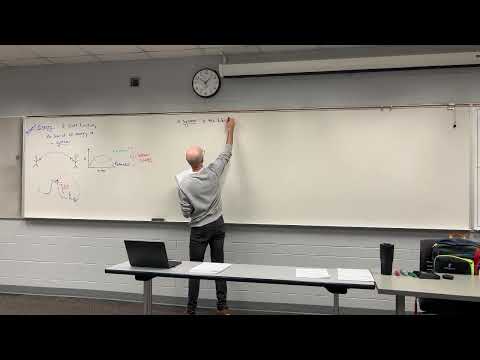
1:39 to make sense of that term internal, we say that this is the sum of all energy for a system. And we'll define system in just a second. So um first, I want to I want to give another example. So I'm putting on my artist hat. And I'm going to draw two guys playing catch. So here's their baseball. And their baseball is going to exchange hands. So there will be a parabolic movement of the baseball like this. Can we map out what the change in energy looks like over time? So here's energy and here's
2:26 time. Well, there's two types of energy that's at play here. There's kinetic energy of the baseball and then there's the potential energy that it has if it has no kinetic energy. So at time
This is the start of the transcript. Save this video free for the whole transcript, searchable and time-coded.
In this course
Related notes
Summary, takeaways, and chapters were generated by AI from the video's transcript and may contain errors. The video belongs to its creator, John Flood Chemistry.