Precipitation Rxns and Intro to Acid-Base Rxns
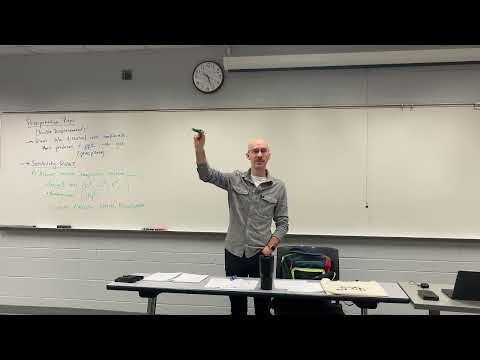 Watch on YouTube →
Overview
John Flood connects precipitation reactions to solubility rules, showing how to predict products and move from molecular equations through complete ionic equations to balanced net ionic equations. He then introduces Brønsted–Lowry acid–base chemistry, conjugate pairs, strong and weak acids, and carbonic acid’s role in ocean acidification.
Key takeaways
- Always-soluble ions such as Group 1 cations, NH₄⁺, NO₃⁻, and acetate override general insolubility rules, so lithium carbonate remains aqueous.
- In a complete ionic equation, aqueous ionic compounds split into ions, but precipitates such as PbCl₂(s) stay written as intact solids.
- A net ionic equation shows only the species that change; remove ions that remain aqueous and unchanged, then balance the remaining equation independently.
- For Li₂CO₃(aq) reacting with Ca(NO₃)₂(aq), lithium and nitrate are spectators, leaving Ca²⁺(aq) + CO₃²⁻(aq) → CaCO₃(s).
- Brønsted–Lowry acid–base reactions transfer protons: an acid donates H⁺, a base accepts it, and each reactant becomes its conjugate partner.
- Carbon dioxide dissolved in ocean water forms carbonic acid, which can produce bicarbonate and hydronium and thereby contribute to ocean acidification.
Chapters
- Examples include metabolism, aerobic and anaerobic respiration, photosynthesis, combustion, and hydrogen peroxide reacting with blood stains.
- Landfill decomposition produces methane, which can be piped out and burned.
- John Flood reviews balancing equations and treating polyatomic ions as intact units when they remain unchanged.
- Precipitation reactions are also called double-displacement reactions because ions exchange partners.
- Dissolved ionic compounds can form a solid precipitate or a gas, changing the physical state of products.
- Solubility describes a substance's ability to become aqueous; it also applies to molecular substances such as sugar.
- Compounds containing Group 1 metal ions or ammonium, NH₄⁺, are always soluble under the rules presented.
- Nitrate, NO₃⁻, chlorate, ClO₃⁻, acetate, C₂H₃O₂⁻, and bicarbonate, HCO₃⁻, also make compounds always soluble.
- These always-soluble rules override the general insolubility rules for ions such as carbonate.
- Fluoride, chloride, bromide, and iodide compounds are generally soluble, except when paired with silver, mercury, or lead ions.
- Sulfate, SO₄²⁻, compounds are generally soluble, with exceptions that include silver, mercury, lead, and the heavier Group 2 ions.
- Calcium, strontium, and barium can precipitate sulfates even though those same ions behave differently in the hydroxide rule.
- Carbonate, CO₃²⁻, phosphate, PO₄³⁻, chromate, CrO₄²⁻, and sulfide, S²⁻, compounds are generally insoluble.
- Group 1 ions and ammonium provide important exceptions, so sodium carbonate is soluble despite carbonate's general rule.
- The class reviews how to distinguish the polyatomic ions by their formulas and charges.
- Hydroxides are generally insoluble, but the lecture identifies heavier Group 2 ions as exceptions.
- Students devise one soluble and one insoluble ionic compound, then exchange examples with another group and classify them.
- John Flood notes that the final-exam equation sheet includes solubility rules, but students still need to interpret what each exception means.
- Lithium carbonate is aqueous because lithium is always soluble, overriding carbonate's general insolubility.
- Silver nitrate dissolves because nitrate is always soluble, despite silver appearing as an exception for some other anions.
- Lead(II) phosphate is classified as insoluble because phosphate is generally insoluble and lead is not an applicable exception.
- John Flood calls the initial representation a molecular equation, while noting that ionic compounds are not technically molecules.
- For lead(II) nitrate reacting with iron(III) chloride, nitrate makes lead(II) nitrate aqueous and the halide rule makes iron(III) chloride aqueous.
- Lead(II) chloride is solid because lead is an exception to the general solubility of chlorides; iron(III) nitrate remains aqueous.
- Aqueous lead(II) nitrate separates into Pb²⁺ and two NO₃⁻ ions in the complete ionic equation.
- Aqueous iron(III) chloride separates into Fe³⁺ and three Cl⁻ ions, rather than an imaginary polyatomic Cl₃ ion.
- Aqueous compounds are written as constituent ions, while precipitated compounds such as lead(II) chloride remain intact.
- Lead and chloride ions combine into a solid because the product is not dissolved as independently moving aqueous ions.
- John Flood recalls a demonstration in which dissolved potassium iodide and lead nitrate formed yellow lead iodide crystals.
- The solid product is written as an ionic compound, not split into ions, in both complete and net ionic equations.
- Spectator ions remain unchanged and aqueous on both sides; iron(III) and nitrate are spectators in the lead chloride example.
- Removing spectators leaves the chemical change: Pb²⁺(aq) combines with Cl⁻(aq) to form PbCl₂(s).
- The net ionic equation must be balanced independently, with the simplest whole-number coefficients, rather than copying coefficients from an unbalanced molecular equation.
- Students convert a provided complete ionic equation into the net ionic equation for silver chloride precipitation.
- The result is Ag⁺(aq) + Cl⁻(aq) → AgCl(s), with all coefficients equal to one.
- Reactant order can be reversed because adding silver and chloride ions is commutative.
- The reactants are Li₂CO₃(aq) and Ca(NO₃)₂(aq), with lithium and nitrate identified as always-soluble ions.
- Double displacement pairs lithium with nitrate and calcium with carbonate to predict LiNO₃ and CaCO₃.
- Calcium carbonate is solid because carbonate is generally insoluble and calcium does not override that rule.
- The complete ionic equation separates aqueous lithium carbonate, calcium nitrate, and lithium nitrate into their ions.
- Calcium carbonate stays intact as a solid; lithium and nitrate appear unchanged as spectator ions.
- The net ionic equation is Ca²⁺(aq) + CO₃²⁻(aq) → CaCO₃(s), without balancing the irrelevant molecular-equation coefficients.
- For reliable work, write reactants, swap ions to predict products, assign phases, separate aqueous compounds, remove spectators, and balance the final net equation.
- Balancing the molecular equation first does not guarantee correct net ionic coefficients because spectator ions disappear.
- Students can skip steps only after they can confidently identify polyatomic ions, charges, solubilities, and spectators.
- Arrhenius acids produce H₃O⁺ in water and bases produce OH⁻, making this the most restricted definition discussed.
- Brønsted–Lowry acids donate H⁺ and bases accept H⁺; this broader definition includes the Arrhenius cases.
- Lewis acid–base chemistry is based on electron-pair interactions and is set aside as the lesson focuses on aqueous proton transfer.
- A generic acid, HA, transfers H⁺ to water, producing H₃O⁺ and its conjugate base, A⁻.
- Water acts as a Brønsted–Lowry base when it accepts a proton, then becomes the conjugate acid H₃O⁺.
- Conjugate acid–base partners differ by one proton and take on opposite roles in proton transfer.
- Strong acids are described as completely dissociating in water, whereas their ions make the solution a strong electrolyte.
- The listed strong acids are HBr, HI, HCl, HClO₃, HClO₄, HNO₃, and H₂SO₄; HF is specifically identified as weak.
- Sulfuric acid is diprotic, and the lesson balances its overall reaction with two water molecules accepting two protons.
- Weak acids partially ionize and use a reversible arrow; examples include carbonic, phosphoric, sulfurous, hydrofluoric, and hypochlorous acids.
- Dissolved CO₂ forms carbonic acid, which can donate a proton to form bicarbonate and hydronium.
- Increasing atmospheric CO₂ raises the amount that can enter oceans and contribute to ocean acidification, threatening aquatic life.
Transcript excerpt
0:00 Anybody watching the World Series? Go Brewers up two nothing. Third game tonight. Sorry, I'm not really a a sports guy, but it's I' they've never made it to the World Series in my lifetime. Anybody need a packet? All right. Um, tell me what you understand about chemical reactions. >> Thank you. >> You're welcome. You're welcome. >> You know, last week I asked you guys for some examples and we stopped after two. Do you guys want to give me more examples of chemical reactions? That's a chemical reaction.
0:49 Did you get your finals equation sheet? Anybody need the final exam equation sheet? I'm assuming it's the same people. You didn't get that? >> No, I didn't. >> You did. >> Thank you. >> You're welcome. >> You're welcome. Is being alive a chemical reaction? It's a lot of different chemical reactions. Metabolism is a very complex chemical pathway. uh an aerobic metabolism, anorobic metabolism. I'm a little out of my depth. I don't not sure if that's the right word to be using. Aerobic and
1:36 anorobic respiration. Um what else? I mean, the the energy fuel that we're using to get move around every day. Photosynthesis. It's a lovely chemical reaction. takes the energy from the sun, uses it to make and break bonds, >> burning stuff. Yeah. And anything. In fact, um, respiration is kind of burning. If we consider burning to be a reaction with oxygen, that's exactly what you do. You take oxygen in and you convert it into other things. You oxidize other things and that is combustion. So, we are just on fire. Actually,
2:24 it's really useful that um that oxygen is as reactive as it is. I mean, do you guys think of oxygen gas as a reactive chemical? You know that it makes up like 20% of
This is the start of the transcript. Save this video free for the whole transcript, searchable and time-coded.
Related notes
Summary, takeaways, and chapters were generated by AI from the video's transcript and may contain errors. The video belongs to its creator, John Flood Chemistry.